Valeska Soares has worked in a wide variety of mediums including sugar, glass, steel, marble, beeswax, perfume, and photography. Her latest works continue her investigations of illusion, temporality, and control and enlarge on previous material juxtapositions. Working with found and fabricated objects, her new accumulative sculpture/installations are based primarily on the selection and reconfiguration of pre-existing objects — objects that bear their own history and associational retinue.
In two concurrent shows in New York, Soares expanded her strategy, showing increased mastery of a potent conceptual process that began with Marcel Duchamp’s readymades.
The passage of time is a key concern for Soares. Her choice of materials directly addressed this in passa tempo at Greenberg Van Doren Gallery. The poetic Timeline 1 consisted of title pages from books strung together and hung in a horizontal line. Each differently sized and variously yellowing page included a quote vis-à-vis time such as “In the Beginning.”
In a soulful relief called Horizontes III, Soares affixed old wooden boxes to the wall, inlaid with scenes from her native Brazil. By repurposing these boxes and aligning the scenes into a communal horizon, she activates an interface between collective and individual responses.
In the centerpiece installation, the title Un-rest seems to indicate our inherent apprehension regarding the relentless passage of time. Soares ordered over a hundred footstools from E-bay and presented them in a sweeping arc. She had a glass chair fabricated, which stood at one end of the arc as if in command. The footstools, with their varying designs but identical functionality, took on anthropomorphic and sociological dimensions. The units gained personality and their legs implied volition.
From the far side, the glass chair became somewhat invisible, underlining the dissimilarity in materials and by implication, their relative hierarchical position. In addition to this divergence, the impossibility of sitting in the chair contrasted pointedly with the inadequacy of sitting on footstools.
At Eleven Rivington, Soares expanded her light bulb sculpture exponentially in an interactive installation called Vaga Lume (which could translate from the Portuguese as something like “vague light”).
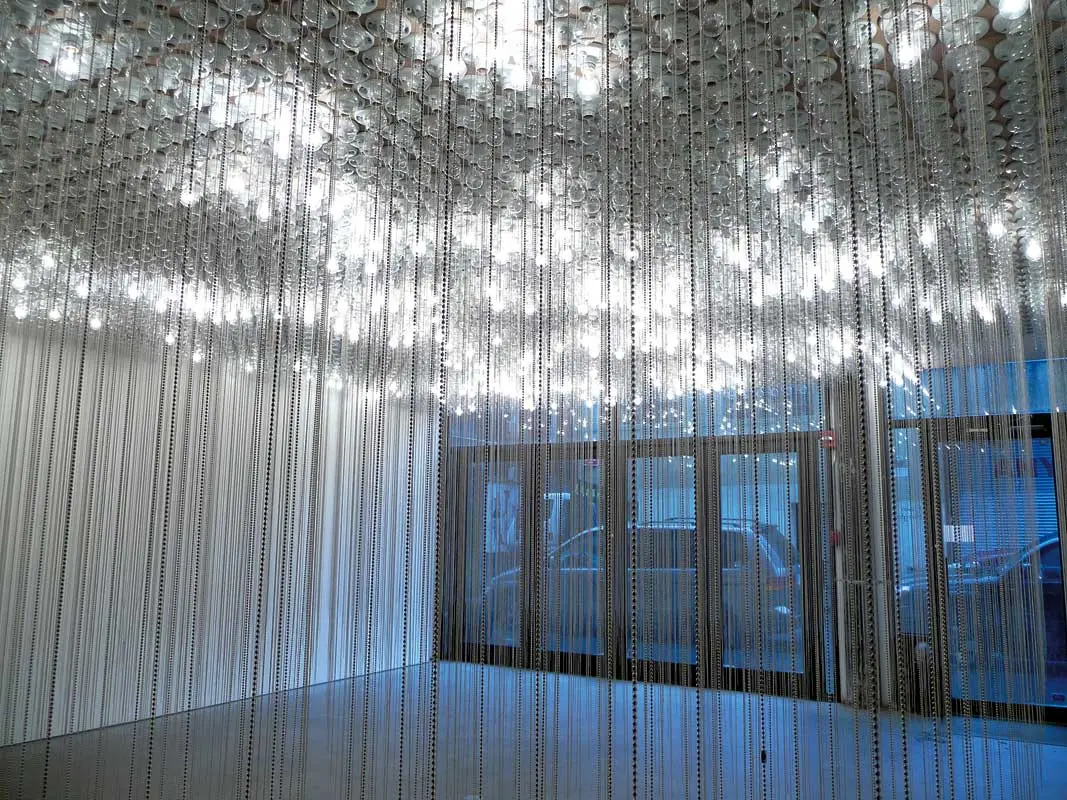
No less than 2,500 naked light bulbs in simple porcelain fixtures adorned the gallery. Fitted snugly against the ceiling in rows, long pull-chains dangled to within a yard of the floor. Gallery-goers could wade in and switch the light bulbs on and off. In a digital age of binary code, the artist reasserted the primacy of a single individual as an agent of change.
Just as a light bulb can be on or off, it can be a positive or negative signifier. An old fashioned light bulb symbolizes an idea — a Eureka moment — as the image pops above ones head in a cartoon. Ominously, it also infers incarceration and interrogation.
The location of Eleven Rivington — in the heart of New York City’s lighting district where all manner of illumination is bought and sold — adds an extra dimension of social awareness to Vaga Lume, making the piece geographically site-specific.
Entering the all-around environment produced novel physical and aesthetic sensations. A hazy intensity made the burning bulbs a little inscrutable and they were best viewed obliquely, the opposite of traditional art. The mildly oppressive heat (and intimations of global warming) accentuated the coolness of the chains, which bounced and clicked as one walked through.
In unbroken vertical lines, the shiny metal created a mirage effect as the focus shifted from foreground to background. Associations with doorways veiled by screens of beads led to an ever-present promise of entry — or exit — of sanctuary or escape.
As one walked along, the plethora of chains dragged across your skin feeling like jewelry or alternately, the clinging tendrils of all-consuming robotrons. Looking back across the gallery, the chains danced behind in a display of misty splendor, a kinetic record of your passage.
Soares has always found ways to reify minimalisms’ aesthetic strictures while maximizing its metaphoric capacity. In form and matter, a sense of pureness recesses this artist’s presence. Her works depart from monolithic narratives allowing the participant fuller ownership. She describes her multi-referential creations as “triggers that activate memories and contexts.”
In examining the authorship of art, the philosopher Boris Groys has championed artwork with “inner value” that is “presented as being collaborative, participatory, and democratic.” He could certainly be describing the work of Valeska Soares when he concludes: “This value derives from the participation of both artist and the public in… a common affiliation that relativizes the space between artist and public.”
The light bulbs in Vaga Lume, with their patches of shadow and swaths of glare, are imprinted by the audience’s engagement. The history of each individual’s interaction lingers until it is replaced as another participant switches the light again to tell a different story. From the old outline, comes a new pattern. Valeska Soares is definitely onto something new.
JEFFREY CYPHERS WRIGHT