
There seem to be two quite different Biennials; the art and the art seen through the thematic and historical screen constructed by the curators Francesco Bonami, of Venice Biennale 2003 fame, and Gary Carrion-Murayari, of the Whitney. When I tell local arts professionals who have seen the exhibition but not read the catalog that the show is political, their reactions are of two types; dismissive laughter or the blank stare of incredulity. No really, I mean it…they mean it…well, really…sort of…. Look, they have President Barack Obama wearing a cowboy hat on the cover, and in the essay, they call him “the coolest artist of all.” More stares, more laughter, from the city and people that overwhelmingly supported Obama in 2008/9 and, for the most part, like the current Biennial. Clearly, we have a problem but not necessarily a failure, more a successful failure, or maybe a failed success? Either way, it is an instructive exercise for anyone who wants to look into the USA at this moment through art, and, finding curatorial equivocation in the Whitney Biennial is an integral part of the process. Equivocation, a thwarted undercurrent, may also be the best measure of our time.
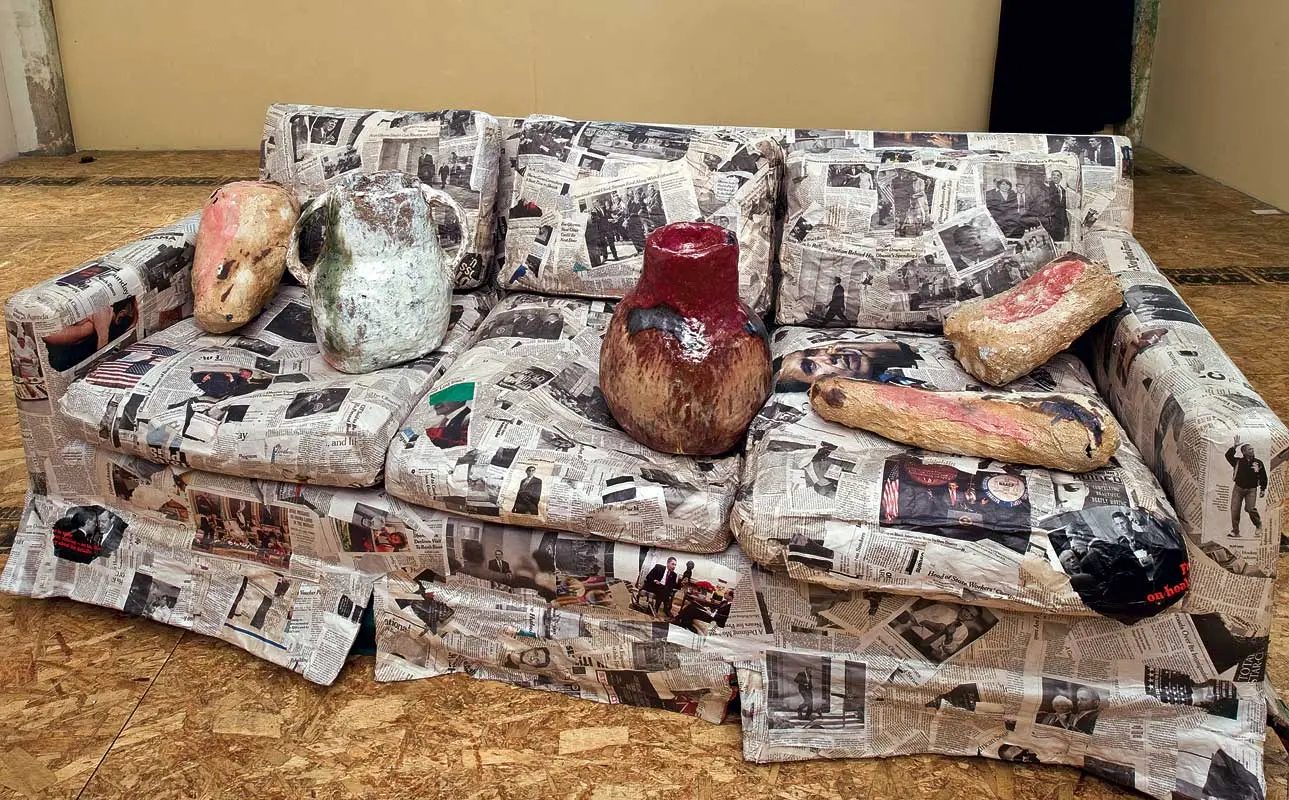
Both successes and failures are due in large part to the broad but difficult frame the curator’s developed and implemented. According to the catalog essay, they were not looking for American art, but for “a certain kind of American spirit,” one that matched their characterization of the last two years in an America dominated by the run-up to and the first post-election year of Barack Obama—hence his picture on the exhibition cover, although only one work in the exhibition directly refers to Obama. Jesse Jackson Hutchins covered her personal and well-worn couch with every newspaper article she “encountered” about him (Couch For a Long Time, 2009). The exhibition title, 2010, tells us this is an attempt at characterizing a zeitgeist, a phrase the curators avoid but one they intend and a concept they have trouble wrestling into an open admission. According to them, the art chosen does, and at the same time does not embody the times, and when and how (and if?) it does, the process is an uneven one, especially since, by their own statement, the social, historical and cultural mood that inevitably imprints art may not be visible or direct.
Such vague vapors would indeed be hard to describe, let alone capture in solid form. But then how does one frame the United States, or any country, or the nature of our current time, except in fragments and with broad strokes of the pen of history? Thankfully these are limitations the curators acknowledge repeatedly, and limits maybe, in the end, the most important alignment with the political and cultural manifestation of our national times. But before I offer my opinions, what of theirs?
Obama’s election translates for them into shaping a historical period that freed art and artists from prior open commitments to political resistance demanded by the conservative politics of the previous U.S. administration. In these new political times artists now turn inward to private creativity, a “strategy” the curators identify as “self-modernity or a personal modernism.” The reference to “modern” refers to their locating a recent, renewed interest by U.S. artists in aesthetics, especially in painting (which predominates in this exhibition), abstraction, and the use of gesture in painting or in relation to the body and its choreography.
The importance they attach to Obama’s election for the liberal community, one that generally defines the contemporary art world, seems historically accurate and remains culturally true albeit less dynamically so in 2010. They chose works and artistic attitudes defined as more private, aesthetic, and oblique, if not downright ambiguous, in their intentions. But not in the extreme. They purposefully excluded art that was too self-contained, artists they identify only as “on an intimate, spiritual journey” whose art “coincides with life,” artists they refer to as Una-artists in joking reference to the Unabomber Ted Kaczynski’s self-contained, but also, one should point out, schizophrenic interior life that caused him to send mail-bombs to kill people under the rationale of a sane response to an overly technocratic world. I’m not certain who these omitted artists are but they sound interesting, if crazed, and if they are connected to life then why would they not fit into the second major criteria developed by the curators as characteristic of recent times, the simultaneous conversion of individual inwardness into a broader social connection.
“Community” and “connected” are favored curatorial and interpretive concepts here, artistic concerns that, so the argument goes, are the legacy of united political action that helped elect the president. The curators seem convinced that the U.S. motto (of earlier times yet remaining on the back of all dollar bills) of E Pluribus Unum—out of many, one—should invert to E Unum Pluribus (if I have my Latin case endings correct)—out of one, many. Interestingly enough, this can be read not only as a correlate to the individuality at the core of creativity but is an emphasis—one and not pluralism—currently used by conservative commentators to argue against multiculturalism and diversity. Such equivocation, either by purpose or accident, can, I suggest, also accurately summarizes the state of the nation where major legislation of social reform narrowly passes and is opposed by a majority, many of whom elected the president. The curators’ actual phrase is a paraphrase of Obama’s campaign cry, from "Yes, we can" to, "Yes, I can", conjunction of early 21st Century DIY (do-it-yourself) culture now aesthetically linked with the 1960s "We the people", a case of retaining your narcissistic self-interest and yet remaining socially conscious, conjunction that seems so American—to have it all and give up nothing. Maybe they have the nature of the times just right after all!
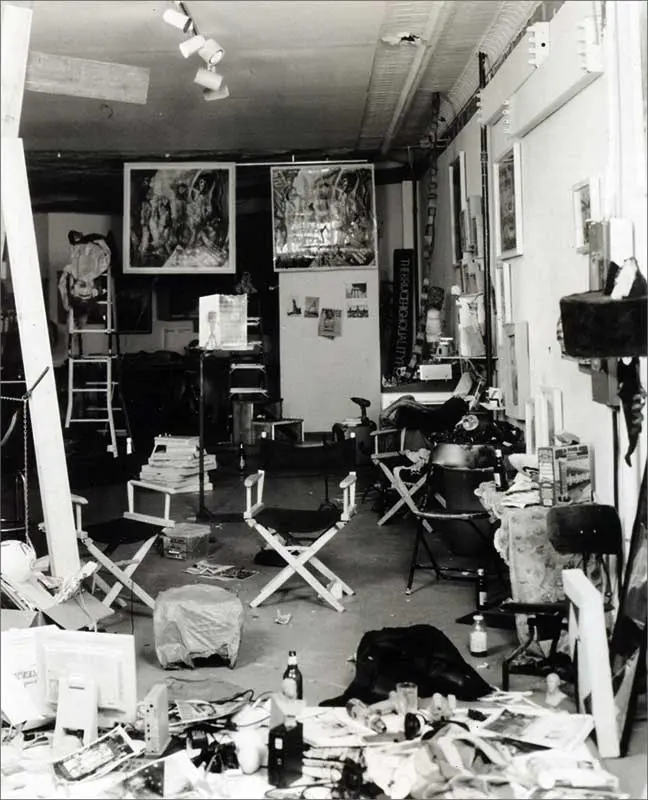
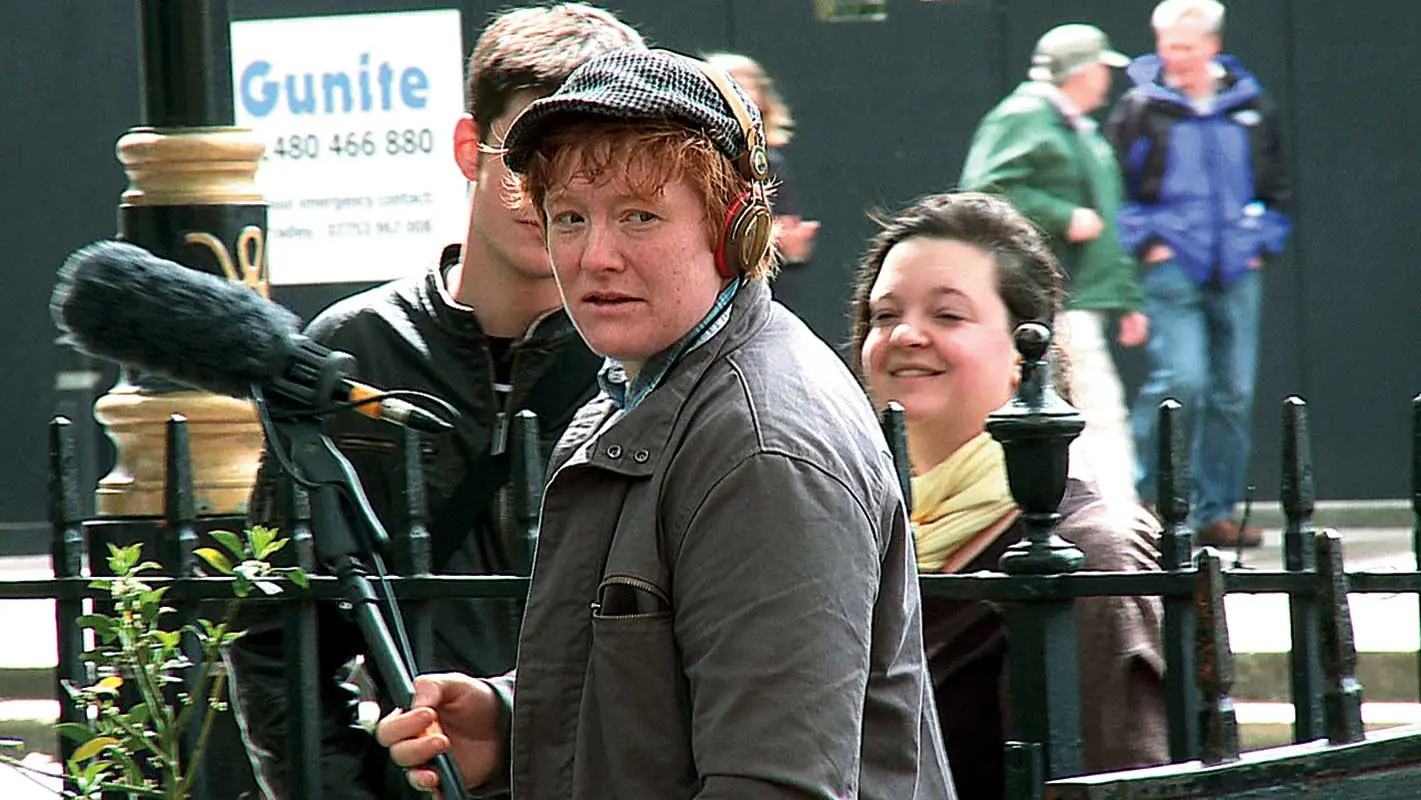
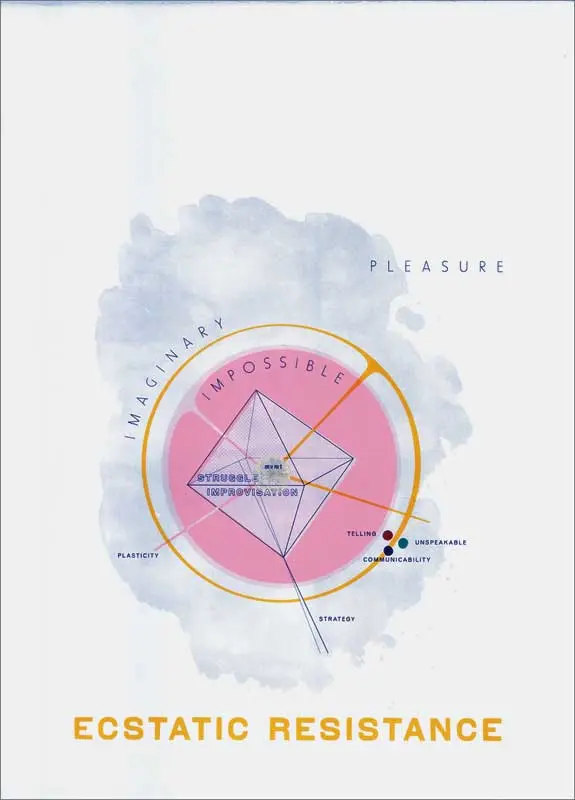
That made the keynote work for much, but not all, of their claims for the nature of our times, Emily Roysdon’s Ecstatic Resistance, a choice that places the election of Obama on the border of religious fervor. Roysdon’s position is of the artist as an ongoing platform, an argument made cogently by Okwui Enwezor in his prescient curation for Documenta 11 in 2002. But whereas Enwezor stressed a decided integration of theory with the praxis of global Realpolitik, Roysdon’s project encompasses the far more ephemeral; somewhat absurdist performances, videos, music, dance, actions, and art objects consciously designed by others to stand against a more logical and coherent politics in favor of a more ambiguous and alternative language whose sense of resistance is based on (mostly) implicit references to issues of pleasure and imagination. Few of the project works leave monuments behind; the temporary traces are conceptual pass-throughs, which embody the overall anti-heroic theme of the Biennial, with its concentration on everydayness. Politics here are a matter of the personal stated publicly, and connected to earlier traditions, which with Roysdon are of feminism and queer actions. All these issues—a whiff of the political processed through internal and somewhat privatized responses, but with the individual linked with others and with self-conscious ties to established historical forms and movements, the anti-heroism of everydayness—are characteristics claimed as central aspects of this historical time period and embedded throughout the Biennial. The only thing missing is obvious aestheticism. But in fairness Roysdon’s significance cannot be adequately represented in, and as, static objects in a museum—here are a few photos and some chairs for future action on the New York City Westside piers.
There are others whose political connection between the self and the public exists in equally conceptual form, such as Sharon Hayes’ video of her re-speaking of her personal loves using a bull horn in public. However, her intentions are broader. The title Parole refers to the semiotic relation between her individual speech acts and the larger language system (langue) that underlies the individual speech. But here we begin to see the ambiguous relation in many of these works between the legible intention and the less legible connections, or at least the victory of theorizing the commonplace over the ability of the art to communicate the intended awareness. How do such performances and speech acts made in public arenas form a community of the like-minded as a zeitgeist rather than speaking into not the public but the more rarified cognoscenti; another rendition of the liberal left art world conceptually talking to itself and pretending anyone cares enough to listen, let alone change their mind…or vote. This has been a central issue in contemporary art since at least 1912 and most of us, in that art world, side with the necessity for interior freedom, but not without question. Peter Plagens recently queried, sarcastically but truthfully, could it be that such topics “have by now been ‘interrogated’ into veritable dust” by a “preachy, self-indulgent” art world under the supposition of an ignorant and unthoughtful public now corrected? It may be that the questionability is the more appropriate tone of our current time. We are, as many have noted recently, at a time of being in-between.
But there is a balance here, a fact many critics loved about this Biennial and its curation, as other works step forward to announce their obvious aesthetic concerns and their relationships to the past in combination with a much harder-nosed, directed realism in the world. The two most discussed were works by Stephanie Sinclair and Nina Berman that presented horrific realities which are barely acknowledged let alone ever seen, presented in high-chroma photographs whose beauty helps foreground the horrific consequences of real-world events. Sinclair, a Pulitzer-winning photojournalist now claimed as an artist, exhibits documentation of Afghani women, many of them married as child brides, who had set fire to themselves in order to escape abusive marriages. One dead, all scarring their bodies to have emotional freedom; the cry is in the title, Self-Immolation in Afghanistan: A Cry for Help (2005). Nina Berman foregrounds her broad concerns with injured soldiers returned from the Iraq war and inserted into everyday life by documenting one severely disfigured Marine sergeant’s marriage to and rapid separation from his high school sweetheart. (Marine Wedding, 2006-2008). Her follow-up is that the sergeant has weathered his crisis.
The curators can’t quite decide whether they found these characteristics in much of the works they looked at, or, if they were on a predetermined scavenger hunt, lists in hand, knocking on doors. For instance, they note that within the works shown many of the figures bear the “scars of war, discrimination and hatred; they are attacked, controlled or disfigured.” How hard is that to find in the art world at any and all times? Yet, like good post-WWII existentialists, they locate in this “a new form of regeneration and hope” because somehow they refer to “individual dignity” and regeneration.
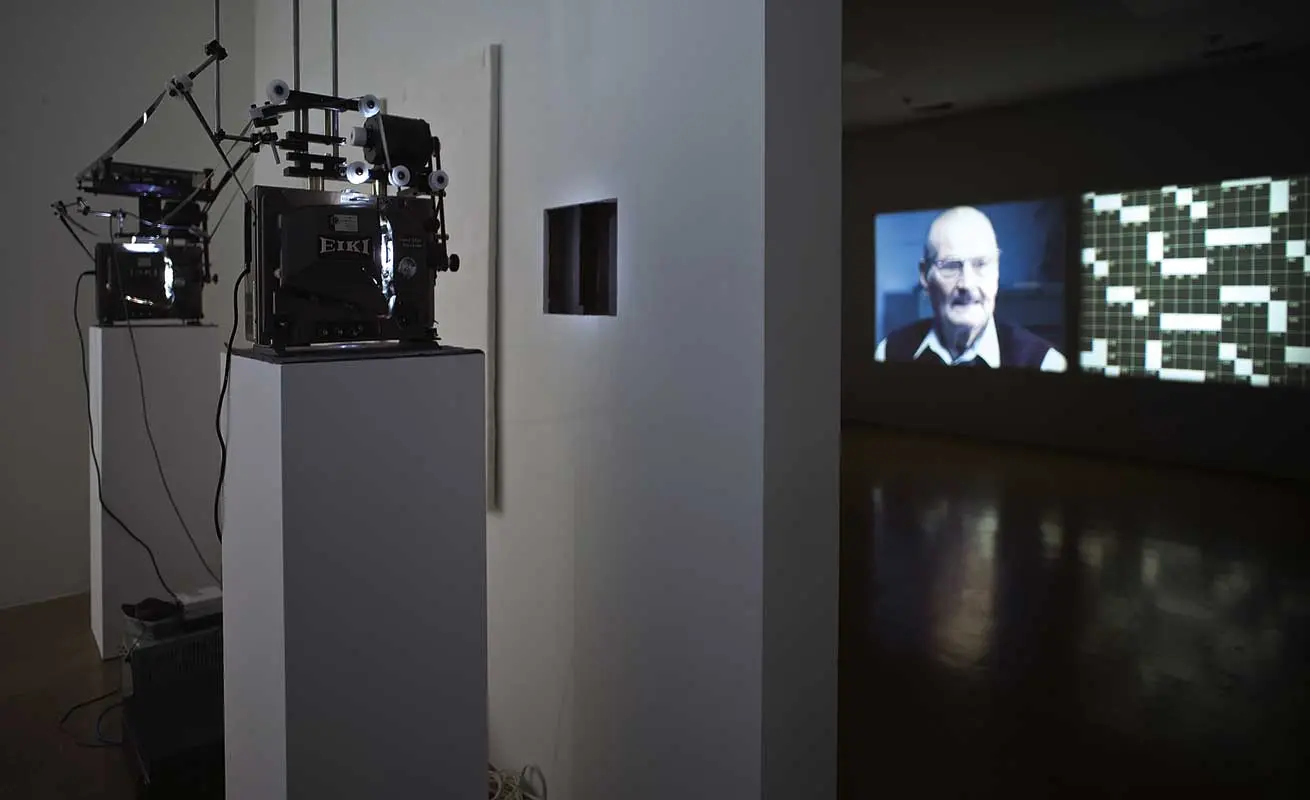
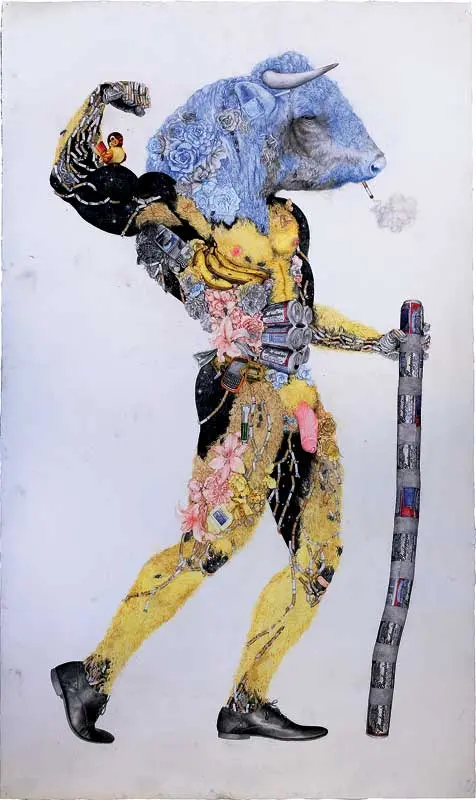
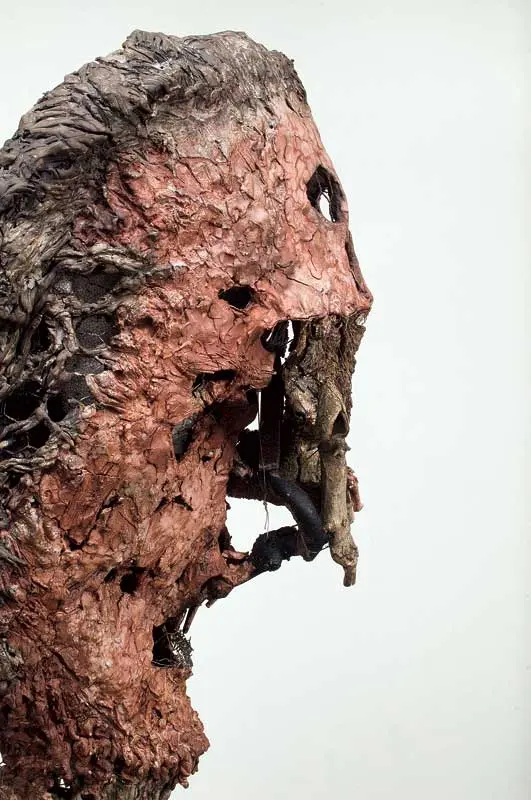
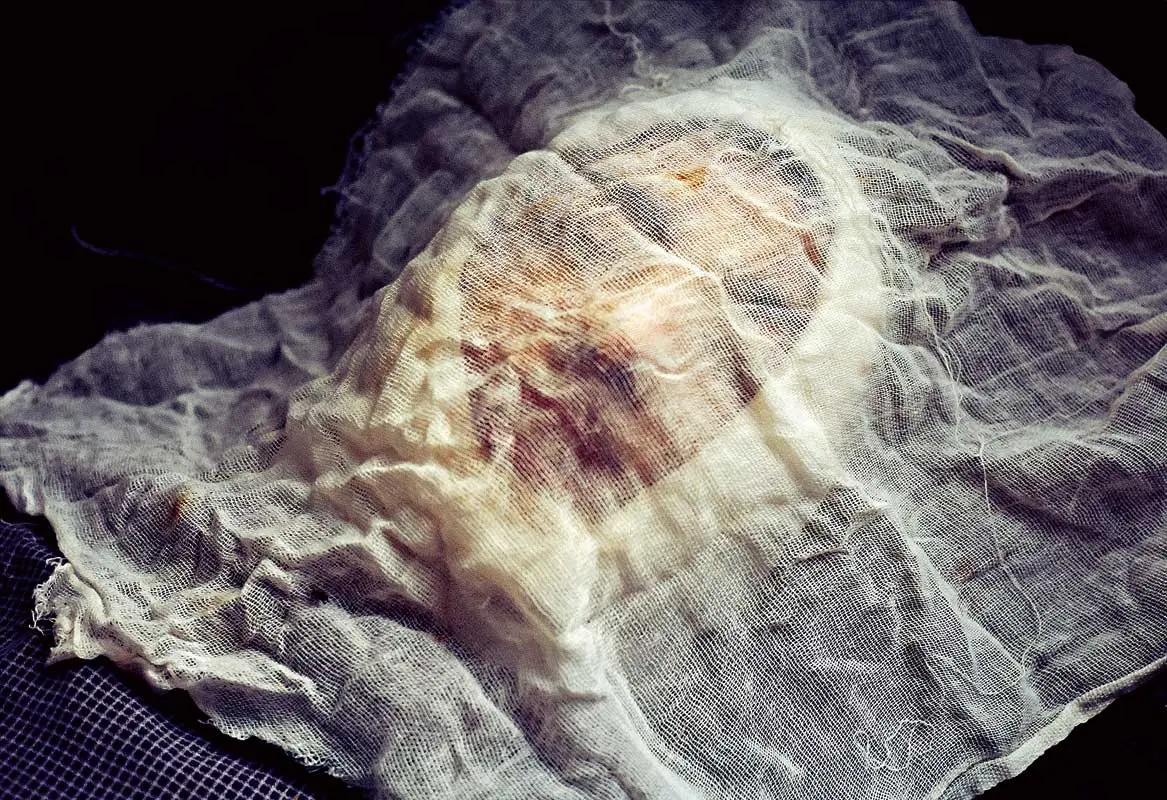
Huma Bhabha’s disfigured sculptural figures (1,000, 2009) literally embody damage with their ragged plaster, paper, and synthetic resin surfaces stretched over wire, but they belong so strongly to past traditions of disfiguration that they can be placed in any time continuum. Auriel Schmidt’s beautiful colored pencil figure of a muscle-bound minotaur created by drawing an assemblage of junk and discarded objects, and splattered with beer, dirt, and blood (Master of the Universe/Flexmaster 3000, 2010) does seem apropos of our recent, maybe-soon-to-be-regulated Wall Street masters, and perhaps regenerative, through our laughter…but not when we look at our decimated retirement funds. The minotaurs among us continue to live and devour unwilling sacrifices. The curators read Kerry Tribe’s double film projection documentation of H.M., a man whose brain surgery to cure his epilepsy rendered him unable to remember anything except the last 20 seconds (H.M., 2009), as a reflection on our provisional nature. But I tend to read it, along with the supposed lessons and hopes we are to learn through this art, as more in keeping with the American writer Gore Vidal who rightfully characterized us in 2004 as the United States of Amnesia. You say po-tawt-toe, I say po-tay-toe.
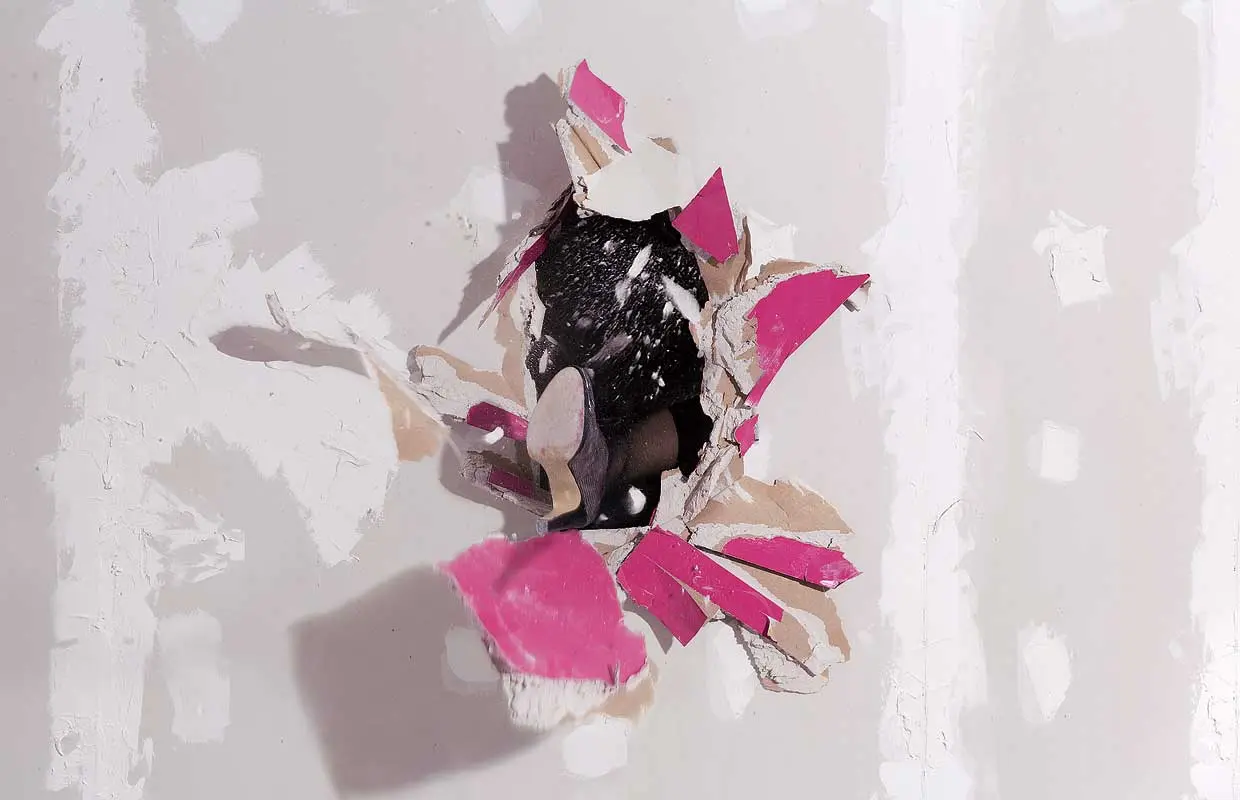
Perhaps the public knows best. The greatest and most animated (salivating!) crowds surrounded Kate Gilmore’s projected video of her kicking and clawing her way out of a self-constructed, plasterboard box, reassembled here with its debris (Walk this Way, 2008). Heroic or pathetic? Both, actually, coexisting in the everyday. And therein lay the fragility of hope, that may or may not come to fruition; deep-seated anger among the American public that can construct or destroy, often not caring which, without the full realization of their own complicities. At least the complicities here—the great debts these works owe to past art which have led to the dismissal of this Biennial as a version of Roland Barthes’ déjà vu/déjà lu (already seen/already read)—are acknowledged. My greatest sense of hope for the future came from the curators’ recognition of the limitations of their endeavors. If a majority of the nation can come (is coming?) to grips with that historical fact, then I have hope for our in-between equivocations. After all, who’d ever thought we’d see a Biennial with more women artists than men!
RICHARD LESLIE
Visiting Professor of Art History, Criticism, and Theory at the State University of New York at Stony Brook and a member of the Graduate Faculty at New York’s School of Visual Arts.