Art permits the existence of historical transmission and dissemination of knowledge, perpetuated and transformed into other modalities of knowledge.1 Hence the relevance of works that intervene various enclaves and cultural manifestations and that study the construction of the mechanisms of historical narratives, their implications, and their tools for interpreting and reorganizing events in order to promote a new perception of reality.
The work by Armando Andrade Tudela (Lima, Peru, 1975) is characterized by a reflection on form and its relationship with time. His work analyzes the variations of the formal and semantic languages of modernity, as he investigates the ways in which the language – refined through the forms and meanings of modernity – has undergone multiple transformations and reappears in the most unexpected places. Tudela has lived in Lima, studied in London and the Netherlands, and currently resides between Berlin and Saint-Etienne (France). This experience of traveling and being on the move frequently has led him to develop an interest in the projections and translations of the imaginary and of thought that find their way from one culture into another.
Andrade Tudela’s diverse experiences – with textures and materials, indigenous cultures, the anthropophagy and Tropical Modernism movements, architecture, design, art history, and general history – are a consequence of this special interest in form and its circulation in heterogeneous contexts, as well as in the way ideas from various cultures intercalate. From objects to sculptures, photographs, or videos, the artist’s work explores the relationship among form, typology, and meaning and offers several modalities for interpreting objects and, as a result, also several ways of thinking about the future through the multiple pasts to which each society has access.
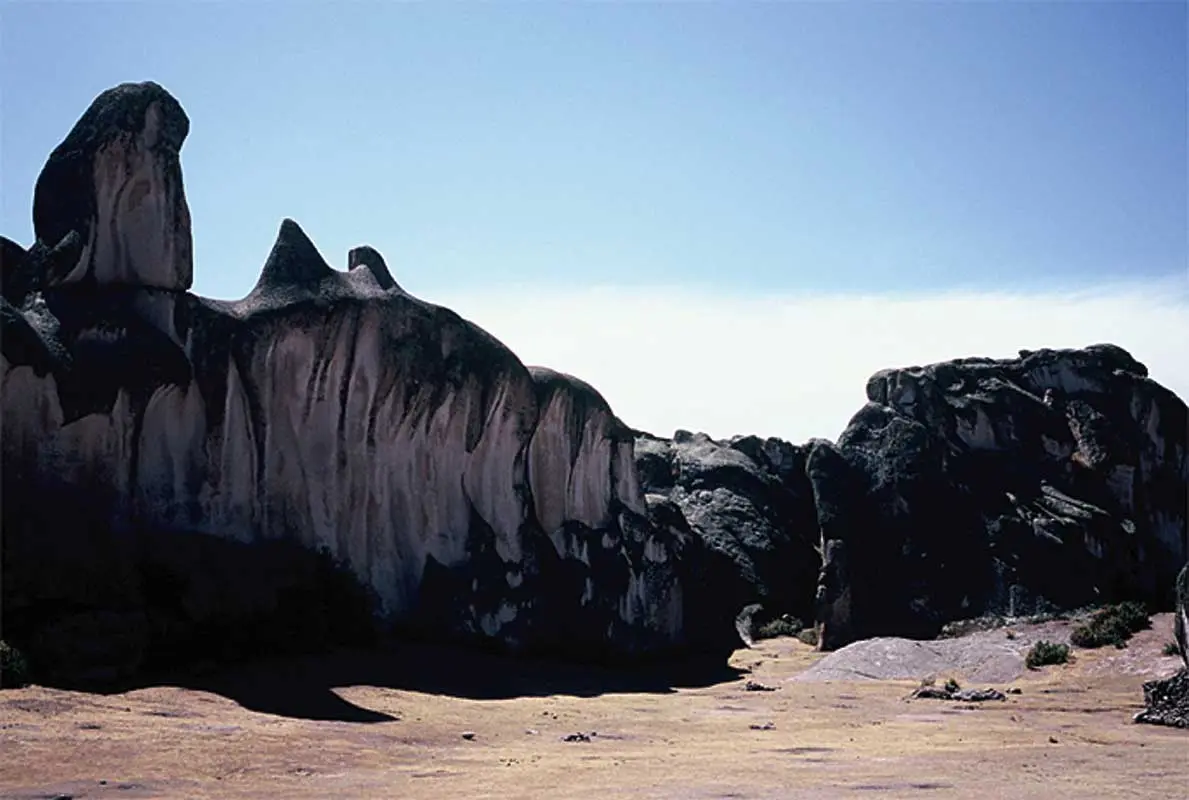
For the project at the Capella-MACBA – in which he inaugurates a series of monographic inventions – Tudela has centered on two 16-mm films (transferred to video) that describe communal experiences and that are connected through the idea of “altered states.” Both films – 8 and 10 minutes long, respectively – can be observed at the same time and are part of an ephemeral modular structure specially designed by the artist to interact with the convent’s architectural space. Following the same idea (strategy) developed in other occasions, the camera operates as a sort of eye, which offers several planes and details, and which uninterruptedly transcribes the information sans cuts or editions. Amazing rocky formations alternate with a walk through the spaces replete with furniture, plants, and objects. The absence of human beings, referents, and sounds, makes the viewer feel uneasy. What are these empty mountains, similar to human faces, telling us? Or what is this strange and chaotic accumulation of furniture and objects about?
The spectators find themselves in the presence of an ever-changing theatre of formal relationships in which the absence of information on what is observed transforms everything that appears on the screen into “archeological remains from a completely unknown world.” In this manner, Tudela entices us into making sense of what we see, to establishing new relationships of meaning between the various contexts, in an effort by the artist to “alter and de-form the history of taste, of conventions, and of human archaeologies in order to subject these to the oscillation of a significance or migration, so that the spectator can interpret new meanings and semantic values."2
Marcahuasi (2009-2010) offers the view of a plain in the northwestern part of the city of Lima. It is an amazing volcanic rock formation known as the Meseta de los Dioses (Plateau of the Gods), which, during the Sixties, became a mecca for hippies from across the continent. Concurrently, in a sort of reverse or curious correspondence, the piece titled Synanon (2009-2010) takes us into a warehouse for furniture and objects from an old self-help community, created in 1958 in Santa Monica, California, with the purpose of promoting a way of life conceptualized as a perpetual rehabilitation exercise. It was a type of cult religion that brought together hundreds of people, a project congruent with the utopian spirit that energized a great part of the 1960s. It was a place for collective liberation, on one hand, and for the reinsertion of persons who had been in the periphery of collective systems on the other. Both proposals represented remnants of a secular utopia in which the interior and the exterior, close and far, natural and human were intertwined to establish a metaphorical game of objects, meanings, and forms reminiscent of conceptual surrealist debates, in the midst of a reality sustained through inverted narratives opposing the grand official discourses.3
This possibility of liberation, of the inversion or revision of the great narratives, is evidenced in the third piece, which completes the exhibition: Sin título (Untitled, 2010) is a large-scale wall installation made up of the very modules that Tudela uses for projecting the films. Here, the artist transforms the secondary role of the object – as support – and converts it into a central element; into a play that underscores the rebellious possibilities of the projected image. Covered in glass, these panels act as mirrors, multiplying the surroundings, the reflections of the space, and the very situation in which we find ourselves.
NOTES
1. Cf. Chuz Martínez: #01 Armando Andrade-Tudela. Ahir, demá, from March 10 to June 6, 2010. Capella MACBA, Barcelona.
2. Ángela Molina: Armando Andrade-Tudela. Ayer, Mañana. La Capella Macba, en El país, 04/17/2010.
3. Cf. Ibídem.
WENDY NAVARRO