
“When you stop painting monsters you will start making art.” With this statement, Carlos Amorales’ father dictated many years ago a reverse premonition that seems to have set the tone of Amorales’ oeuvre.
The Orange County Museum of Art, OCMA, presented the touring exhibition Discarded Spider a solo exhibition of Carlos Amorales, organized at the Contemporary Arts Center in Cincinnati by curator Raphaela Platow. This summarized tour version at the OCMA included 4 large-scale sculptures, 19 drawings on paper, 2 paintings, and 2 videos, all works from 2008, displaying the evolution of Amorales’ “Liquid Archive,” which is an ongoing digital image inventory that started in 1999 and now contains more than 1500 images. Working from sources that range from his parents’ visual legacy—as both are important conceptual artists in Mexico since the 70s—to the mythical stories as told to him in his childhood and youth, Amorales’ pictorial language is full of icons, symbols, common elements, and familiar figures that, just as in mass media, are put together to create a system of communication that dissects the spectator’s personal iconography of fear, by triggering oneiric memories. His Selected Ghosts, 2008, are laser-cut drawings which are interestingly described as “collages” as they are compositions made by superimposing different images from the Liquid Archive such as skulls, birds, spider webs, and wolves. The almost obsessive reconfiguration of such somber elements results in the production of monstrous creatures and apocalyptic nightmare scenes that seem to come alive in the form of black gigantic spider web sculptures spread throughout the galleries with Surrealist nods: it is not a coincidence that the most recurring symbols are spider webs and caricaturized human skulls, as another work by Amorales’ from 2008 (not in the exhibition) makes a direct reference to Duchamp’s Mile of String at the First Papers of Surrealism exhibition in 1942.
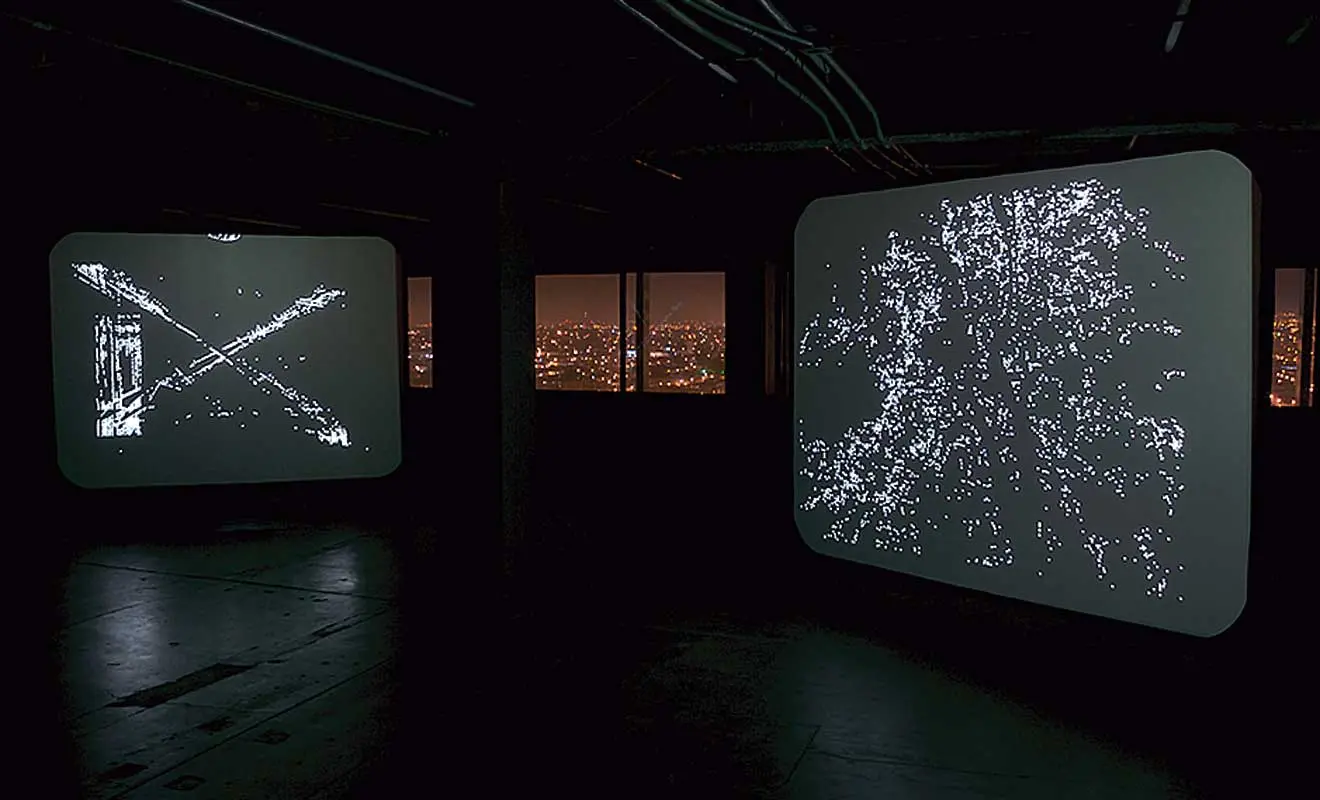
But Surrealism is not the only allusion to art history in this body of work. The large-scale Transformable Webs are malleable objects that suggest the presence of a performatic intention in the ways they are installed, as corroborated in the video that gives its title to the exhibition, Discarded Spider, in which Amorales can be seen “transforming,” playing, or dancing with the rubber-aluminum webs, creating a mysterious play of figures and shadows with his body and the web, visually reminiscent of ancient shadow theater, and even cut-out or silhouette animation like the pioneering Prince Achmed by Lotte Reiniger, from 1925. This cut-out aesthetic throughout the drawings in the Liquid Archive—which are coincidentally images transferred to digital format through a process close to the animation technique of Rotoscoping—is visible in the lines and contours of the collages and sculptures are unveiled by laser-cutting the negative space; a conceptual gesture that could be explained in obvious terms by the Mexican tradition of papel picado, or by the experiments on the exploration of space by Lucio Fontana and Gordon Matta-Clark. The Fireworks paintings and the poetic “perforations” of the video Psicofonías, in which different shapes of images from the archive appear as perforations on the simulated player piano roll and each hole triggers a musical note, producing a multi-media (visual and auditory) collage where the richness is in the simplicity or pureness of the images.
The iconographic language of the Liquid Archive possesses a cinematic quality in itself, as each one of them is the synthesis of a group of ideas and when juxtaposed or composed in an abstract scene, they become theatrical narrative, and the myriad of possible narratives is drawn from the given abstracted symbols and from our own mental database of icons. Thus, Amorales’ effort to collect and recycle images to develop configurations from them makes him a sort of “graphic Frankenstein,” who appropriates and considers the image as a found object that can be manipulated, morphed, and evolved into new narratives. And the children—or monsters—that are born from these compositions; his drawings or collages, videos, sculptures, installations, are an existential search for beauty in the most essential place: in our personal and collective iconography of fear, for fear is the most primitive and intense feeling one can have, and our oldest and fondest memories from childhood tend to be those dark images of the made-up myths and monsters that we create to understand the mysteries of nature and of our own humanity.
This trimmed edition of Discarded Spider at OCMA was not entirely representative of the depth of Amorales’ work, due to the exclusion of stronger media in his production, such as video and vinyl installations of flocks of birds—instead of the excessive number of drawings—which could have contributed to creating a more vibrant museographic experience and a broader understanding of the artist’s oeuvre.
SELENE PRECIADO