Carlos Estévez’s art exists in a space between the nostalgic past and our own time, between the esoteric and the real. His drawings and paintings in oil and pencil describe modern man by means of a visual language that is evocative of historical treatises and Renaissance manuscripts, as much in the composition as in its decorative and illustrative qualities. In his works, the most delicate linear drawings converge with large areas of color or black, over backgrounds that look like worn walls of aged documents.
One is impressed by Estévez’s sense of design, his careful use of line to create geometric systems or circular patterns that resemble the parts of a clock, and his esoteric diagrams and mandalas, those concentric diagrams that represent the powers of the universe. His iconographic schemes often include the facades of Romanesque or Renaissance buildings, both secular and ecclesiastical, as well as machines or mechanical systems of unclear purpose, created through meticulous line drawings that recall the complex devices designed by Da Vinci.
In Estévez, however, both the architectural and the mechanical forms function as symbols of humanity, as representations of the practical and spiritual aspects of man. They appear in compositions laden with signs to a variety of sources, related to rituals or sacred texts, with anthropological, esoteric, or religious connotations. Standing before this multiplicity of icons and mysterious shapes the observer takes on the role of a decoder or a medium of sorts. In Mensaje subliminal (Subliminal Message), for example, one sees the palms of town hands, one covered with gears, and the other by what looks like a medieval city plan, in side-by-side symbolic representations of the inside versus the outside. There are circular diagrams on the tip of each finger and, in the center of the palms, an eye, which links these hands to the hamsa, that Arabic talisman (also comments in other cultures), which serves for protection against all evil. the circles in Estévez’s hands appear in multiples of five, a number with mythical associations.
In the works titled El rumbo fijo (Fixed Path) and El rumbo indeterminado (Uncertain Path), within the silhouetted forms of heads in red and blue, there are architectural and mechanical structures in the shapes of a steam engine and a ship, which make reference to the railroad as a specific path and the ocean as one that is undefined. In general, in Estévez’s oeuvre, a man appears as a figure that provides a sense of balance among the drawn shapes, whether they are flying machines or cups of tea in the form of heads with “open” tops. In Expresión infinitesimal (Infinitesimal Expression), a pseudo-mechanical dancer stands on a tightrope while balancing two large, fragile, and torn butterfly wings, with ten heads that roll along with them in different stages of the rotation. Equally delicate is his Las damas de blanco (Ladies in White), a work that makes reference to the women who hold demonstrations for the unfairly jailed dissidents in Cuba. These five women parade in profile like Egyptian figures, holding up torches. They have ethereal bodies, composed of fine lines and mechanical disks, connected to windup keys or small turning levers. The more solid shapes are their heads and their unusual colorful shoes that make an ironic salute to fashion.
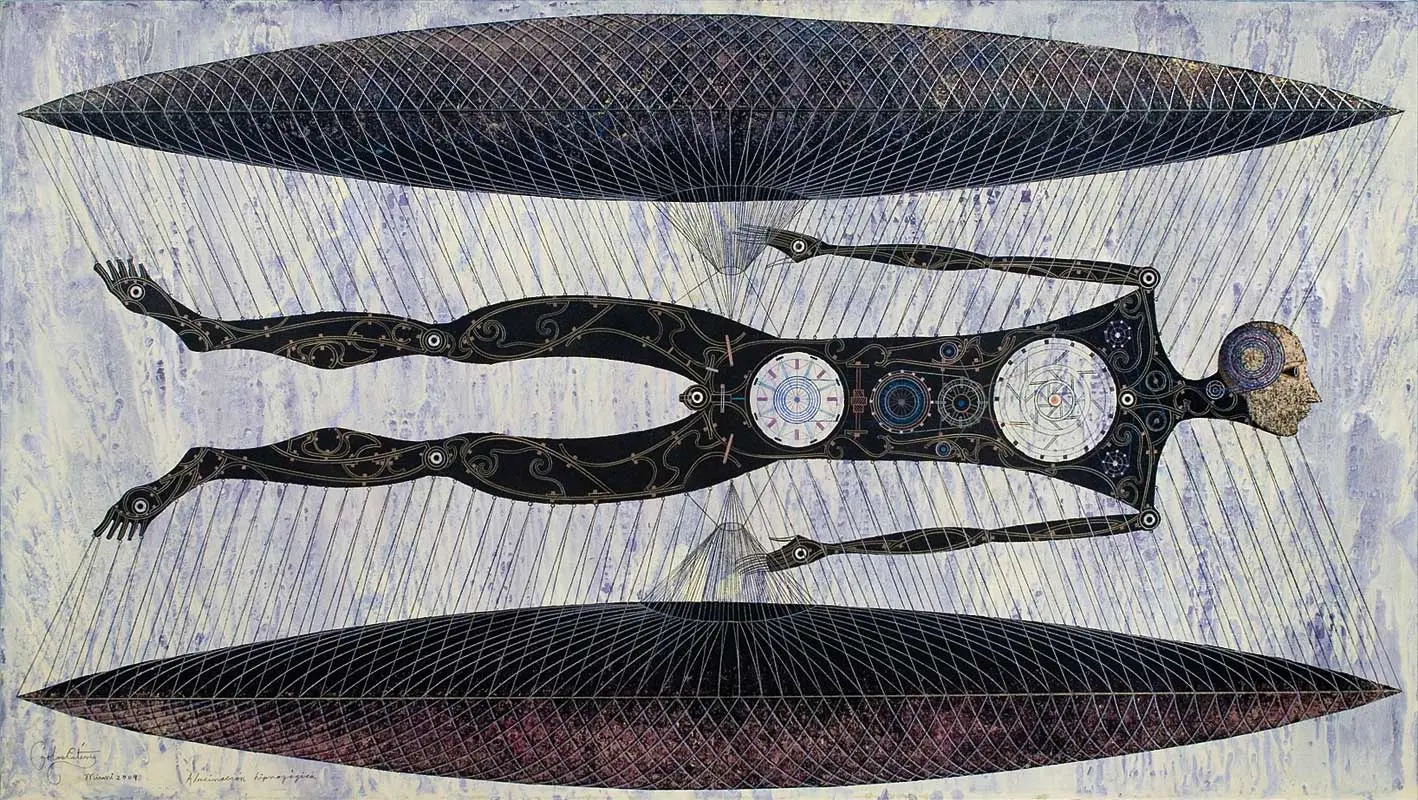
In some cases, Estévez uses thin lines like puppet strings to sustain and give a sense of movement to his figures, as with the dancer in Movimiento armónico complejo (Complex Harmonic Motion), who is a cross between a woman and an insect with several arms and legs. In other works, such as Alucinación hipnogógica (Hypnagogic Hallucination), the threads hold a human being precariously balanced between two vessels, like the hulls of two boats, which transport him on a spiritual journey, the product of a state of semi-sleep. In Sentimientos de pertenencia (Feelings of Belonging), these threads of life become dramatic blue rivers that emerge from a central figure surrounded by the architectural forms of “cities that belong to us.” Inevitably, one perceives a connection between these communicating lines in Estévez’s works and those of other Cuban artists such as Juan Francisco Elso and Jose Bedia. They also share a way of representing the human figure as a thin, dark silhouette, with gear-like joints, and the use of cosmological symbols, both ancient and modern, sometimes related to Afro-Cuban religious traditions.
Estévez’s shadow boxes and collages are similar in character and style to his drawings and paintings, with the added feeling of the third dimension and the appropriated imagery, which the artist handles with his own magic. The black backgrounds heighten the feeling of mystery, as does the juxtaposition of dissimilar elements. In El propósito (The Purpose), a wind-up rider on a horse, an image of Saturn with its rings, and an angelfish are connected by thin wires that hang from a single source. There is no doubt that Estévez is an artist well-versed in a variety of subjects, that he has stories to tell, and that he knows how to do so in ways that arouse our admiration and curiosity.
MÓNICA E. KUPFER