
Tierra-Bruna is the first solo exhibition by Emma Malig, a Chilean artist who has been living in France for some fifteen years. It is at this diverse and active – in terms of its programming – municipal gallery near Paris where several Latin American artists have presented their works, among these the Argentines Jack Vanarsky and Octavio Blasi and the Uruguayan José Gamarra. The recent work by Emma Malig (2006-2010) is very discrete and subtle; it almost whispers as it eludes the strident screams of a contemporary painting that can only exist in the excess. Through imaginative and sensitive cartography consisting of large- and small-format tondos, paintings, and drawings, Malig creates a journey of memories marked by signs, words, and phrases that convey, as poet Sylvia Baron-Supervielle once expressed it, the “nostalgia of a country.” But this journey that invites us to observe and read is, above everything else, an internal journey, the barely outlined perception of an imaginary territory between heaven and earth, between oceans and shores, where things remembered and forgotten lie silently in wait. In this symbolic work, repeated phrases or terms – such as exilio (exile), carta de sin fin (a letter with no end), carta de tierra sola (a letter of lone earth), mares del olvido (forgotten seas), tierra del olvido (forgotten land), vagabundeos (wanderings), among others – are accompanied by different symbols. There are signs that organize space; first of all, the dominant circle, but there are also some miniaturized icons, such as a tree, a boat, or a bird, as well as barely identifiable fragments of maps. All these symbols evoke sentiments associated with traveling or with a sense of belonging. The nostalgic geography of Emma Malig is not solely perceivable in this form of writing amid words and signs, but it is also expressed through what could be called an “Ode to the Skin” (to refer to Pablo Neruda’s wonderful Elemental Odes): whether it be the soil, the water, or the clouds; whether it be something torn, glued, drawn and painted, wrinkled, superimposed, scratched, soaked, or washed out; whether it be with paper, with its flexibility, texture, and adaptability to different media, in other words, it is due to the nobility of paper that Malig is able to place the delicate but indelible mark of her feelings in her work. And this paper – that she loves and respects – has been created by her for each of the works included in this exhibition.
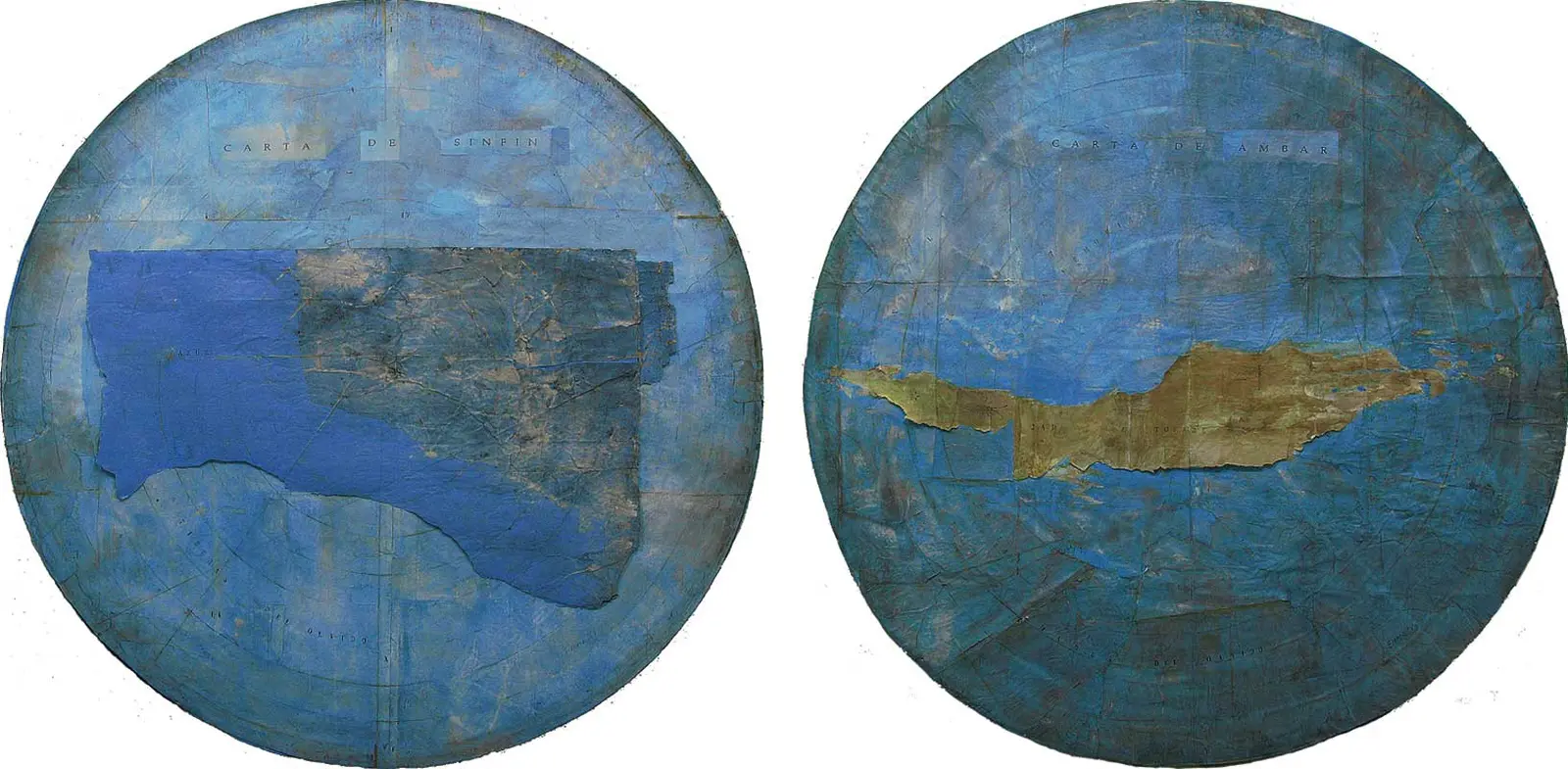
With a single small stain on a solid color background, in the piece titled Ceci est la Couleur de Mes Rêves (This Is the Color of my Dreams), Joan Miró gave us, in 1925, one of the keys to his oneiric and colorful universe. This could also be the point of departure for the ochre and blue journey that Malig invites us to embark upon. In her museographic proposal – that occupies two exhibition areas amply connected between each other – there are large free spaces between each work, something that works in favor of Malig’s visual and intellectual approach in that it confers an element of weightlessness upon the exhibition as a whole. In the first exhibition room, the works titled t.Exilio I (T. Exile I) and t.Exilio II (T. Exile II), respectively, are two large world maps – 76.8 inches in diameter, mixed media on paper, 2010 – that occupy a large wall on the right. Created with several layers of fragmented paper that have been glued together, the irregular ochre-painted surface presents a wrinkled and yet delicate appearance – like a fragile and tormented land – on which Malig draws, nearly as if it were calligraphy, landscapes, trees, and animals, which signal an improbable journey. While there is land – depicted with ochre and beige textures – there is mainly water, rendered in tones of blue that make one dream that open limitless spaces where there is plenty of time for memories to disappear. The vastness in the piece Carta a Este Mar (Letter of This Sea, 57 × 74 inches, mixed media on paper, 2009) suggests a permanent oscillation among tangible elements that make us belong – the land – and intangible ones, namely, the water, with its shores and sands – that could almost be quicksand – that keep us away from the inaccessible. On moving to the second exhibition room, we find the series Errances (Wanderings, 2010), which comprises 13 tondos, each 9.8 inches in diameter – ink and pencil on paper – that depict two men walking toward each other and toward the center of some circles. Although they appear to want to meet, they are condemned to the impossibility of an encounter, because they are prisoners of the circularity surrounding them. And for Malig as well, this represents a virtual prison built with words and memories. Installed on the wall at the back of the second exhibition room and visible from the entrance, the monumental Tierra-Bruna – 27.6 × 146.6 inches, oil, and ink on paper, 2010 – appears as an infinite territory in which red-ochres create the atmosphere of a landscape that appears and disappears with the same opacities and the transparencies. Two display cases present workbooks, a number of drawings, and two poems by Malig that complete the exhibition in a subtle fashion.
This is a work of mediations on time, disappearance, and precariousness; it is a poetic work of resurfacing memories and whispers. In it, Emma Malig – also a writer of haikus – offers us a cartography of emotions in which lost horizons are in continuous dialogue with the absent. As Sylvia Baron-Supervielle wrote in her Journal d’une Saison Sans Mémoir (Dairy of a Season Without Memory), “Most people are born into exile, but are not orphaned.”
CHRISTINE FRÈROT