
Franco Manterola (Mexico City, 1957) is committed to an unyielding formal struggle with his materials – literally evident in his works – that results in a field of abstraction the viewer must guess underneath the purely figurative elements. Shining within the frame, a patch without attributes becomes an emotional protagonist in Manterola’s works.
The Japanese and Chinese themes and motifs are only an excuse. Birds and branches – a minimal evocation of the landscape derived from a learned or stolen rhetoric – are merely invoked to be dissolved in the pattern of multiple tapestries in search of a symmetry that is the only meaningful thing. The landscape disappears when the tensions generated by color and the impasto are instinctively resolved, and instead becomes an essential scheme, a starting point hidden in the lyrical provocation that is manifested in the elements forming the composition.
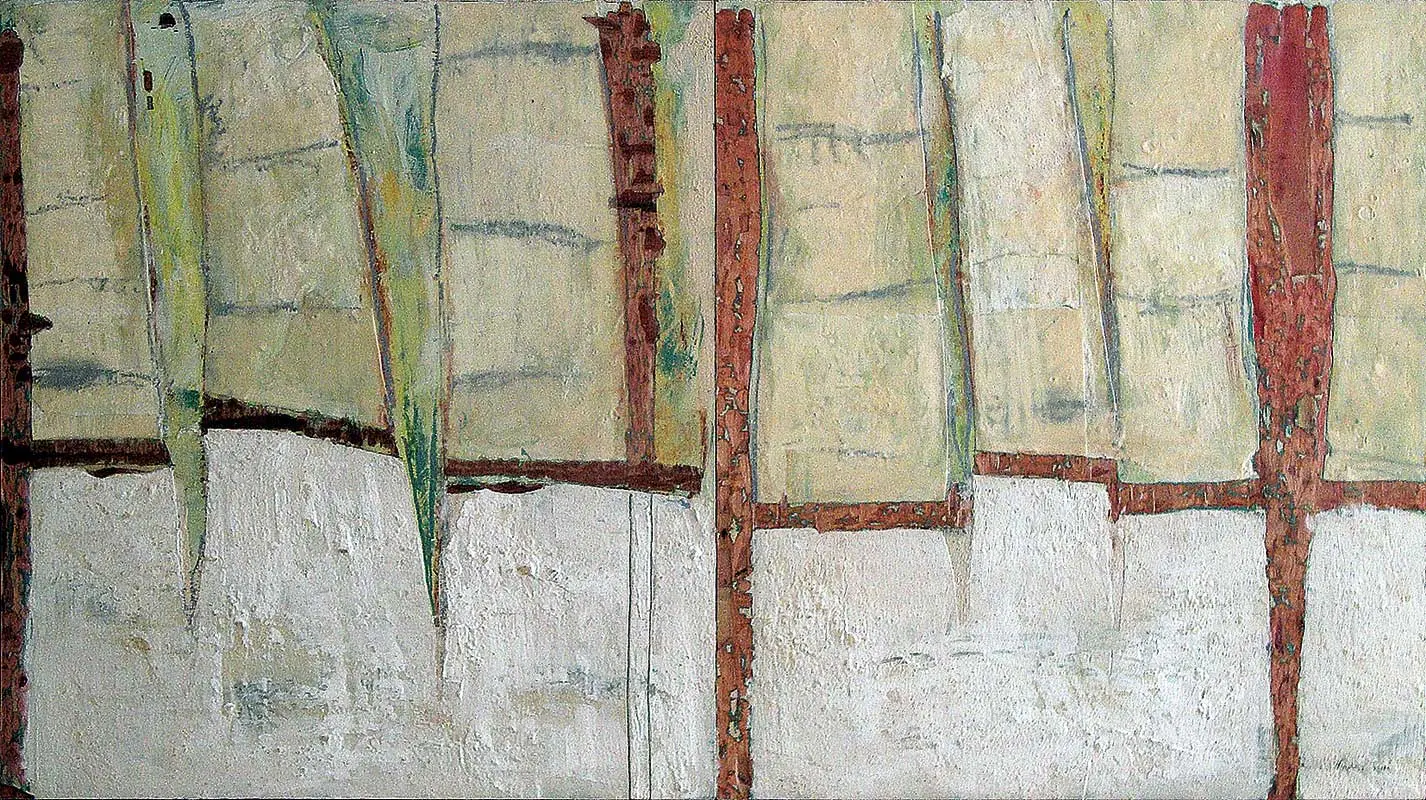
The birds – transcribed with the taxonomical attention to detail of someone fond of ornithology – more than just necessary points of tension, stand for the moment gone by. There are no blatant impositions overstaying their welcome like elaborate accidents in the weft of a tapestry that changes organically. They are there, however, on the altarpieces, like the unwelcomed guests that they are: one place and one occasion; always ready to disappear in midair, trapped like the metaphor of their noise.
In his search for meaning, Manterola does not go after double or triple readings. Like a Zen monk, he is after a glimpse of nothingness that shines and slips through the cracks of his mesh. The same crack that exists in the resources of this world when it comes to achieving the representation of the ethereal – which is the theme he focuses on.
The crisscrossed strokes serve as the net for an abolished landscape. The Cartesian diagram reveals it as the pattern for a possible mosaic, armed – in a play on symmetries – with accidents, elemental forces, and the exposure to the environment. The title of these altarpieces, Amanecer (Dawn) and Atardecer (Dusk) points to those influences. A gold or silver leaf that has been dulled, that has been attacked by a patina that transforms it, with brutal subtlety, into a landscape. Light, just light, refracted if possible, made of instants that overlap to merge into one, as imperishable as they are ethereal.
The emotion – the attack perpetrated on the wood – is no more than a gesture toward the abstract. Between theme and representation, Manterola leaves tradition aside in order to generate foundations and to provoke, from a violent place, the transcription of something still expected to be wood – but in the essential rather than in the material sense. The altarpiece is revealed as a sum of assumptions, in elements that shine within the rigor of the minimal. As the layers are superimposed, the symmetrical patterns collectively render figurative elements that appear as if they were an unavoidable temptation. The birds, I insist, more than a contingency, are that which – once captured – resolves that could not have existed before or after that moment. Manterola wants them for their strident qualities, just like the tea tin containers he uses for one of the altarpieces: it is a form of laughter worthy of a pseudosaint; a provocation that could very well be redeemed or become part of the kitsch vocation it appears to be. The birds and the branches are the perpetuation – always artificial and decorative – of a present moment that is continued like a Parmenidean ideal, a desperate conspiracy of time, in the possibility of the immobile.
RICARDO POHLENZ