
Crónicas eventuales the title of Jorge Macchi’s exhibition at Ruth Benzacar, combines two words with opposite meaning in order to originate new meanings. That which is chronic happens with regularity, is long, extends over time. In turn, that which is eventual is subject to any contingency, may or may not come to pass. Together, the chronic and the eventual produce singular intermittency.
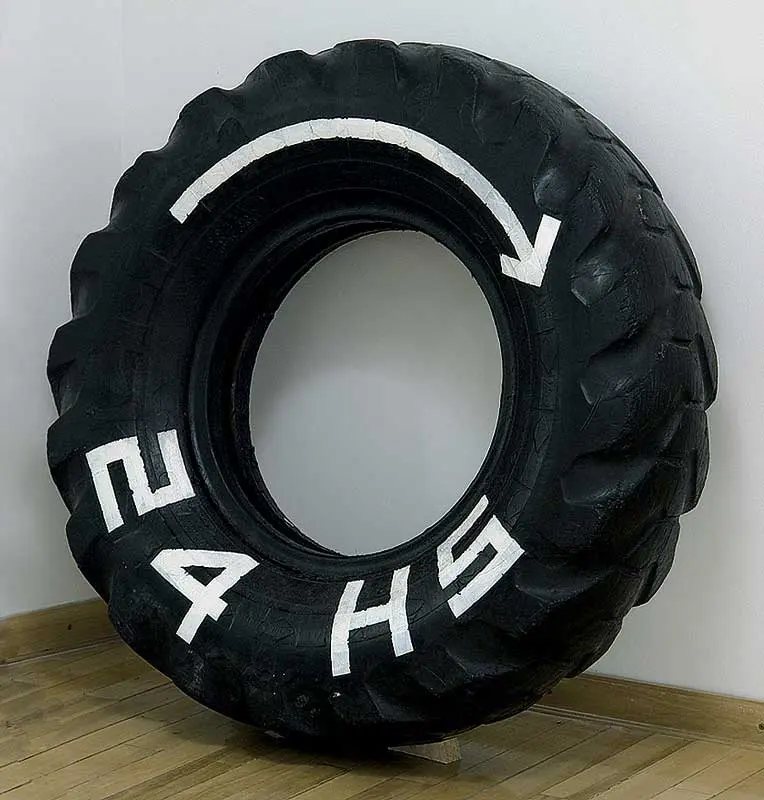
At the beginning of the exhibition, we find a giant car tire titled 24 Horas (2010), of the kind used by mechanics as advertisement, with an arrow painted on it and the inscription “24 hs.” Macchi is placing us in front of the wheel of time. Time returns, the world turns, nothing stops. Later comes, installed towards the back of the gallery, the video 10:51 (2009). The projected image of a clock plays with the spatial limits of the gallery: exactly at 10:51, the clock’s two hands seem to clash against the ceiling. time stops. The minute hand tries to move, but fails; it retreats and tries again, hindered by the real presence of the ceiling. It is hampered in its movement, frozen in one second. The opposition of these two works, 24 Horas and 10:51, marks the differentiated time proposed by the exhibition. In the constant tic-toc, Macchi isolates tiny hiatus and narrates some probable histories from the thousands that could be.
Crónicas eventuales is filled with visual puns of double-meaning plays with images and words. The photograph titled Fragata (2009), for example, presents a matchbox inclined against a blue background. The matches are of the “Fragata” brand, very common in Argentina, and a ship is printed on the box. The ship sinks into the sea. The watercolor Liberación I (2009) is a white sheet, ripped from a notebook, left with the perforations of the spiral binding that held the whole thing together. Strewn on the face of the sheet, in several colors, are small painted squares, equal in shape and size to the perforations. The colored squares are thus liberated from the straight line of the perforated ones. Macchi skirts the customary flow of logic and produces perplexity by frustrating learned responses. His games of meaning possess intelligence similar to the puns proposed by another artist, Bruce Nauman, who carried incongruence to its extreme, disarticulating expectations and presenting another way of understanding the world. I remember Peter Scheldahl’s note that, coming out of Nauman’s retrospective, he felt as if he had been hit by the anguish of realizing he knew less than he thought he knew. Macchi’s works, however, leave no such sour aftertaste. The opposite is true. Macchi works with that which is familiar and closes at hand, connected to our affections.
Perhaps because of that, his transformations do not provoke anguish. His disenchantment is, let us be contradictory, enchanting. While common things lose the function we ordinarily ascribe them — there is a perversion, a shift in the state of things — we gain a new way of relating to them. Macchi, without a doubt, makes a difference. He modestly changes day-to-day.
My wave (2009) is a sky-blue plane that expands on one of the gallery walls. Looking at this work is like looking at the sky. There was even a small step stool next to the mural for us to achieve some height and contemplate the extended horizon. Although it is obvious from the start that this blue expanse is painted. Macchi puts on display here his frank gestureality. We see the quick traces of the brush. Even the stool, which is white, is dotted with blue paint. There is no simulation. There is no trompe l’oeil. My wave could be a background creating the sensation of the natural sky or of environmental amplitude, but which expresses immediately its theatricality, presenting itself precisely as representation, as a stage device. Regarding his works, Macchi has said, “There is no tragedy, the code is the exacerbation of artifice (…) As happens in the theater, one knows that everything is artificial, and yet it moves us.” The romantic firmament of My wave shows as false its depth effect, just as a firefly explodes in the night only to extinguish its luminescence. The powder of these fireworks — open, aleatory, devoid of the pretension of containing reality — excites emotion, unsettles, disquiets. Fuegos de artificio (“Fireworks,” literally “fires of artifice”) was precisely the title of a show by Macchi at Ruth Benzacar in 2002, which continued with the “Incidental music” of a previous exhibition, held in the same location in 1998. Today, Crónicas eventuales corroborates and carries forward the gaze already manifest in those receding exhibitions. Macchi offers incisive visions, revelations, always filled with humor and indetermination; he provokes intimate reactions: attentive to the pulsations of everyday life, he works with fiction and transformation and finds, above all, a counterpath to common sense, a strange order in chance.
FLORENCIA MALBRÁN