
Before settling in Buenos Aires in 2006, Leandro Katz lived for more than three decades in New York, where he was both witness to and protagonist of some of the most important processes of the U.S. artistic vanguard, and of conceptualism in particular. His artistic endeavor circumscribed to a variant that is essentially supported in the hybridization of the visual (photographic) with poetry, literature, and philosophy. This current had two of its most important exponents in two Bronx natives: Vito Acconci, and Lawrence Weiner. Nevertheless, unlike these artists, Katz centered his work on the object itself, which is photography in this case.
On the occasion of his personal exhibition titled Historia Natural (Natural History), Katz presents a series of vintage photographs from the 1970s that contain some of the fundamental keys of his poetic. Exploration of the image as it relates to temporality, codification of natural objects, and the return – once this codification had been outlined – and writing as self-reflection are elements in the works being exhibited. They reveal Katz’s increasing interest in finding a visual language that could also condense the temporal with the symbolic.
Sobre la Tortuosa Naturaleza de Nuestro progreso (On the Tortuous Nature of Our Progress, 1972) consists of a black and white photographic series that depicts stretches of vehicle roadways shot in several parts of the U.S. The images invariably show the curve of a highway surrounded by vegetation. The photographs – taken from what it could be an automobile driver’s view – proposed a type of reflection based on the every day, similar to many classic conceptual proposals. Katz has said that he does not want these images to be seen as landscapes, even if they are. In this sense, his decision not to use color is very effective.
Codifying the highway as a symbol of progress is not a new idea. Since Roman times, vías, roads – as supports of intra-imperial communication – were essential for sustaining progress. Little has changed since then, to the point that blocking a highway is one of the most frequently employed mechanisms for the citizenry to protest. Nevertheless, Katz does not appear interested in the political dimension of the symbol, given that he has eliminated from the image any indication of a human presence. Twisted and fragmented highways appear to fall victim to a natural world that is resolute in reminding us of their limitations.
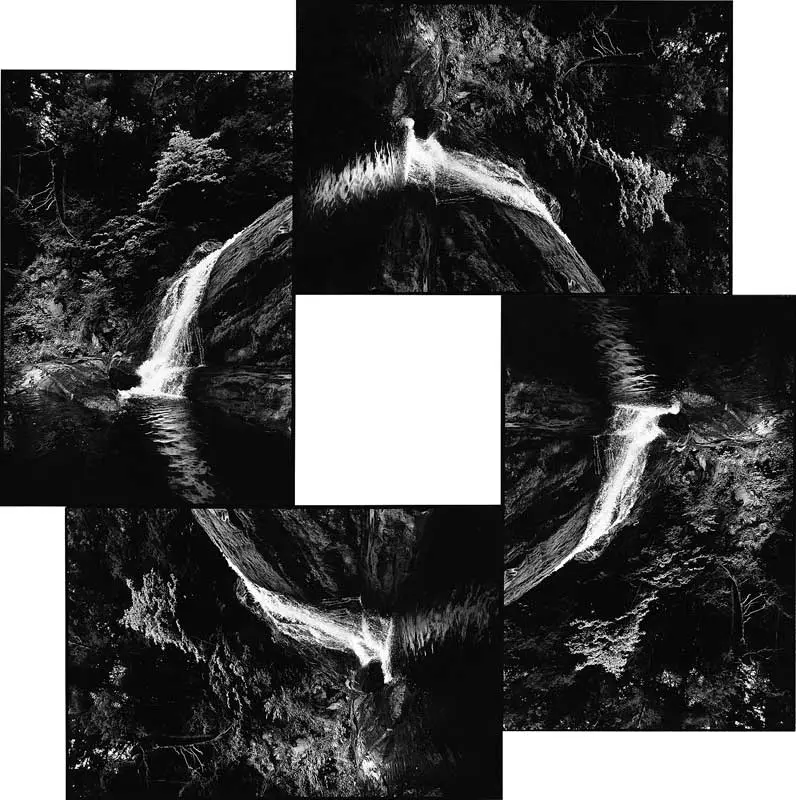
The temporality of the image, in this instance the always imperceptible changing reality of a river, is the theme in Caída del Indio (Fall of the Indian). The work comprises two pieces: a polyptych of ten images – taken during a ten-second interval – and a triptych capriciously mounted in the form of the letter Y – three images in three seconds – in which Katz shapes the top area of each image to blend with the others to create a circle of light corresponding to the landscape’s sky. The river bed in these images would appear to emulate the sinuousness of the earlier series’ highway images. But the most important element is the way in which temporality is manifested through the nearly imperceptible changes of reality. Unlike Cezanne and the Cubists who wanted to integrate the fourth dimension into the image by representing several perspectives at once, Katz images avoid altogether any visual contraption and instead focus on the interior nature of change that exists in the landscape. Rather than seeking the visibility of change, this artist concentrates on the codification of nature itself as a constant change, although this sometimes is impossible to represent.
Once the conceptual premise has been established for an image or a series, Katz can move on to a superior plane that is concerned with representing the images. He is then able to create, for instance, the circle formed in the triptych Caída del Indio (three seconds), a format he uses again in later works such as La Caída (The Fall) – 4 seconds in circles, 1977 – and Caída Vórtice (Vortex Fall) –4 seconds in circles, 1976. In these works, the artist comments on the cyclical behavior of the natural processes. Katz explores formal combinations in the series Caída en Diagonal (Fall in Diagonal, 1976) and La Caída (The Fall) – six seconds in diagonals, 1977 – with the specific goal of forming additional diagonals from one diagonal in a parallel fashion. Variations occur in the elements of each form: it is at times the water’s current, and at others, the photographs themselves, that is, elements in the interior and exterior of the image-in-question. There is no doubt that this indicates a distancing that Katz utilizes in an attempt to stress the equally formal nature of both the content and the container. In other instances, the forms remit to an arch, as in Arco Quebrado (Broken Arch, 1975), or to a pyramid, as in Caída en la Jungla (Fall in the Jungle), a triptych from 1978.
On occasion, Katz plays with cinematographic sequences. In his 1974 Girando (Invierno de una Serie) (Spinning [Winter of a Series]), he points the lens toward the zenith as he puts tree branches into service as the visible elements in the rotation. La Terraza (The Terrace, 1975) portrays a sailboat moving from right to left along the horizon. Likewise, in Self-hypnosis of 1975, a white cloud appears on the ceiling of an enormous house with a sign that reads “Self-hypnosis.”
The exhibition is completed with pieces that are very representative of Katz’ work: Alfabeto Lunar (Lunar Alphabet, 1978) and phrases based in this coding of the various gradations in the lunar cycle (waning, waxing), which include all letters of the Spanish alphabet. These works – that came into being after the previously mentioned explorations on temporality – mark the artist’s return to the use of literary elements that are now the beneficiaries of an “appropriate” visual code. Invariably associated with the poetic universe, the moon is renovated by Katz and presented as a symbol of the infinite possible combinations that nature has to offer, very much in the same way that one alphabet has led to millions of literary works.
ELVIS FUENTES