Hans-Michael Herzog begins his interview with Luis Camnitzer, published in the catalog for Camnitzer’s exhibition at the Daros Latinamerica Foundation in Zurich, with this forceful statement: “I find it difficult to interview Luis Camnitzer because he’s a person who seems to have written everything, to know everything, to have said everything…” And the truth is that he is right because Camnitzer is one of the most complex and experienced personalities in contemporary Latin American art, someone who throughout his long career has been able to bring together the skills and achievements of the artist, the art critic, the historian, the theoretician, and the professor, with his art activism and political commitment to the resistance against the military dictatorships that controlled the Southern Cone in the second half of last century. And there is also his own circumstance as a transnational person: he was born in Lübbeck, Germany, shortly after the Nazi Racial Laws were enacted and shortly before the start of World War II; he was raised and educated in Montevideo, in Uruguay that was still dubbed “The Switzerland of the Americas;” he emigrated to New York City in the early 1960s, when the city, already “the Modern Art capital of the world,” was witnessing the unfolding of Pop, Minimalism, and Conceptual Art, to mention just three of the more active and outstanding movements of the period. Yes, Camnitzer’s life story and his oeuvre validate the judgment that he “has written everything, seen everything, said everything.”
And it is equally true that he has previously exhibited almost all of the works included in the show that, under the laconic title of Luis Camnitzer, the Daros gallery presented in Zurich. But on this occasion, the works were selected and grouped in such as way as to allow for an orderly review of the constants that define Camnitzer’s conception of art as well as the main subjects and issues through which it has unfolded throughout his career.

Of course, I am not threading new terrain if I say that the work of Luis Camnitzer is inconceivable without taking into account conceptualism, which was both the immediate context of his work in the 1960s/70s as well as an important source of inspiration, even despite the fact that Camnitzer has claimed that his art responds more to the purposes of a hypothetical contextual art rather than those of its conceptual counterpart. The nature and complexity of the relationship of affinity, difference, and disguise between Camnitzer’s work and conceptualism are further clarified if we contrast them with a certain scheme in the thought of Joseph Kosuth, who, with his pivotal 1967 essay Art after philosophy1 made one of the most sophisticated philosophical arguments about the attitudes and concerns shared by the partisans and promoters of conceptualism2. And we can begin to sketch that scheme by noting that Kosuth's entire effort to think what he called “the art condition” is explicitly indebted to the analytic philosophy of language, as underscored by the decisive role played in Art after philosophy by the quotes from and references to A. J. Ayer, one of the preeminent names in that philosophical school. It is Ayer who contributes the conceptual instruments deployed by Kosuth to articulate a theoretical discourse whose essential purpose is to defend what up to then was the most radical version of the idea of l’art pour l’art, art for art’s sake 3. Radical in a twofold sense. In a historical sense, because it asserts art’s definitive break not only with the museum—which for Kosuth is nothing but an overvalued warehouse of “historical curiosities"4—but with the kind of formalism that considers works of art only those that are so by virtue of “its remembrance to earlier works of art"5. And in an ontological sense, for his call for an equally radical separation of art and aesthetics, inasmuch as the latter focuses on taste and deals in “opinions and perceptions of the World in general"6. The premise and the conclusion that obtains from this dual radicalism is the systematic equivalence between art and the analytical proposition, the validity of which—following Kant—depends entirely on the logical coherence of the symbols it contains,7 its paradigm being a tautology. Thus, after extendedly arguing in favor of the idea that it is practically impossible to discuss art without resorting to tautologies,8 Art after philosophy concludes with these forceful assertions of art’s self-determination: “Art’s only claim is for art. Art is the definition of art”.9
It must be noted, however, that Kosuth’s vindication of art as its own definition was resolved in his own artistic practice through works that, paradoxically, focus more on the problems generated by the definition than on the problems solved by it. The emblematic work of Kosuth’s most radically conceptual period is probably One and three chairs, which, although created two years prior to the publication of Art after philosophy, literally puts on stage the aporias that lurk behind the definition of any object. In this case, a common chair, the Webster definition of which Kosuth copied onto the wall and exhibited alongside a real chair and a life-size photograph of the same chair. The dictionary definition quoted by Kosuth is not evidently unidirectional, but this problem is much less intractable than any of those that arise from statements such as “the real chair” or “life-size photograph.” Why is the Webster definition less real than the chair? Or then the photograph of that chair? Is there an unproblematic criterion to adjudicate this? True, there is always the resource—used by Wittgenstein in his day to resolve the problems posed for the notions of sense and meaning by the intrinsic ambiguity of natural language—of asserting that “the meaning is the use”10. This is to say, that nobody can sit down on the definition of a chair, or on its photograph. But this solution to the aporias of the definition—besides being rather banal—generates for the case of Kosuth’s three chairs the additional issue of clarifying why the exhibition of these aporias constitutes a work of art. Why, if art is the definition of art, anything that deals with its own definition is art? This reasoning looks like a fallacy of composition, and perhaps it is. At any rate, its defective character reveals the fact that Kosuth, rather than resolving as he intended, and in an uncontestable way, the issue of the nature of art, reduced the continent of art to philosophical speculation that dared not speak its name, carried out through the systematic counterpoint of heterogeneous languages.
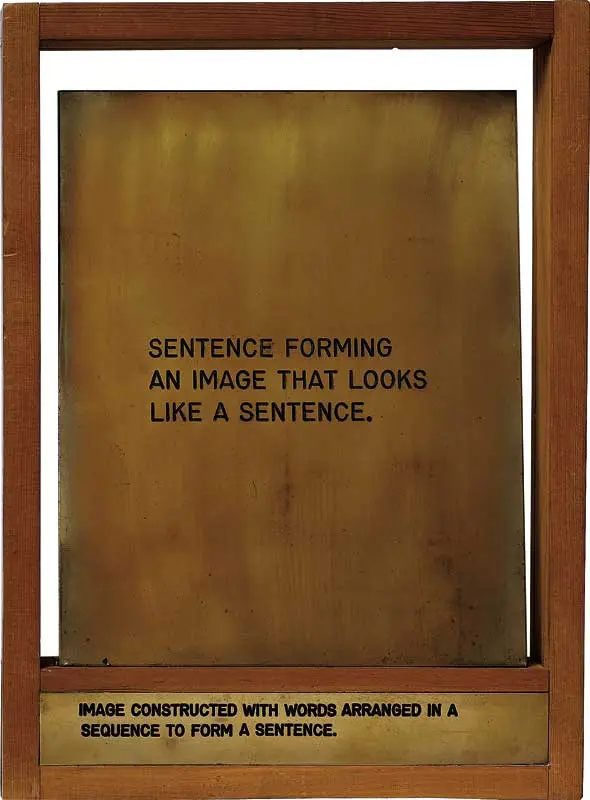
And it is precisely at this point that we can return to Camnitzer’s exhibition in Zurich and confirm that part of the works included there respond to their author’s strategy of counterpoising language and image in order to evince their radical insufficiency and to put into play the implicit imaginative possibilities in such insufficiencies, and even the apparently inarguable univocal nature of tautology itself. A notable example of the application of this strategy is the tautologically titled Image constructed with words arranged in a sequence to form a sentence (Sentence forming an image that looks like a sentence), of 1973.
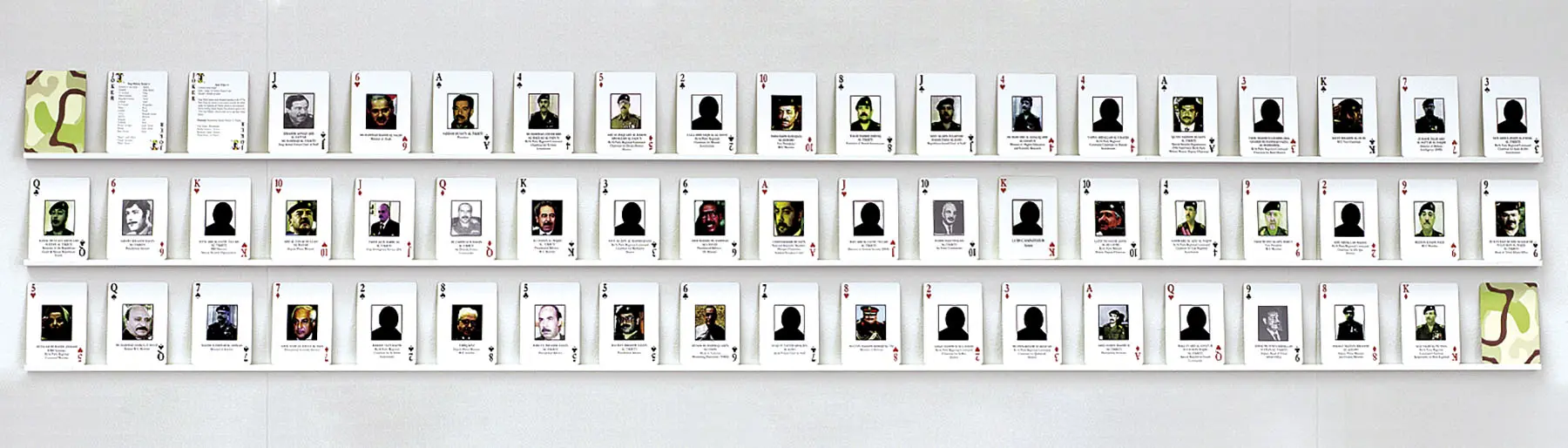
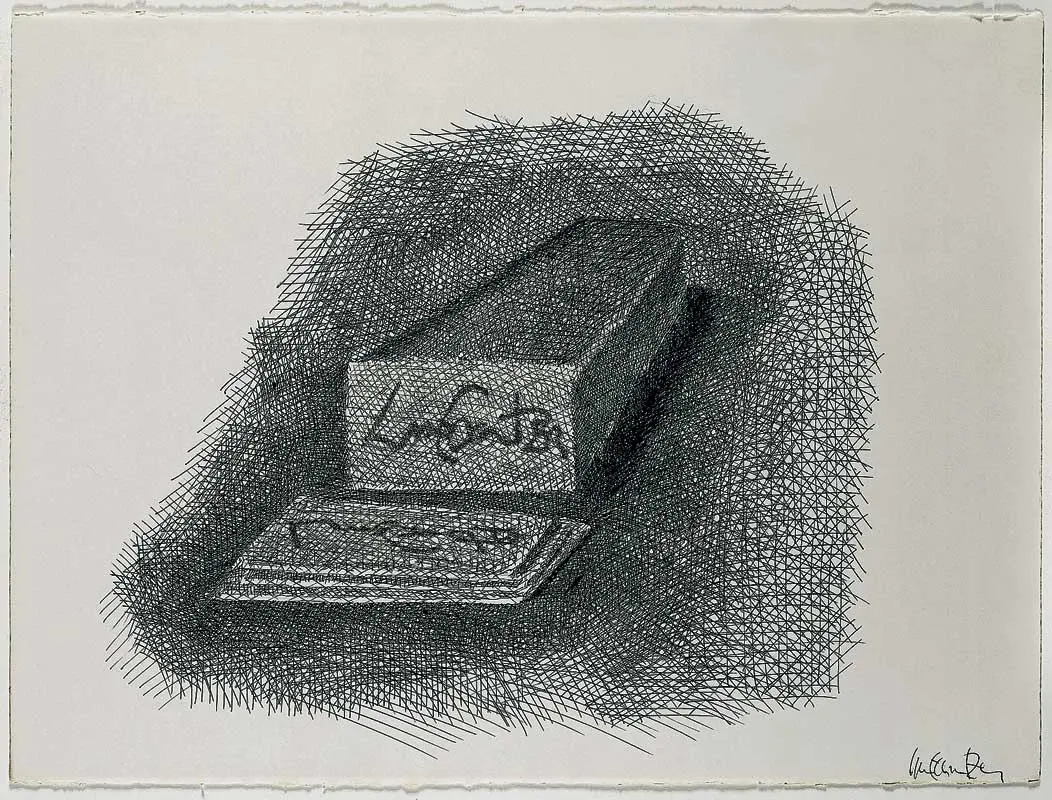
Yet Camnitzer, against what Kosuth wanted, didn’t allow the strategy to be at the service of philosophical speculation and deployed it, to the contrary, in support of an anti-authoritarian critique of the artistic institution. And specifically, a critique of issues of authorship, unity, intangibility, and originality in the work of art, the personality of the artist, and the crucial importance of his or her signature. Camnitzer also moved away from the tautological concept of art, dealing in his work, with similar energy, with matters such as the terror regime implanted by dictatorships in the Southern Cone. Or the Iraq war, to which he devoted the 2002 work installed in the vestibule of the gallery in Zurich. It is titled King of Hearts and is a replica of the set of cards distributed by the Pentagon at the time of invading that country, printed with the photographs of important Baathist figures for whom a recompense was offered. In Camnitzer’s cards, the King of Hearts is himself, not Saddam Hussein. This is a parody as a weapon.
NOTES
1. Joseph Kosuth. Art after philosophy. www.ubupapers, 1969
2. Cf. Arthur C. Danto. Después del fin del arte: el arte contemporáneo y el linde de la historia. Paidós Ibérica, 2002. Introduction.
3). Kosuth cites and warmly approves of the following remark by Ad Reinhardt, dated 1963: ‘Art is nothing but art. Art is not what is not art.” Op. Cit. p. 11
4. “Actual works of art are little more than historical curiosities,” Op. Cit. p. 7
5. Op. Cit. p. 7
6. “It is necessary to separate aesthetics from art because aesthetics deals with opinions and perception of the world in general.” Kosuth, Op. Cit. p. 8
7. “A.J. Ayer´ s evaluation of Kant's distinction between analytic and synthetic is useful to us here: ´ A proposition is analytic when its validity depends solely on the definitions of the symbols it contains, and synthetic when its validity is determined by the facts of experience”, Kosuth, Op. cit. p. 9
8. “Indeed, it is nearly impossible to discuss art in general terms without talking in tautologies –for to attempt to 'grasp' art by another 'handle is merely to focus on another aspect or quality of the proposition, which is usually irrelevant to the art work’s condition”, Kosuth, Op. cit. p. 9
9. Op. Cit. p. 29
10. Quoted by Kosuth, Op. Cit. p. 2
*All images illustrating this article are from the Daros Latinamerica Collection. © The Artist.
CARLOS JIMÉNEZ
Writer and independent curator. Teaches at Madrid’s Universidad Europea.