
Colombian artist María Teresa Hincapié (1956-2008) first studied acting, and in 1978 began working with the Bogotá-based Acto Latino theatre company. Subsequently, she developed an exceptional artistic career as a performance artist that conferred great importance on the poetry found in gestures and to the analysis of gender issues pertaining to women – domestic life, oppression, fragility – in order to vindicate her own cultural context from a personal perspective similar to that of Beuys’s dream of merging art with life. Hincapié’s work also underscores the policies of the body and incorporates, to a certain extent, the Lacanian thesis on patriarchal society and its conversion of women into fetishes.
In 1987, Hincapié began her performance career with the work titled Parquedades (Frugalities), produced by José Alejandro Restrepo. It included music, video of her strolling on a park, and centering all her attention on her gestures and movements to convey the most mundane of activities. In 1989, she created Punto de fuga (Vanishing Point), once again acting in a vast space where she marked a center from which she began walking toward several imaginary lines. That very year, she created the work Naturaleza Muerta en un Espacio Muerto (Still Life in a Death Space), in which she grouped household objects to form small compositions that copied still-life images that contrasted with the ugly environment within the frame.
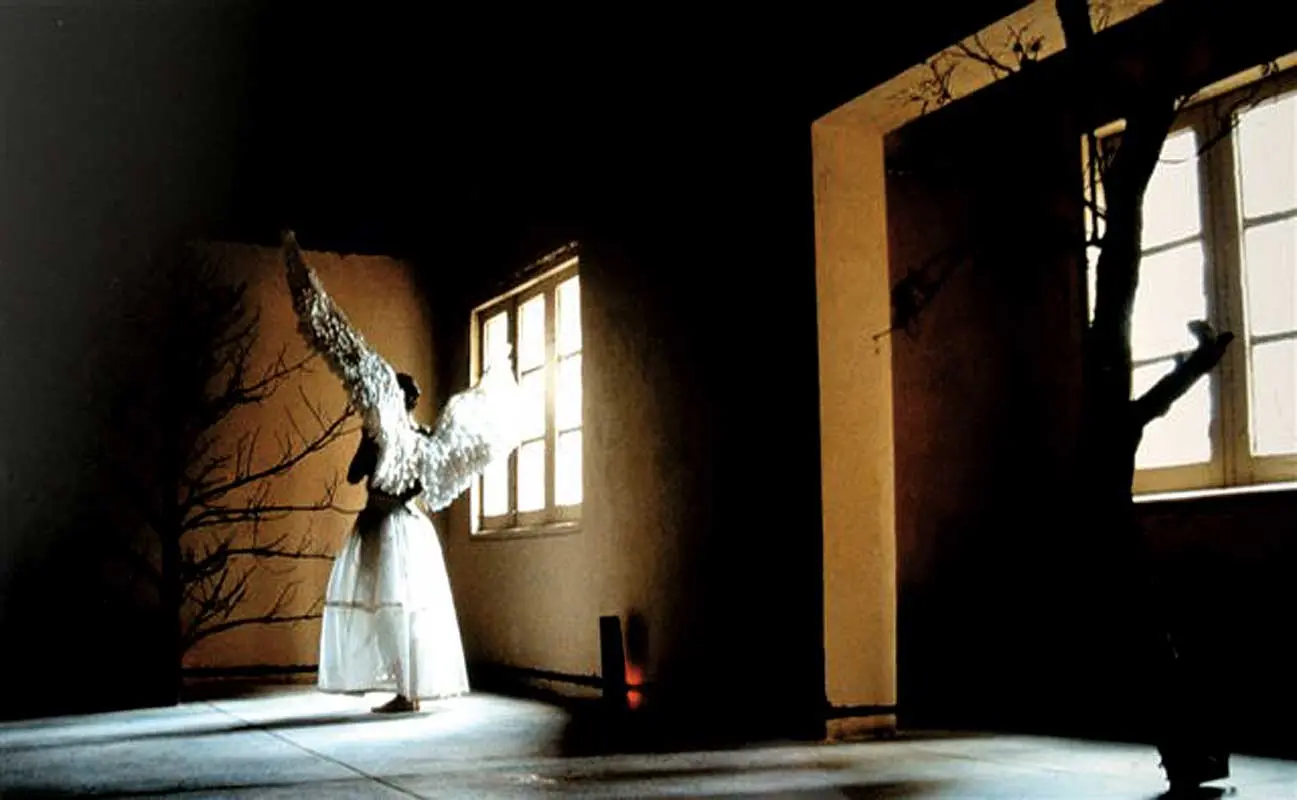
The Frost Art Museum of Florida International University recently presented the exhibition titled In Body and Soul: The Performance Art of María Teresa Hincapié. It offers a wide-ranging and concise vision of this important Colombian artist. Curated by Francine Birbragher, the exhibition is sponsored by the Galería Casas Riegner y Santiago Zuloaga: It opened on January 20 and will remain open until May 16 of this year. It includes photographic documentation and video of some of the most important works by the artist. The two videos presented in the exhibition document the performance Vitrina (1989), performed during the Encuentro Latinoamericano de Teatro Popular (Latin American Popular Theatre Encounter). The performance lasted eight hours in reference to an 8-hour working day. There, dressed as a housemaid, Hincapié can be observed behind a display window performing actions stereotypically regarded as feminine, as the glass that separates her from the spectators becomes an interface to interact with them, while she writes phrases backward so that the public on the other side of the window can read them.
The other video, projected on two channels, shows the work titled Una Cosa es una Cosa (A Thing Is a Thing). Earning Hincapié First Prize at the 1990 Salon of Colombian Artists, it portrays a ritualistic-domestic action in which the artist removes objects, food, and personal belongings from bags and suitcases and devotedly places them on the floor to form an enormous triangle that gradually becomes a labyrinth as the line of objects becomes longer. Then she gathers them and stores them again in an action that lasted twelve continuous hours for an uninterrupted period of 18 days.
The remaining pieces in the exhibition are small color photographs. El Espacio Inexistente (The Non-Existent Space, 2001) is an installation created for the Valencia Biennial. Here, Hincapié attempted to recreate and communicate the spiritual awakening that she experienced during a voluntary seclusion in Quebrada Valencia, a natural reserve located in Sierra Nevada (Santa Marta, Colombia), where she had bought a piece of land and where she would often spend time, work the land, and reaffirm the pro-ecological views that she included in her work, for the first time during the mid-1990s in the piece titled Divina Proporción (Divine Proportion, 1996), and continues to do in works such as Caminar es Sagrado (Walking is Sacred), Peregrinación hacia los Huicholes (Peregrination Toward the Huicholes), Tú Eres Santo (You Are Saint), and Sueños de Flor (Dreams of Flor).
Another of her important works is El Espacio se Mueve Despacio (Space Moves Slowly, 2003). In the first version of this piece, Hincapié wrote in chalk the word “pain” on the gallery floor, and then erased it slowly with her feet for a period of 24 hours. A second version of that work – that included music by her son Santiago Zuloaga – showed an installation with lighted candles, a birdcage, and a projection of images from the film Baraka by Ron Fricke. It was presented in 2005 at the 51st Venice Biennale and it is one of the works that best exemplify the subtle and symbolic narrative that exists between body and soul. Likewise, in Dulce Compañía (Sweet Company, 2000), she struggled to carry on her shoulders, for six hours, a heavy prop that simulated an angel’s wings. It became a really difficult physical task during the final hours of the performance and underscored the great contrast between the physical attributes of the object and the spiritual symbolism that the Judeo-Christian tradition confers upon it. And this is precisely the duality that is emphasized in the exhibition In Body and Soul.
RAFAEL LÓPEZ-RAMOS