Marilá Dardot (Belo Horizonte, Brazil, 1973) has been referencing important works and authors from the international literary world since the beginning of the 1990s. The book’s physical and textual materiality is transformed into an artist-book, object-book, video-book, and an installation-book. By presenting the book as an object – or by making small alterations and subversions in its text – Dardot adds an amplified poetic and sensorial experience to the act of reading and to an experience supported by ideas. The search for a vessel for the written language is conveyed in the way in which Dardot resorts to materials as diverse as light, public signage, architectural structures, plants, glass, mirrors, and weavings.
The famous work of English literature, Alice in Wonderland (1885) by Lewis Carroll (1832-1898), was used by Dardot as the basis for her most recent exhibition titled Alicias (2010), which is also the title of the exhibited installation. It proposes a play on words and perception by replicating the changes in size undergone by Carroll’s main character throughout the novel. This is achieved by enlarging or reducing the pages in the book. Totaling 13 pieces that measure 26 × 35.4 inches, some of Carroll’s book pages were photographed and subsequently mounted on neutral paper, Medium-density fiberboard (MDF), and mirrored acrylic. The reflection achieved by the acrylic enables the viewer to be included in the universe of the book, as it also represents a reference to Through the Looking-Glass, and What Alice Found There (1871), both of which are sequels to Alice in Wonderland.
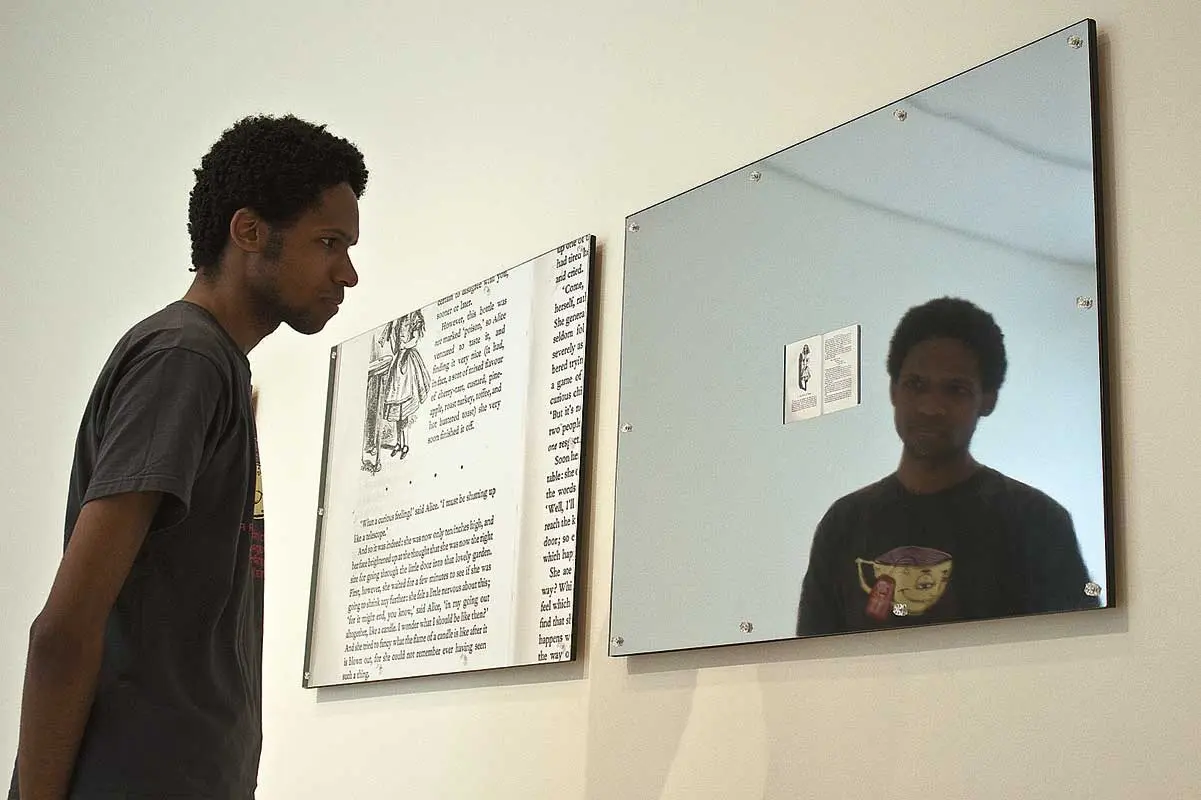
Throughout the narrative, Alice changes size twice. The installation begins with the life-sized first page of the book, followed by the first alteration in size that corresponds to the story, when Alice drinks a magic liquid and becomes 10 inches high, which allows her to enter through the small opening that separated her from a mysterious garden. Conversely, the following page presents characters that have been enlarged. Like Alice, the viewer is transported into a universe where, temporarily, the environment has been magnified. Then, Alice grows to nearly 9 feet in height, thus becoming much larger than her surroundings. Therefore, the ensuing page is miniscule and reveals – through the mirror – the presence of a colossal spectator.
Such semiotic and hypertext interaction is repeated through the entire work that replicates the Carroll chapters and allows visitors to experience the changes in size that take place during the unfolding of Alice’s adventure.
The changes in size experienced by the character stand for the transformational condition that permeated Carroll’s novel. Such modifications are accompanied by a series of doubts with respect to the very existence of the character, her identity, and her perception of the world. “I wonder if I’ve been changed during the night? Let me think: was I the same when I got up this morning? (…) Who in the world am I?” Alice asks herself. These are central questions regarding our perception of language and objects, and are also questions on identity and change that appear and permeate Dandot’s work.
The invitation to delve into this universe is subtle. The exhibition rooms in the Centro Brasilero Británico were not designed to communicate empathy, as they offer an impersonal architecture and are not ideal venues for pausing and reflecting. In the search for meaning in the seemingly opaque story – sometimes actually indecipherable due to its lacking the foundational elements found in the original text – the spectators are forced to move around the space and create – so they can understand – the formulations that are absent in the work. In Alicias, the spectators’ experiences overlap that of the reader, because by moving across space they experience a sensation that is equivalent to reading the story.
Once again, we are before a work that does not resort to the clarity of meaning. Like other works by Dardot, Alicias employs a visual language that could appear hermetic to those not willing to examine it carefully, despite the sober and precise beauty of its presentation. The exuberant universe of Carroll’s Alice is limited here to white, black, and grey tones. The multiple mutations of meaning that exist between the rational and magical universes are simplified in the duality of enlarging and reducing the main character. Of all the dilemmas, just the question “Who am I” – complex and unanswered – reverberates across the play-on-dimensions proposed in this installation. In the story by Carroll, as well as in Dardot’s piece, Alice is always either too large or too small, she never does quite fit the mold, just as we find ourselves with language, confronted by the world.
JÚLIA REBOUÇAS