Natalia Revilla (1981) presented her first individual exhibition, titled Días grises. It is so titled because the artist uses hues of gray in her drawings: neither white nor black but that ambivalence, that mixture that is never well defined. Revilla presents three large-format drawings on canvas, 22 cut-out drawings (made with a knife) on white construction paper, and a 3-minute video. The three untitled drawings are painted on canvas and have the appearance of photographs; the subtlety of the artist is evident from the start. Revilla’s work is realistic, as it resembles, precisely, black and white photography. In the first drawing, we can discern a river through abundant vegetation —the river gives life to the plants. But on the riverbank, there is a woman kneeling down, her head leaning on the ground and the rest of her body floating in the water. The question is obvious: is she a corpse? Is she resting or relaxing? The woman is dressed and does not appear to have been beaten or otherwise hurt. Her arms and legs are inert. One starts to think, if she had drowned, she would not be there, she would be at the bottom of the river. Perhaps she is resting after a long swim. Her face is not underwater, she might be alive. In this way, the artist engages the reader in her work. But Revilla explains her intent: “I guess the response depends on who is looking; I think it can also be read as s state in between being alive and dead, to float, to dream.” 1
In the second drawing, we see a great density of very beautiful plants and the body of a woman who has fallen to the ground. Her legs are covered by the vegetation. She does not present physical damage, either, and there is no blood. Is she drunk and sleeping? Is she dead? Has she fallen down and decided to rest? Her hair is well kept, however. Her clothes are neat. What can possibly have happened? All these questions come to mind. Each detail is important in a reading of the work. For this work, Revilla used a collage of several photographs of plants, which she arranged according to her own design.
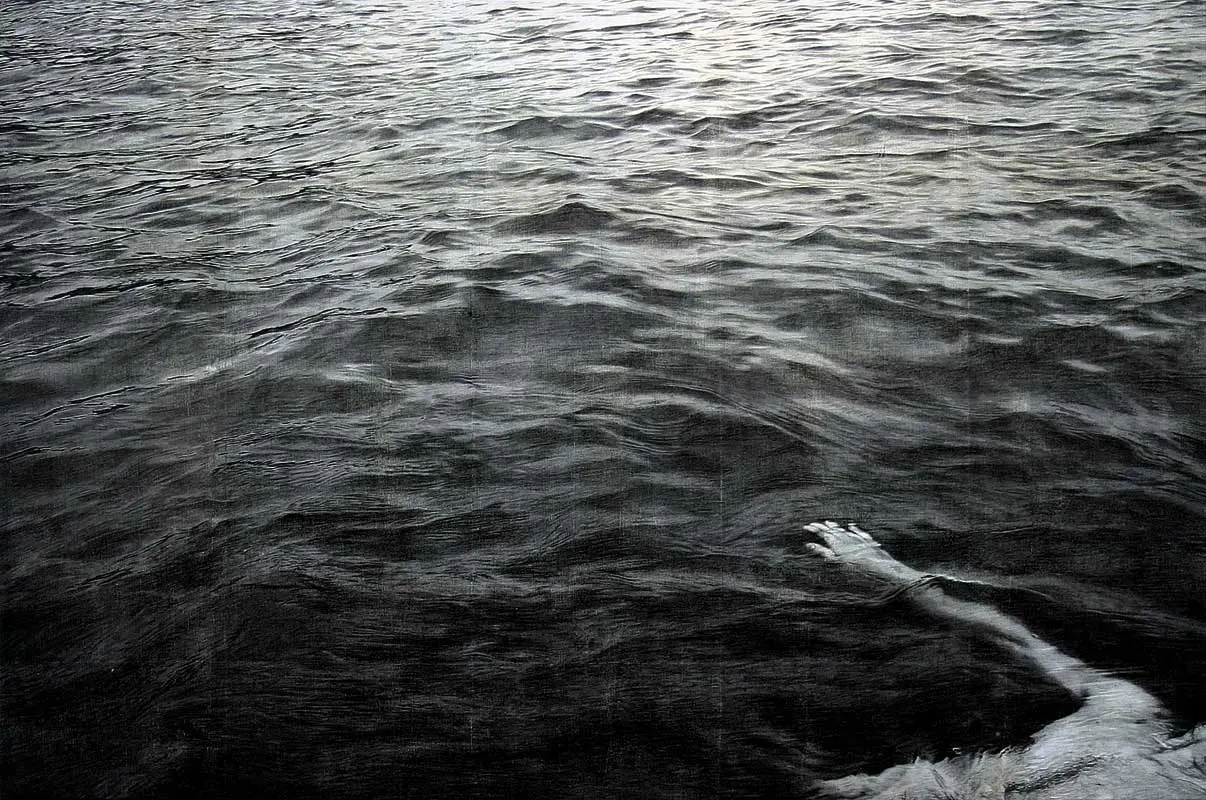
In the third drawing, there are sea waters and half the body of a man naked from the waist up, in the lower corner. We can’t see his face or his legs, and one of his arms stretches out. Again, there are no wounds or blood. The questions arise one more time: is he dead? Did he drown? Is he relaxing? The beauty of the technique deployed in the representation of water is outstanding. Obviously, technical perspicacity is an important part of Revilla’s work.
The ambivalent mystery in Revilla’s work—a person can be dead or dreaming—makes it all the more interesting. What we see is not real, it is a work of art, a creation. The artist expects a mental and visual intervention on the part of her viewers. Her art is no longer just visual, it is also mental and requires a response. A response based on the viewer’s own memory. How does the story end? The artist offers no answers. You must investigate and elucidate in order to arrive at the true answer.
The artist prepares a sketch of the work she wants to produce, takes several photographs and arranges the landscape, and later puts the photographs together following her sketch. One takes the photographs for real, and since her work resembles a photograph, one takes her work for real as well. But the work is created, imaginary, and this is what gives Revilla’s work greater interest.
In the first two works, the beauty of nature is undeniable. It is in the countryside, outside the city, where we find peace and calm. Yet, even where there is none of a city’s commotion, we do find almost criminal human interventions. The character in the first two drawings is the artist herself; these are self-portraits. The male body in the third drawing is her boyfriend. In Revilla’s work, there are no absolute answers to the question about what is happening in what we see.
Revilla tells us that she paints the mystery, because “each work is like a starting point for something that doesn’t necessarily have an end. These are images of loss, vacuums, and confusion where the body, at times dead, at times in inert or ambiguous states, appears as the container of other peoples heartbreaks, which remind us of the fragility of our own condition in the face of circumstances or events for which silence is the solely available response.” 2
Revilla’s cut-out drawings are small, they seem actually drawn until one comes closer and notices the cuts and the gaps. The subjects of these drawings are portraits, children, couples embracing, bed-ridden characters who could be very ill, dead, or dreaming, and also, as couldn’t be otherwise, scenes with people laying on the ground.
Three things are important in these drawings by Revilla: mystery, subtlety, and natural beauty. These are the artist’s tour de force.
NOTES
1. Interview with the artist, April 2010.
2. Ibid.
AUGUSTO CHIMPEN