
Remo Bianchedi (Buenos Aires, 1950) is back at the Centro Cultural Recoleta in Buenos Aires, this time to exhibit more than 300 notable pieces that confirm his mastery in the composition of powerful and unforgettable images. Owner of a vast body of work and a sharp tongue, Bianchedi is an intense storyteller who delves into certain inquiries for which an answer is not easy to find.
Paintings, drawings, and collages are part of the six mainly never-before-shown series that constitute the exhibition titled Remo Bianchedi: Trabajos 2006-2010 (Remo Bianchedi. 2006-2010 Works). Displayed in the very prominent Cronopios exhibition space, the works El Castillo de Immendorf (The Castle of Immendorf), El Señor Lafuente (Mister Lafuente), En el Observatorio del Mundo (In the Observatory of the World), Altamira, En la Otra Orilla (On the Other Edge), and Retratos del “Espíritu del Tiempo” (Portraits of the “Spirit of Time”) spin the story of Bianchedi’s confrontation with himself. The exhibition was inaugurated concurrently with the profusely illustrated book titled Yo no es Otro (I Is Not Another). It is a sort of affidavit to corroborate the visual journey on display in the exhibition. The texts by Bianchedi were extracted from several of his workbooks, components of a secret, and parallel endeavor. “They are not diaries; they are books that I personally bind. They began to be filled when I arrived in Germany, and, as more of a pocket diary, they represented a confirmation that I am alive, a type of logbook for my memories.”
The title of the volume, designed by the artist and published by the Fundación Mundo Nuevo, inverts the proclamation by Arthur Rimbaud “I is another,” a notion that has been sustained throughout the years: “I create art, I paint, because it is the place I most enjoy, where – based on the concept by Rimbaud – ‘I am another.’” After these last very introspective years, when he even played with the idea of abandoning art altogether, Bianchedi finally appears to have found himself. Having presented his first solo exhibition at the Lirolay Gallery in 1972 – and after living for many years now in exile in the silent town of Cruz Chica, in Córdoba – the artist could not resist embracing once again his artistic practice. Painting has always been an internal and historical need for Bianchedi, whether or not he exhibits or sells it.
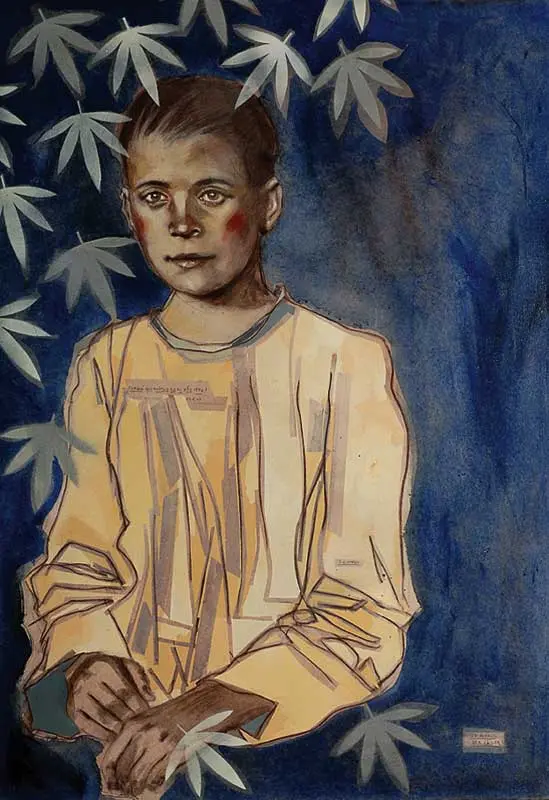
The works are even mounted on the floor, just as they were painted. This way, the viewer is forced to move around them, effectively interrupting the habitual linear progression of the gaze. The drawing and the human figure, sometimes unfinished, are at the beginning of each work, which is also populated by artistic, political, and literary allusions. Feminine profiles, penetrating faces, masculine silhouettes at rest, clippings from periodicals, transformed landscapes populated by other figures – covered in leaves and abstract designs – occupy their place across this cascade of works. One or two standing figures that occupy the center of the scene – between versatile margins – are part of the point of departure in Altamira, a work about which the artist tells us that he “will paint and hunt the bison.”
The light changes and contours are diversified in the succession of works in El Señor Lafuente, a tribute to Duchamp, about whom Bianchedi – an admirer of the French artist – has written: “I paint with my head, I think. I believe just as Duchamp did – who gave more importance to imagination than to execution – that the work of art is not solely that which one applies to a canvas, but rather, any modification perpetrated on an object.” Bianchedi usually works with what is available and through the years has developed a paradoxical style: he utilizes ephemeral materials to build a dam to protect against any losses, to rescue the memory.
A palette very much from Buenos Aires and the liberal use of corrective traces deepen the appeal of En la otra orilla, the enigma and movement of Retratos del “espíritu del tiempo”, the perturbation and meditation of En el observatorio del Mundo. Bianchedi – who had always worked with the concept of series – in El Castillo de Immendorf, he again explores the dialogue between individual and collective identity. In these works, he resumes the central thematic of the most recent years: power; violence, and death. “My visions of the Bauhaus, the Holocaust, the violent disappearance of thirty thousand people, and childhood, have authoritarianism and death in common,” Bianchedi notes. The expressions of the characters in El Castillo de Immendorf, inhabited by works of art – several of Gustav Klimt’s included – that were confiscated and burned by the Nazis in 1945 to prevent artistic treasures from falling into the hands of the Soviets, are especially unforgettable. Is it possible that even these works remember with great sorrow this great loss to humanity?
Revealing a tension between opposing forces, Bianchedi’s art appears destined to explore knowledge before creating beauty. It emerges from human traditions, breaks isolation, and moves across a penetrating emotional environment.
Remo Bianchedi: Trabajos 2006-2010 will continue to travel to other provinces throughout Argentina. The section devoted to the Castle of Immendorf will be exhibited in Germany concurrently with the Book Fair in Frankfurt, to which Argentina has been invited in honor of the Bicentennial of its Independence.
VICTORIA VERLICHAK