
This exhibition represents a turning point in the work of artist Sandra Gamarra, who has focused much of her energy and attention on questioning through her work the phenomenon of the museum. She has approached this from a different perspective than the habitual view shared by the art critics of the First World, to whom the museum is not merely a building per se, but a widespread and diversified network of spaces and teams of people specializing in conserving, exhibiting, and interpreting ancient, modern, and contemporary works of art. This network is so enormous and complex that a thesis by prominent theoretician Andreas Huyssen is right on point when it suggests that Western societies are deeply marked by a powerful trend to “the museualization of the world.” On the other hand, the museographic machinery in the Third World is much more precarious, to the point of sometimes being pathetic, as is the case of Peru – a country that despite holding its capital Lima in such high regard, does not even have a museum of contemporary art with its name. This is the reason that the installations – furniture, display cases, paintings, and objects – that Sandra Gamarra has used for years to develop her project of a Museum of Contemporary Art in Lima, do not refer to the immediate reality of a museum in the city in which the artist was born, but rather to the always unfulfilled desire to have one. In fact, hers is not an imaginary museum in the manner of André Malraux’s, as hers stands for the imaginary – and therefore additional – satisfaction of desiring a museum.
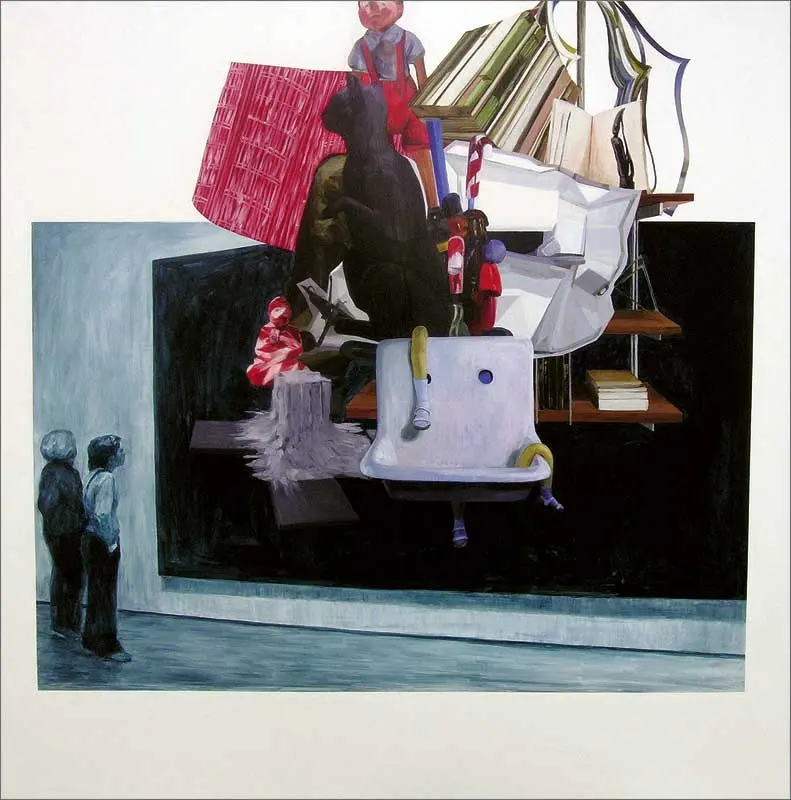
Nevertheless, the works presented in the exhibition titled En Orden de Aparición (In Order of Appearance) respond to other concerns different from those associated with her imaginary museum. But such differences do not necessarily imply a disconnect or indifference among her various preoccupations. Gamarra herself has said that she is worried that the overwhelming flow of information subjugating contemporary societies has made art lose “its proper place,” and that the works exhibited in En Orden de Aparición attempt to induce or promote the sort of reflection that museums should also be equally responsible for instilling. In an effort to introduce into the invasive contemporary flows of information, spaces for reflection equivalent to those that are or have been employed in art, Gamarra has adopted, as a norm, a procedure that consists of taking photographic images from newspapers and magazines and using them as models for the images she then paints. Such duplication is reflexive in an elemental optical sense: photography contemplates the mirror of painting and observes in it its reflection.
However, that in this game of optical duplications, Gamarra also introduces an element to make spectators notice – in a thoughtful manner – the specific difference between the photographic and the pictorial images. While hyperrealism has perennially attempted to eliminate or neutralize this difference, the artist, on the other hand, desires to achieve the opposite effect, that is, of rendering it more obvious. To do so, she utilizes the pictorial reflection to distort the photographic image that – in newspapers, magazines, and even in books – seeks technical precision and mimetic fidelity. In the works by Sandra Gamarra, the images are deliberately blurred and muddy, with a palette of subtle color changes that avoid high contrasts, as the figures depicted tend to blend with the background instead of standing out. This preponderance of stains and dark areas over the classic clarity that the line and the contrasts introduce into painting has a distant connection to the paintings by Vija Celmins, and a closer one to the works by Luc Tuymans. This approach ensures that prior to setting the image, the painting can generate a mood, an environment, or a diffuse sensation, as has been pointed out by David Cohen when he speaks about Tuymans’ paintings: “you come away from them with a generalized sensation rather than specific visual memories.” But the atmosphere – whether considered in meteorological or kinesthetic terms – is not less powerful because of its evanescence. The mood in Gamarra’s deceivingly opaque works produces very powerful and revealing effects.
In the works based on photographic reproductions of other works of art, Gamarra convincingly proposes that none of these reproductions is able to convey the same meaningful sensations achieved in the originals. In Milagros (Miracles), the autobiographical series of small-format paintings – this same reference to the mood suggests that life experiences could never be truly recorded by a photographic image.
CARLOS JIMÉNEZ