The most recent project by artist Tania Candiani (D.F., México, 1974) titled Otros Paseos. Otras Historias (Other Walks. Other Stories) subscribes to so-called Processual Art. It also leans toward the Art of Experience, as its literaturized walks with stories narrated by neighbors at the Historic Center achieve that which the Situationist International (1957-1972) regarded as the major milestone and objective for New Art: the creation of situations.
Tourism in the post-industrial era, as synonymous of travel, has its share of unpredictability – predetermined to a greater or lesser degree – although the simplest of “strolls” will always have its share of adventure and will always be a way to elicit “situations.”
Another of the great theoretical contributions of Situationism and its most complex one, Psychogeography, intended to make possible the creation of maps that would point to places or regions that would generate specific affective and aesthetic responses to aid in the creation of reliable planning.
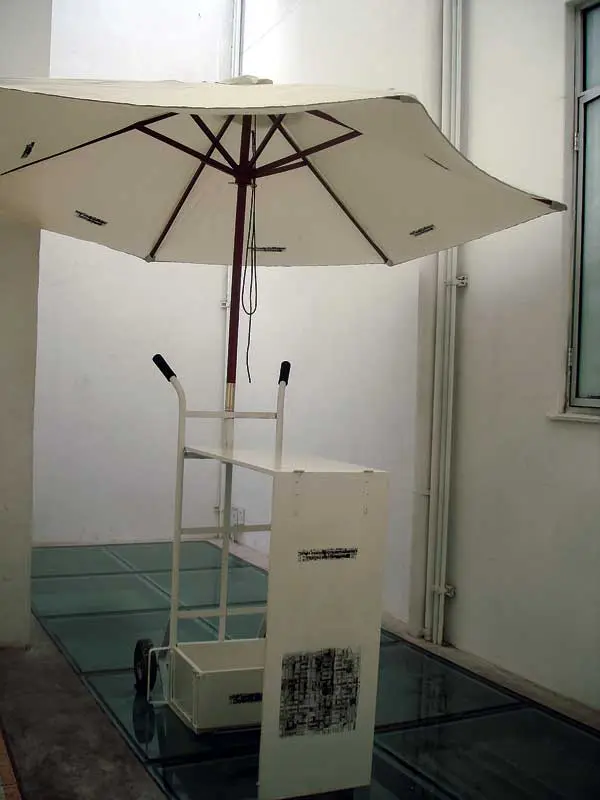
In Otros Paseos. Otras Historias, Tania Candiani sets forth a processual action developed as a project based on recollections, interviews – carried out by the artist and a team of volunteers in modules built for this purpose – and testimonies and memories by inhabitants of the Historic Center in Mexico City; thus, by means of these accounts – “other stories” – Candiani is able to establish guided walks and affective cartographies that rediscover the Center through other eyes, other gazes, and “other walks” based on intimate narratives (testimonies and memories) that unfold at the same time as that other History we all know, the Great Narration par excellence.
Relying on all these micro-stories – the rescue of the collective memory of these neighbors from the Mexico City Historic Center – the artist has envisioned a series of planned, guided walks that take into account any unforeseen chance variations as Candiani weaves an affective web of information with the stories – that will be read by the guides during the walks – gathered in interviews by the volunteers.
Candiani printed a synthesis of these stories that imitated the design on the plaques existing in the Historic Center and that are found at the places addressed in the interviews, whether this is the Cathedral, on the walls of a family business, on Turkish baths, or by El Evangelista stand – a typist working in Plaza Santo Domingo. Everything depends on which route is selected from two pre-established ones. The first begins at Regina Street, and the second, at Plaza Santo Domingo. The idea is to begin in the monumental Center and – in the midst of a process of gentrification – eventually enter into the guts of the “other” Historic Center, corners that despite being very busy, are not frequently visited by many people from the outside neighborhood, only by locals or others from outside who venture in to buy rolls of fabric – that cover the street with color – wholesale school supplies, or who just stop by to print a couple of receipts.
The walks include no more than 10 people each and are guided by volunteers trained by Candiani. These guides recount – or sometimes read – the stories deriving from the interviews carried out for a period of over one month and that were used to tailor these walks. In Lo Visible Invertido (The Visible Inverted), a piece created in 2005 for the Centro Cultural España, Candiani sewed the skyline of the Historic Center on a large fabric that covered the large windows of the building. It was an image that replicated the actual view that could be observed through these windows: domes; bell towers, and roofs of buildings.
In Otros Paseos. Otras Historias, the guided tours are woven over an enormous area that covers a predetermined perimeter of the Center, where Tania Candiani transmutes information (the inhabitants’ memories) into experiences that rely on the creation of situations, and most of all, on a narrative space that superimposes affective and anecdotal itineraries and emotional cartographies on those marked by passersby, tourists, and residents of the Historic Center.
This project’s approach is very similar to the construction of a novel conceived as the sum of many micro-stories. Its structure reminds me of Hopscotch by Julio Cortázar, or La Historia de una Escalera (The Story of a Stairway) by Perec, except that Otros Paseos. Otras Historias is written and read on foot, in walks that are the product of an affective, emotional, or aesthetic response (personal memories). The stories take the user/tourist who reads/walks them by surprise because the cartographies generated by them are rarely the same as that one possesses. As a result, the Historic Center is rediscovered through new eyes: lottery ticket vendors; entrepreneurs who have lived in the Center there for half a century, homemakers, neighborhood photographers…
In sum, Otros Paseos. Otras Historias is a psychogeographic adventure to be read; a novel of micro-stories and anecdotes to be walked.
RUBÉN BONET