City, language, and word were key concepts in VÄLPARAÍSO INterVENCIONES, a contemporary art show held between March and April in streets, squares, legacy buildings, hills, elevators, docks, and art galleries in this port city. It encompassed 24 projects created by artists from Latin America and Spain, invited by the latter nation’s government and that of Chile as part of the 5th Congreso Internacional de la Lengua Española. The idea was to duplicate the format of Cart[ajena], a meeting held during the 2007 Congreso in Cartagena de Indias, Colombia, where artists traveled to the site and remained there, absorbing the place in order to produce new works or adapt existing ones.
The project’s very title, VÄLPARAÍSO INterVENCIONES, proposed playing with axial concepts by using an umlaut, an old poetic resource that gives the term a double meaning, reading “va al paraíso” (“goes to Paradise”). It was a matter of creating a neologism and also of thinking of the city as a language to be deciphered, translated, and interpreted by artists.
Curated by José Roca (Colombia), Jorge Díez (Spain), and Paulina Varas (Chile), the investigations, processes, and practices carried forward by artists such as Priscilla Monge, Esther Ferrer, Rafael Lozano-Hemmer, Catalina Parra, and Fernando Prats, among a group of some thirty in total, had to become intimately connected to the environment. The proposal was not after identifying tendencies. However, this modus operandi reflected an intention that is manifested in a large sector of the international at scene, in biennials, residential programs, and artists with both an ethical and aesthetic sense, who—moving outside gallery and museum spaces—attempt to reactivate their own works in relation to their contexts, with works that explore the potentials, weaknesses, and fissures of systems.
Vaparaíso, Chile, is an enigmatic and seductive city, declared Patrimony of Humanity in 2003. Its buildings rise before the sea, hanging from hills, in labyrinthine streets and unsuspected corners, guarding stories of splendor and glory as well as tragedy and poverty. Diving into Valparaiso—as the curators wanted, “activating different imaginaries about the place”—implied disentangling these favors, aromas, and pains with artists of international stature, who touched on every possible aspect, even actively convoking groups of neighbors and stirring up old conflicts with power. The show, thus, could not avoid poetry and a political/social bias; it couldn’t skirt the circumstances that impacted the mounting of the works, either: the February 27th, early-morning earthquake in Chile.
The show was to be inaugurated precisely on the day after, with a series of performances and the presence of Ángeles González-Sinde, Spain’s Minister of Culture, and her Chilean counterpart at the time, Paulina Urrutia. After the catastrophe, which affected this city but was mostly concentrated in the south of the country, the V CILE was suspended. Only the exhibition itself carried on, thanks to the character of the proposals it contained, not so much precarious as they were simple. The project lowered its profile and also became a dearly austere tour; a walking expedition that—as one went looking for the artwork—trained the gaze on certain Valparaiso landmarks. On an east-west axis, in parallel to the bay, mostly through the city’s historic downtown, the show allowed us to rediscover the lace in its strength and fragility. And also the works, with their poetic force on the verge of vanishing.
This character of the circuit was also due to the art’s work with language and words: the language of art, once again breaking the notion of the work of art as a negotiable object, suspending contemplation on the ephemeral and the enigma, in proposals that appeared rather as aesthetic/conceptual gestures and at times mixed into everyday traffic and the city’s own visual landscape.
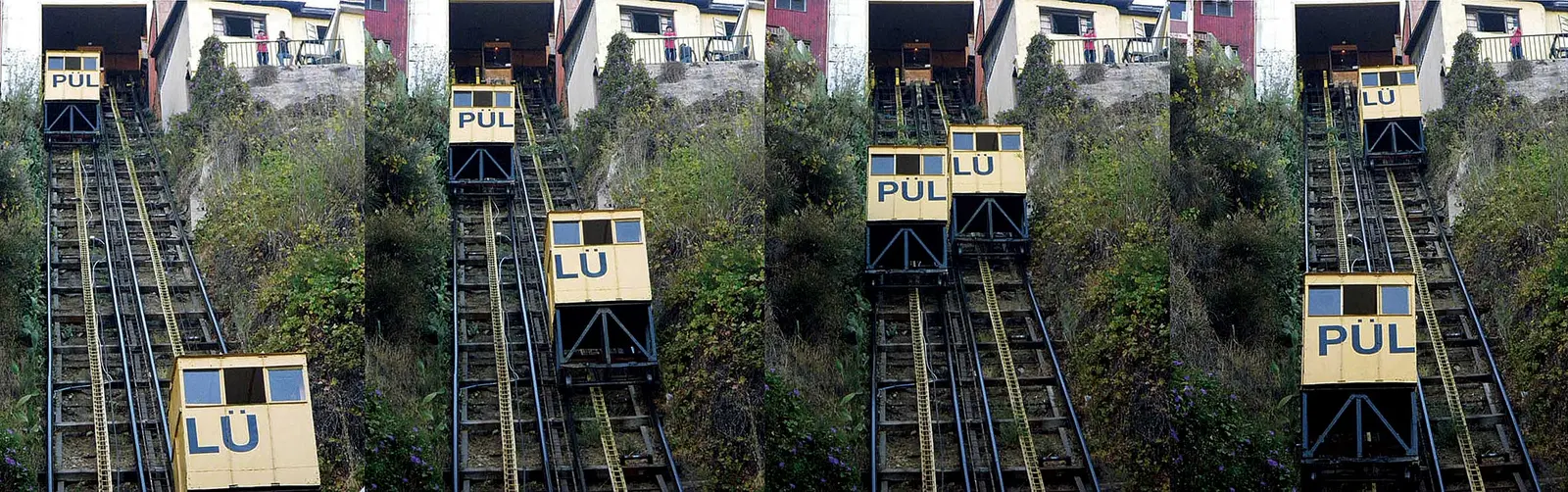
I am thinking, for example, of part of Argentinean artist Tamara Stuby’s project, which consisted in writing “Si el tiempo no fuera dinero, no podrías desperdiciarlo” (“If time weren’t money, you couldn’t be wasting it”) in certain corners of public squares. The other patty of her proposal was more visible: a floating square in the ocean. Or in Chile’s Catalina Parra’s La Araucana which took two Cantos from Alonso de Ercilla’s Sixteenth-century poem and projected them onto the La Matriz church. This intervention happened on the show’s last days. The rest of the time her work was limited to some postcards and posters combining both elements, arranged for the public to take away mainly in the galleries participating in the exhibition. I am also thinking of Ampin. Habitar la palabra, by Sitezise, a Spanish duo that —based on that Mapuche word that means “to give medicine”; “to cure”; “to make the soul speak”— places texts on the elevators used in some of the city’s surrounding hills, reflections that mixed into the landscape like the advertisements on billboards and walls.
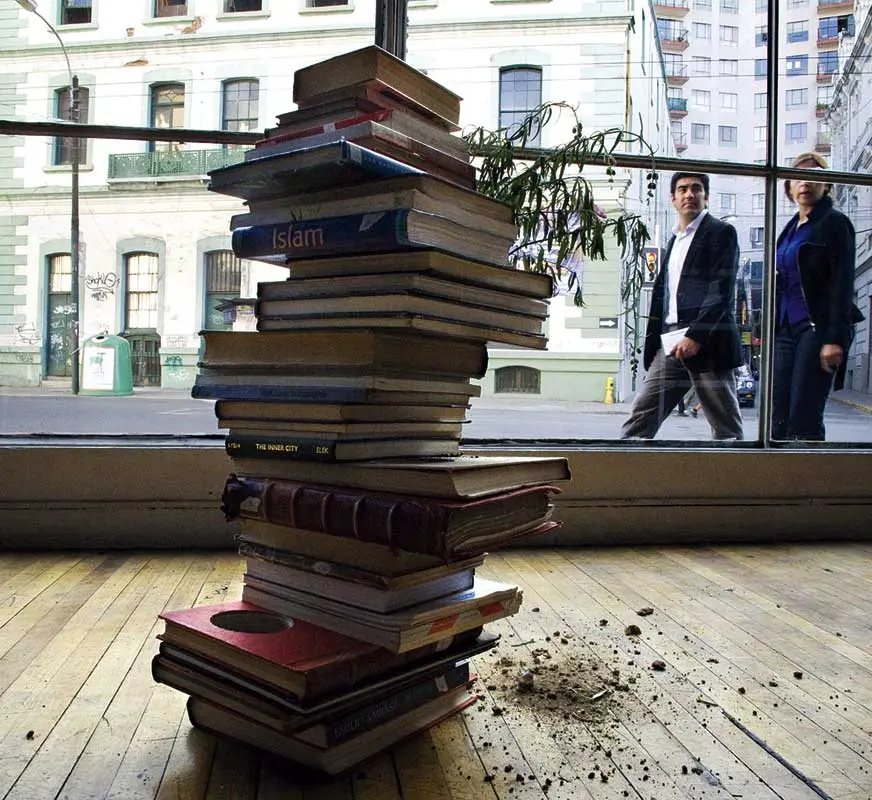
One had to traverse the city in a certain state of awareness in order to discover these interventions. One had to be living in Valparaiso perhaps, inhabiting its spaces, in order to discover certain changes in its urban landscape.
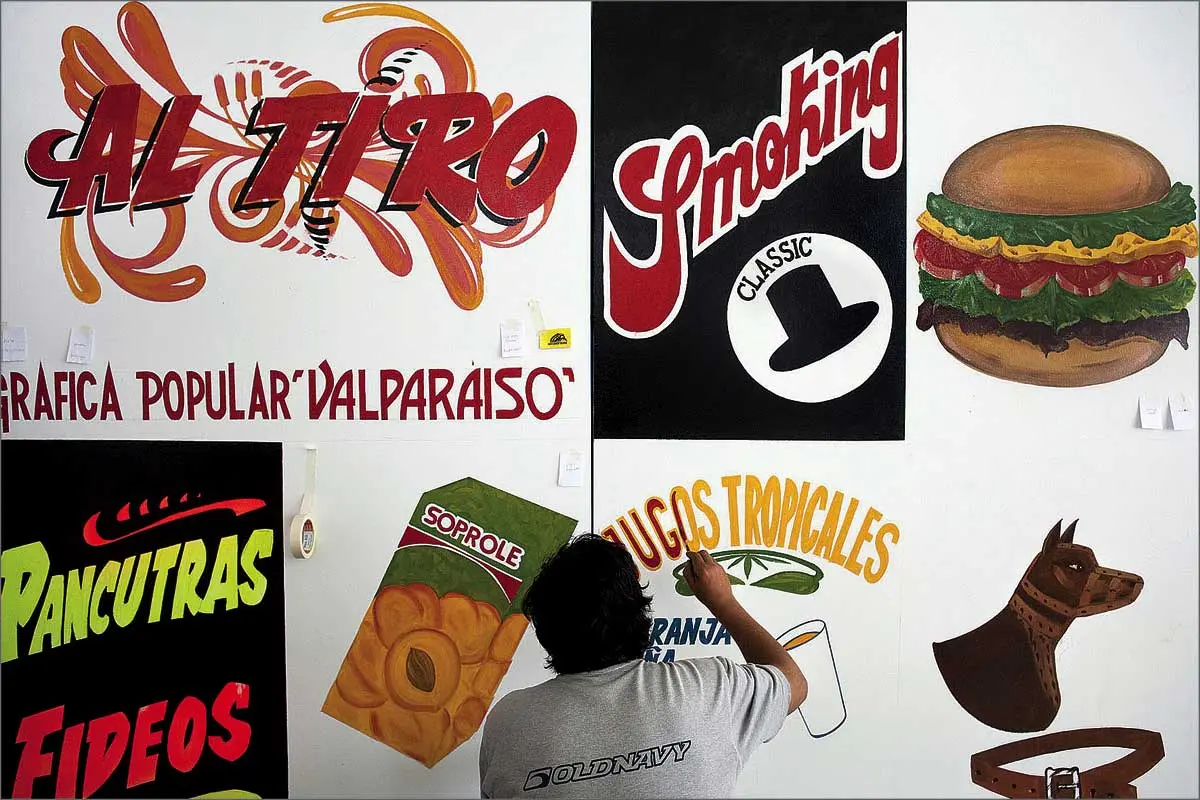
The notion of the work of art as a spectacle was suppressed in the use of letter and text as habitual elements. La más bella por los pelos, by the Spanish collective La Más Bella, was thus placed in a library that functions from the underground level of a cafeteria: with print materials, pamphlets, and a series of hats that carried, in small pockets, publications and souvenirs, artistic collaborations—conceptual and of all kinds—that reflected on and made poetry from the word pelo (“hair”), generating a sensation of unstable time that was perceived in Chile. It was a limited edition of an experimental magazine. Colombia’s Populardelujo, on its part, worked with billboard and sign painters, recreating the gaudily colorful that tends to capture our attention in the street, and taking this work Al tiro. Gráfica popular de Valparaíso, to the El Farol gallery.
The letter as image and concept, as aesthetic ad even beautiful element, was confronted at Puntángeles Gallery through Tipos falsos were Luis Romero (Venezuela) re-edited his Tipos móviles, presented at Carta[jena] and other places. The artist made posters of each letter of a woodblock moveable type no longer in use, and the public was able to manipulate them to build sentences on the wall.
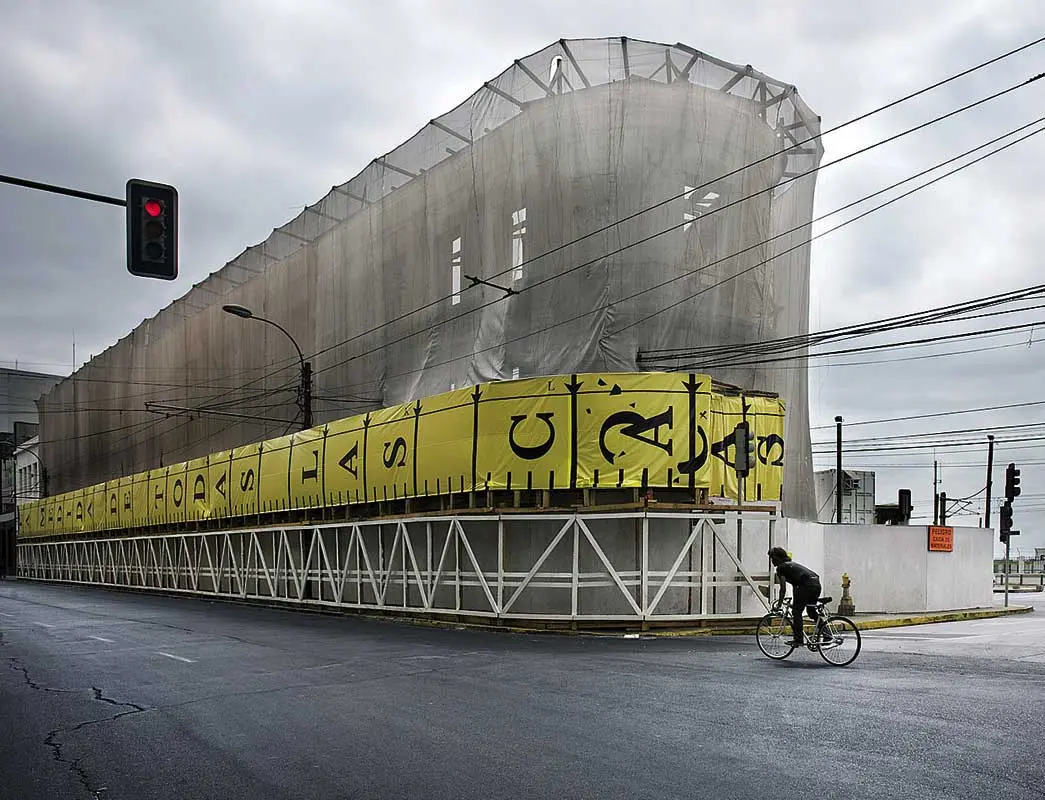
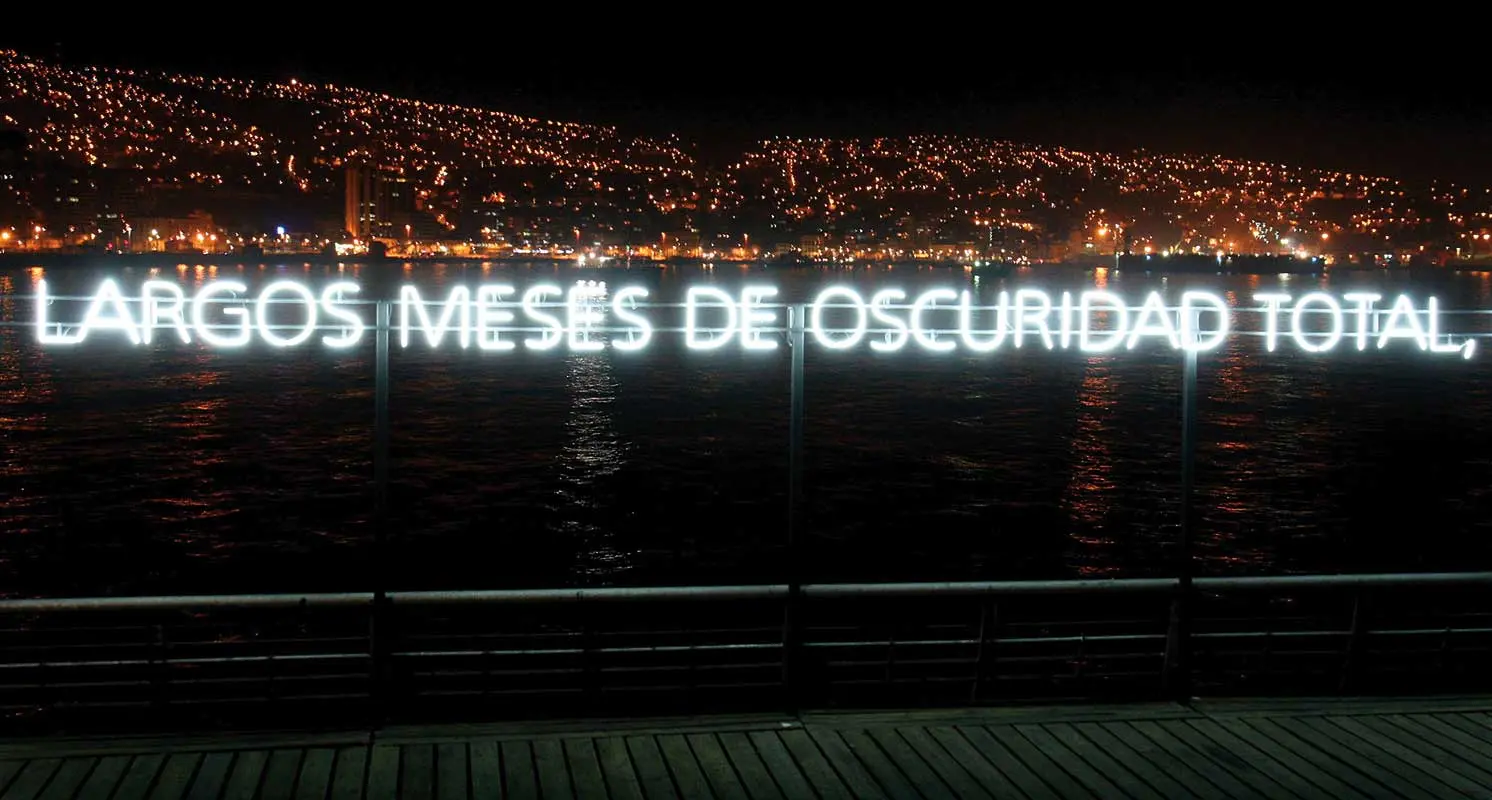
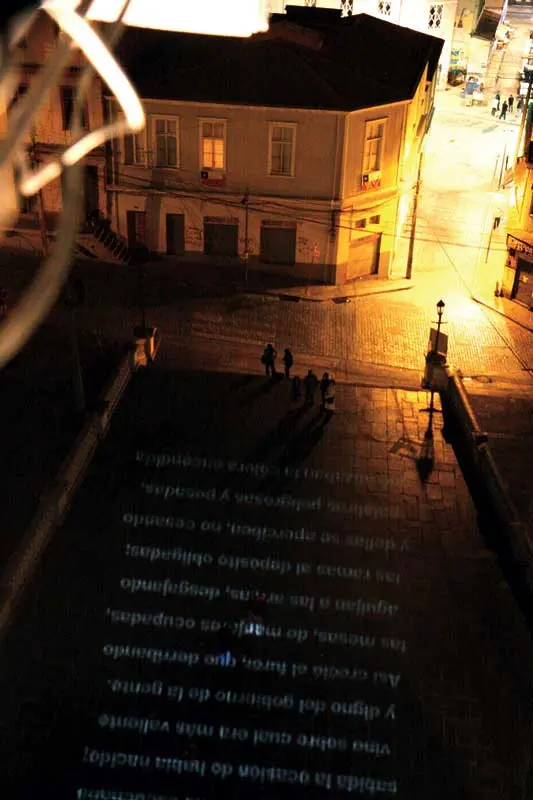
Signs and billboards acquired greater stage presence in Chilean artist Fernando Prats’ Gran sur light letters around the Barón docks, and Spain’s Juan López’s Supr, which covered the Cousiño palace.
Urban sounds and narrative also had their expression, through Chilean artist Cristián Silva’s Perifoneo, which drove through streets and hills on a van with a megaphone broadcasting fragments of interviews, confessions, letters, and discourses of actors in several parties active in political life between 1969 and 1990. The audiovisual record was on exhibit at El Farol. In galleries of the Consejo de la Cultura y las Artes, Cecilia Monge (Costa Rica) presented testimonies of people who had suffered through the suicide of a family member in La Piedra Feliz, an area of Valparaiso. In the video, silence, and whispers dressed hurting in subtlety. Esther Ferrer (Spain) worked with stories of port denizens in the collective performance Les voy a contar mi vida, situated in a public square.
The voice of the people also had a participant role though El contrapunto del arte, where Humberto Vélez (Panama) convoked community storytellers, poets, and singers to a concert of improvisations dealing with topics related to art and the word. In Orgullo popular, Vélez invited Valparaiso’s 42 hills to a competition of representative seals that derived into a show of objects with the graphic proposals printed on them, at the gallery of the DUC Centro de Estudios para el Desarrollo Urbano Contemporáneo.
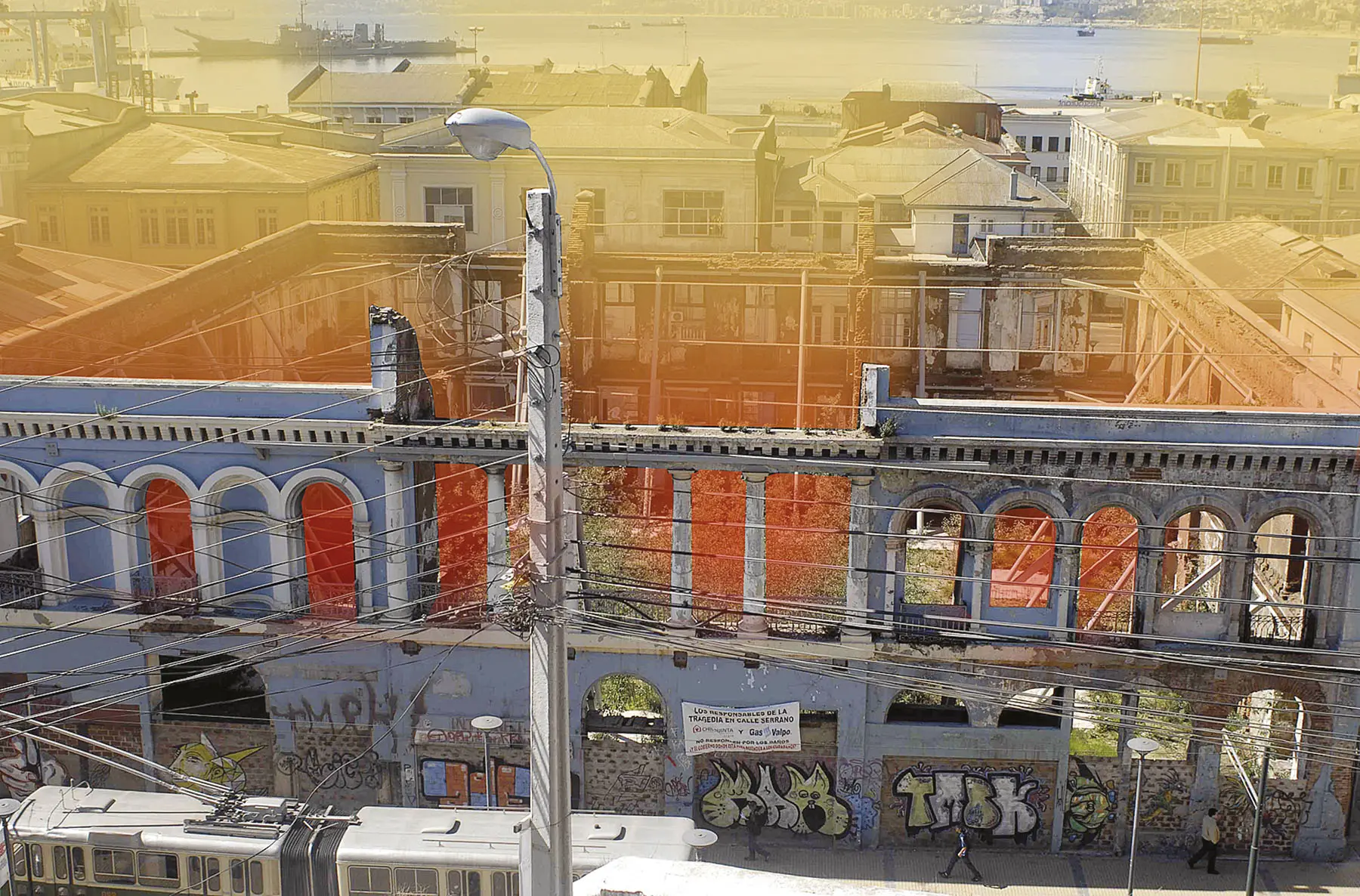
In some works, the city was re-signified on the basis of interventions that played with its architecture and order. This is what happened with Estado vegetal, a light-based intervention on the abandoned ruins of the imposing Subercaseaux building, where Valparaiso artist Guisela Munita pointed out an anomalous space in a sector that has been declared Patrimony of Humanity, like a mute ghost. Or in Estructura plaza, by Ricardo Basbaum (Brazil), which proposed a new meeting space by installing a series of modules, in a concrete-geometric tone, by way of benches and as a break in the normal path of Lord Cochrane square.
In other proposals, Valparaiso was tensed with faraway territories and cities, the contexts of the artist’s own origin. This is what Carmen Nogueira (Spain) did in Porteños, an audiovisual work about her own port city, Vigo, with which she intervened the Museo Naval. Or Rafael Lozano-Hemmer (Mexico), who in Voz alta, the record of a light-based intervention commemorating the 40th anniversary of October 2, 1968, Tlatelolco student massacre in Mexico City, invited passers-by to tell their experience of the event.
The word appeared and fluttered away in the midst of the city’s (visual) noise, in the pathway of a city where so many voices have appropriated walls with graffiti, posters, advertisements, and scratchings that press their own call of our attention. The word attempts to stop the gaze, becoming an open and aesthetic space of reflection and participation. The show propitiated this experience, activating at the same time the streets as a necessary site for art, especially in a locality that is in cultural and social upheaval and suffers from a scarcity of spaces for contemporary art and collective expression. The word as artistic element in the context of the city’s port salvaged its potential to generate new orders, as a creative act, as poetry and as an expression of the social pulse.
CAROLINA LARA B.