
Waltercio Caldas’ nine works on view at the Christopher Grimes Gallery contain contradictions on every level. Formally, they alternate between sculpted drawings and framed still life assemblages, as they are neither strictly two-dimensional nor three-dimensional. Every piece is composed of a number of materials traditional to fine art production, such as acrylic paint, ink, and/or heavy paper, along with industrially manufactured stainless steel rods, and/or domestic items like woolen yarn and pins. While each object is made of a combination of parts, it is delicate, yet sturdy, and invites the viewer in to contemplate its many components. Thus Caldas’ works not only challenge hierarchies inherent to artistic production but also question the spectator’s relationship to art more generally.
Three large-scale installations incorporate the walls and space of the gallery. In Wing (2008) five stainless steel rings project out from the wall, at varying heights, resembling small-scale basketball hoops without the nets. The hoops are all linked to one another by a piece of pink yarn that guides the viewer’s gaze from one to the next. A horizontal pink dash is painted on the wall above or below the steel apparatus and conveys motion, mirrored by the sharp horizontal orientation of the yarn. While the emphasis on geometric shapes and industrial material is reminiscent of concrete Brazilian art—the incorporation of the yarn and the three-dimensional composition shares more in common with the Neo-Concrete practices Caldas is often associated with. In fact, the very shape of the steel hoops simulates those used in sporting events, which allows for the viewer to relate to the work in a very corporeal way—a key concern to have grown out of Neo-Concrete artistic production.
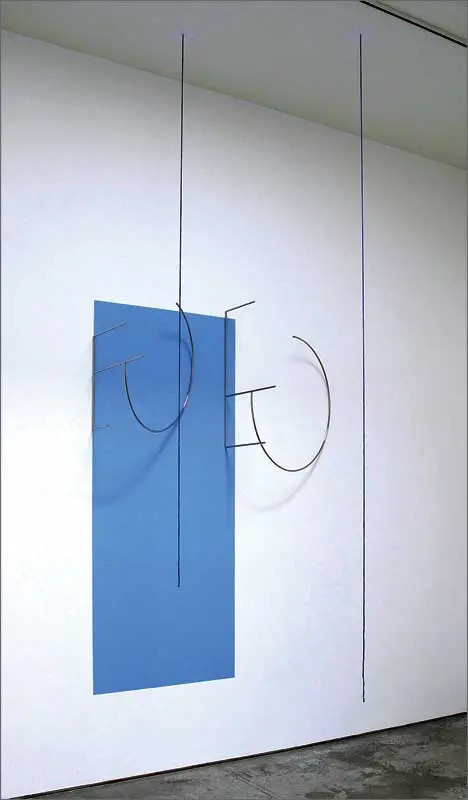
The installation A Greek Day (2007) can be described as a line drawing executed in three-dimensions. A turquoise rectangle is painted directly on the wall marking the space traditionally occupied by a painting. Yet, the only other painted component of the work are two small faint blue squares located on the ceiling, and hanging from each is a long piece of blue yarn. The delicate and limber yarn dangles before the turquoise square in sharp contrast to two stainless steel E and circular shaped formations that project from its surface. The composition vaguely resembles equipment found in a gymnasium—the steel formations again look like hoops, and the yarn, ropes. Guy Brett has observed, “Caldas’ objects are ‘thought’ objects. They tend to open a gulf between what you see or touch, and what you think, which can be vertiginous."1 In regards to A Greek Day, one cannot deny the desire to interact or play with the work, however, it is too fragile and remains a sculpture to be observed.
Shade (2009) and Dinamo (2009), two sculptural forms comprised of stainless steel rods and a black granite sphere (the size of a billiard ball) affixed to its surface, are mounted to the wall and a base, respectively. The ball on each appears as though it could roll along the surface of the rods, yet it is held firmly in place. In Shade, a single piece of pink yarn winds its way around the work, heightening the sense of motion. Contradictions exist between motion and stasis and the natural granite, polished to look artificial, and the industrial stainless steel rods, which reflect the natural world on its surface.
Four framed works appear as enclosed still lifes, as opposed to traditional mimetic drawings of objects. In Drawing 1 (2009) two outlined diamond shapes, one red and one black, intersect. In the top point of each, Caldas has placed a pin with a round cap in the same color as the diamond. Evoking the nail painted on the surface of cubist paintings to produce a trompe l’oeil, and emphasize the two-dimensionality of the work’s surface, the actual pins, and their shadows have been included, making the work three-dimensional and non-illusionistic. However, the work is framed so that upon initial inspection it appears as though the pins and their shadows are drawn. The word “simple” written above the two push pins, challenging the seemingly simple composition of the work.
Drawing 4 (2009), a small horizontal composition of rectangular forms and an oblong bowling pin-shape, cut out of cardstock and painted beige, occupies the center of a white sheet of paper. The small composition is three-dimensional and again breaks with what is expected of a traditional still-life drawing. Two small orange dots bring color into the otherwise monochromatic composition. Caldas often incorporates small intrusions of non-representational color in his objects to question the function of color in a work of art.2
In all of the works on view, Caldas combines disparate media and forms to produce work that ruptures with traditionally defined categories. Yet each work is poetic and invites the viewer in for further inspection. Caldas’ objects compel the spectator to rethink his or her own expectations for and relationship to a work of art.
NOTES
1. Guy Brett, “Waltercio Caldas,” Transcontinental: Nine Latin American Artists (London and New York: Verso, 1990), 70.
2. Waltercio Caldas, Black Series, Opening Reception July 16, 2005, with an Interview with Gary Garrels, DVD, produced by the Christopher Grimes Gallery (Santa Monica, CA: Christopher Grimes Gallery, 2005).
BETH ROSENBLUM