
In Salvadorian artist Walterio Iraheta’s photographs, shoes cease to be everyday items and become iconographic signs or symbols with personalities of their own. The pictures in his portfolio titled My Feet are my Wings, which concentrate on images of footwear, mostly white shoes, is remarkable for its sense of harmony, its visual drama, and its narrative content.
In the stories that these photos embody, shoes—worn, fixed, arranged in order, or dumped—are the main characters. The image of a lady’s single white boot lying among rumpled sheets in Preludio (Prelude) awakens thoughts of romantic experiences. The large mass of shoe soles pointing in the same direction in Cementerio de zapatos (Shoe Cemetery) brings to mind ideas about people marching together for a cause. Iraheta offers a plethora of possibilities for the imagination by representing humanity through their old shoes: one envisions men, women, and children, whole families, lovers, the living and the dead, people known and anonymous, commemorated or forgotten.
Moreover, Ireheta pays homage to art history and to great artists like Marcel Duchamp (two boots on a green field) or René Magritte (this is not a boot against a blue sky). The torn soles, the worn leather, and the tongue sticking out of Zapatos rojos (Red Shoes) inevitably remind us of Vincent Van Gogh’s paintings of tattered boots in which the artist echoed the hard life of the poorer classes. Closer to our own region and time, Iraheta shows sensibility for the history of Central America in compositions such as Zapatos encontrados (Found Shoes), which resembles an archeological showcase of objects unearthed from a mass grave. His invitation to reconstruct history is both powerful and persuasive.
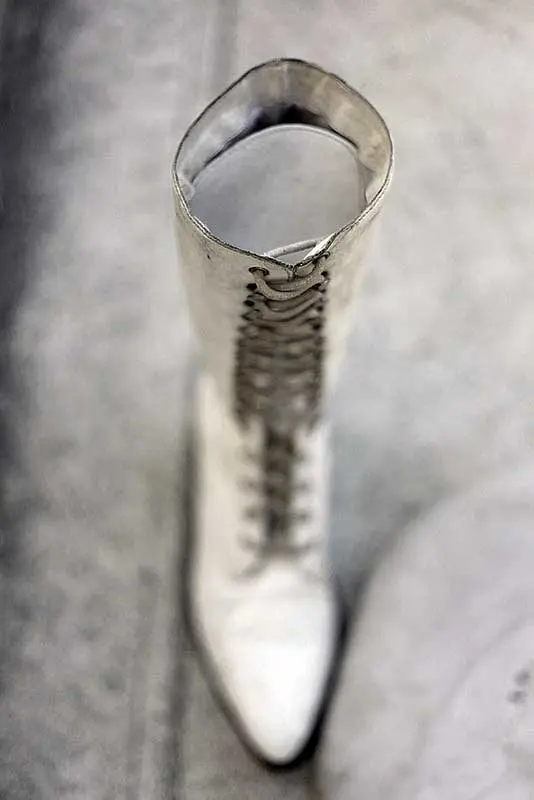
Just as some stories make us uneasy, other photographs offer a sense of balance. In Mandala, the monochrome and essential geometric structure of a circle of white shoes bears resemblance to a garden for meditation. On the other hand, his photograph Jardín (Garden), in which shoes are scattered arbitrarily over a gray surface, suggests the idea of order within chaos and conveys a feeling of freedom, or even fun. The solitary object in Bota (Boot), dramatically lit from above, is more closely linked to the traditional Freudian symbolism of shoes as vessels for feet; as the object of sexual fetishism.
It’s easy to get carried away by the wide variety of associations Iraheta’s photos suggest. However, this is only possible for the observer because his techniques and presentation are so impeccable that they become imperceptible. There are no messy details to distract us from the image, whose balanced and traditional compositions offer a base for the flight of the imagination. It is not a coincidence that Iraheta was initially known for his paintings and mixed media works of nostalgic images that straddled the line between realism and surrealism.
Iraheta, who first studied at the National Arts Center in San Salvador, has gone through a process which began with traditional techniques, but continuously expanded to include any technique or material in the creation of artworks. His past exhibitions provide multiple examples, such as his « constellations » of discarded bottle caps; the objects and installations in his Kriptonita (Kryptonite) series that included meetings between Superman and the Virgin Mary; and his photographic and video series titled Landschaft in which he used networks of electric cables to represent the contemporary landscape and our urban reality. As a creator, he is constantly moving towards new languages and topics, passing from one to another without losing his way in the search for aesthetic results. At times, however, his choices come dangerously (and consciously) close to being too kitschy, or he seems unnecessarily reticent to break with convention, in an effort to preserve a traditional sense of visual structure, and the sort of perfectionism and appreciation for detail that has characterized him as a draftsman.
What remains unchanged is the direct and enriching conversation Iraheta achieves between his work and its viewers. There are moments of mockery and humor, or of social consciousness, as well as more intimate passages related to love and memory. In some pieces, the focus is on himself as the subject, a natural consequence of the self-referentiality apparent in all of his oeuvre. In this exhibition titled My Feet are my wings, there are no images of anatomical parts or winged figures, but the references are clear. Although they are not depicted, we are reminded that our feet provide us with the support as well as transportation, that shoes can pressure us but also give us freedom, and that, in many cases, they are left behind as proof of our passage through life.
MÓNICA E. KUPFER