
The new series by Alexander Apóstol titled Ensayando la Postura Nacional is undoubtedly a creative turn in his steady artistic career. For this series, he used photography and video to create works that are presented as a film set. Beyond any formal concerns, they represent an excellent synthesis of the entirety of his previous work: gender issues; sexual stereotypes; modern architecture, and his project associated with the utopias of the new Latin American republics – particularly the nationalist projects that have constituted a vision of Venezuela today. Apóstol’s impeccable photographic shots convey racial and physical ideals framed by the scenography of 1950s building architecture. The irony is refined, as the artist synthesizes, in the photographic plane, the frustrated, pro-independent ideals adopted by modern dictatorial discourses –from both the right and the left– within the very context of modernity: architecture.
Ensayando la Postura Nacional originates in the “essence of the Venezuelan” paradigm. It appropriates allegories represented in murals created by official Venezuelan painter Pedro Centeno-Vallenilla in government buildings during Marco Pérez-Jiménez’s dictatorial regime (1952-1958). The interior of a modern mansion of the same historical period, Apóstol “recreates” sections of allegorical paintings that center on the myths surrounding the birth of the nation: the reception of the coat of arms emblems; the image of national hero Simón Bolívar; various mythical characters; the representation of the races, and the –latent– fertilization between male and female nudes from working-class sectors that belong to the Venezuela of today.
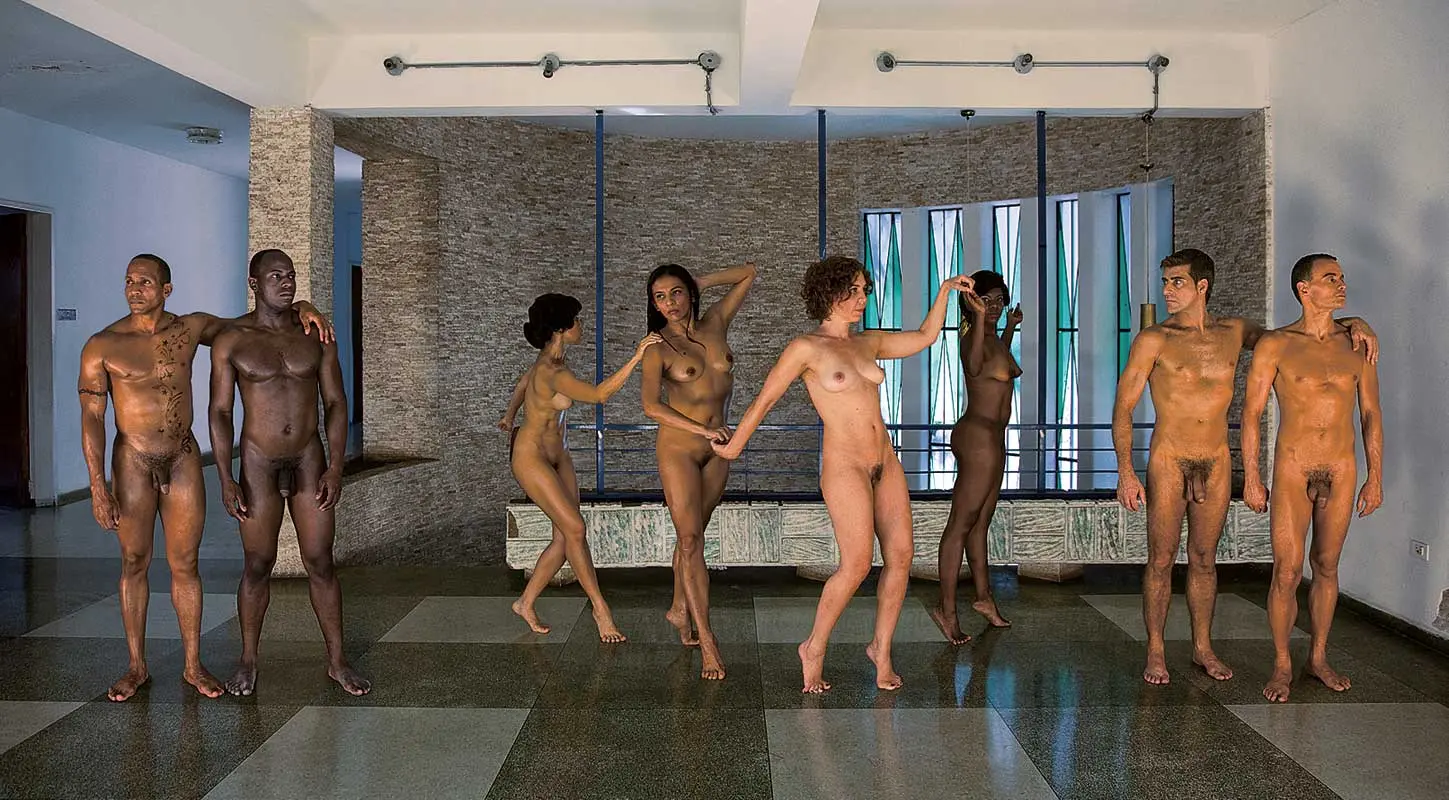
Apóstol utilizes photography as a complex representational system that decontextualizes allegorical symbols from their original source and, without losing their significance, transplants them into the present historical context. Without renouncing to its original pictorial cast, the allegory embodies, in the subjects portrayed, highly idealized and overt notions –previously camouflaged– of a human body charged with unequivocal sexuality. The artist relies on the same pictorial referents employed by Centeno-Vallenilla to point out to what was hidden in these, underneath the apparently non-ideological and idealist discourse of that period: namely, the blind adoration of over-exalted masculinity set in contrast to the “typical femininity” associated to the myths of fertilization and the land.
Architecture included, every representational system hides an ideology. In photography, the interiors are also part of the scenography, as is the iconography that the pictures attempt to identify. The “lack of decorations” and the clarity of the environments, typical of 1950s modernity, are depicted in contrast to the grandiosity and pomposity of the characters that inhabit it. In the photograph titled La Nación (The Nation) –whose referent is a section of the mural Venezuela Recibiendo los Emblemas del Escudo Nacional– Apóstol uses a woman to symbolize the motherland, just as in the work by Centeno-Vallenilla. At the top of the stairs appears the stereotype of the Latina model –projected internationally by the Miss Universe Pageant. The feminine perfection in this notion of ethnic beauty finds its counterpart in the ideal “macho” Latino with a strong frame– who in other photographs appears naked, exhibiting his musculature and his large genitals, very much in the manner of the classic homoerotic images by Robert Mapplethorpe. Next to the women, there is an Indian wearing his typical headdress, and on the other side of the image, we find national hero Simón Bolivar in his emblematic uniform. This is an ideal of a nation built within a modern project that Apóstol sees as an “outdated context aligned to the right-wing nationalism responsible for the entirety of Venezuela's modern process. Modernity that was not necessarily brought forward by ideas, but by a checkbook (oil) that enabled a modern infrastructure to be established, even within an antipodal context.”
As the stage for allegories and appropriations of simulated modernity, the architecture reinforces the failure of the “ideal” –as does the other ideal of the perfect races in Venezuela– by showing the erosion and neglect that surrounds the most beautiful and perfect masculine bodies. The second critique by Apóstol is evidenced in the 16-mm film that gives the exhibition its name, Ensayando la Postura Nacional. There, the figures that appear in the painting La Fecundación (The Fertilization) are transferred to the scenery of a modern lobby with distinctive palm trees in large pots. Individuals from various ethnic groups– that would eventually procreate to yield the perfect Venezuelan race –strike poses in the instability of a dance frozen in time by the brush. They are a group of stereotyped black, white, and mestizo nudes who in the filmed version can barely maintain their national “posture,” as occurs in the political life of Venezuela, past and present.
DERMIS PÉREZ LEÓN