
Alexandre Arrechea’s productions and ideas over these past few years accept, create and critically reveal a world where normalcy is a matter of shifting and multiple identities. Ideas are layered such that the deeper you look the more you realize. Literalness is not so much elided as it is both the starting and return point. As usual, architecture is the key that opens the most, but not all, doors.
On the literal level, the exhibition has two types of new work that begin with known objects in the world. The most physically impressive are two large (13 and 7 feet high) spinning tops based on children’s toys. They are made of wood and resin but topped (pardon the pun!) with waterjet-cut and painted aluminum replicas of well-known buildings from Havana, whose names you need to know; the Bacardi Building on one and the Someillan on the other. On the surrounding walls, an installation made possible and spacious by the new and vastly larger gallery of MagnanMetz, are Arrechea’s drawings, his usual source for his ideas, of tops with buildings but now also referred to as “dancing” to emphasize not only the joyful play of dancing tops but of social motion.
Few visitors realize that the metal tip of the 13 foot Bacardi top allows it to spin (dance) and even fewer tried it. The physical balance was exact because Arrechea had the master top maker from Omaha, Nebraska, Alan Gray, make them. Conceptually they had to spin and dance because Arrechea’s world view does. What do I mean by that? After all, isn’t this humorous child’s play? Not only! His address is to shifting, public systems of power in motion, where nothing stands alone.
Architecture remains a pivot for Arrechea because it is lived history in frozen yet ever changing form. As the US and Cuba now begin to eye each another anew on the dance floor, its complex history is brought back into view through Arrechea’s play and little is more telling than the connection between the buildings he chose and the changing historical meanings too complex to develop in detail. But a brief summary gives some clue.
Bacardi rum was founded by a Spanish family whose members were jailed for supporting the late 19th independence movement in Cuba, and were early supporters of Castro and the revolution. Prospering as good capitalists during the US occupation after the Spanish-American War, the family built their beautiful Art Deco Bacardi building in the 1920s and became an international symbol of hip Havana well into the 1950s. But by this time they had removed most of their assets to other countries and eventually used their money and contacts with the CIA to support exile conflict with the Castro regime and helped write the 1996 extension of the embargo against Cuba (the Helms-Burton Act condemned by most U.S. allies) while winning suits in the US to assure trademark protection. Although no Bacardi drinks or business ties exist in Cuba, they have reintroduced their connections to Cuba in the late 1990s via false labeling and reviving the older name of the rum and coke drink, Cuba Libre, apparently with no sense of irony.
Lawsuits and counter-suits abound across the world in this floating game of money and power tied to the identities referenced here.
Similarly, the concrete high rise of the Someillan built in the 1950s as the first modern condo in post-revolutionary Cuba has changed meaning several times, signifying post-revolutionary exuberance by upper classes merged with the name of a Cuban naturalized US citizen (Luis Someillan) imprisoned around the time of José Martí as an agent for the junta opposed to Spanish occupation. Then came the building’s decay as symbol of revolutionary failure, and now, after the 1990s restoration on the waterfront of Havana, a bit of both, depending on where you look.
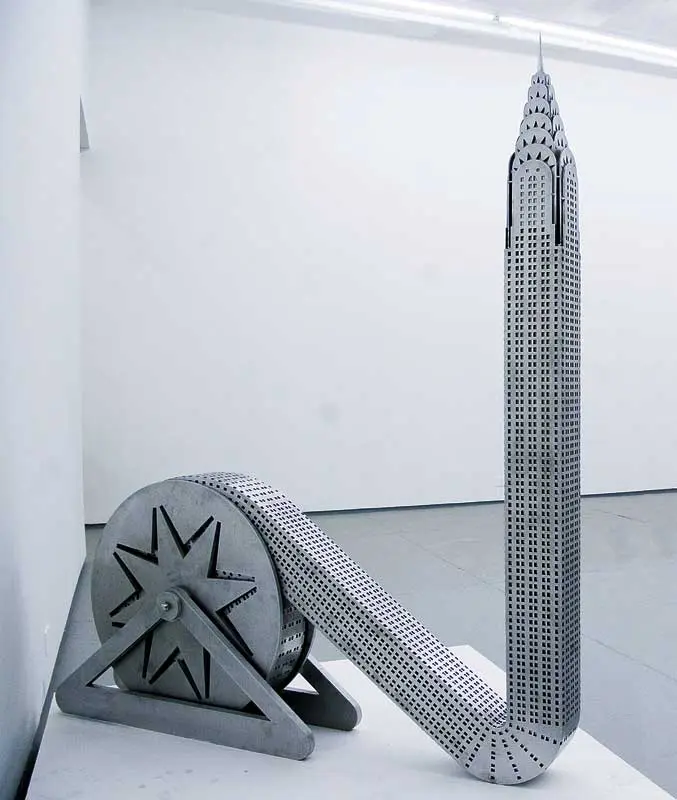
A similar approach is invested in the second type of new art forms found here, metal reproductions of well-known buildings, whose lower sections are now coiled up on replicas of fire hose spools and looking like cartoon characters. Two of the New York “elastic” buildings—the Metropolitan Life Insurance and Chrysler buildings—were developed in their time as signifiers for corporate wealth and prestige as they competed at various times to be (and were) the tallest skyscrapers in NYC. Plotting their histories is equally fascinating, and linked to Arrechea’s concept of buildings, or the material world in general, that expand in prosperous times and shrink during market blowouts.
It’s not only children and artists that play.
RICHARD LESLIE