In this biennial, the visual arts offer a clear, critical, reflective, and hopeful vision titled The Nature of Things reflecting problems, exposing dangers, and explaining the need to generate new avenues for their solution. The exhibition is part of a cycle encompassing education, philanthropy, women as drivers of a new economy, health, the reduction of poverty, a sustainable economy, energy and climate change, political meetings, and other activities. How can an art exhibition cover so many topics without overwhelming the visitor? In a dialog with curator Paola Santoscoy, we learn that in the scarce five months she had to work, she put together an advisory team with María del Carmen Carrión for the visual arts and Lauren Higgins for the conversations between public and artists. Her first curatorial selection was based on artists she was already familiar with; she knew that she couldn’t exhaust all the topics or all the countries; she considered the necessary space for each work and for the public to visit them; and reflected about other institutions in the city, deciding that she didn’t want to repeat or compete with what was on offer. In a time dominated by a cult of success and the start system, The Nature of Things mainly invites us to look at the works, their contents, and proposals, not at the famous signatures in them. As if these two generations—to which the city government also belongs—were working on the issues with great economy of means, without artifice, and connecting the sciences, the arts, and technology.
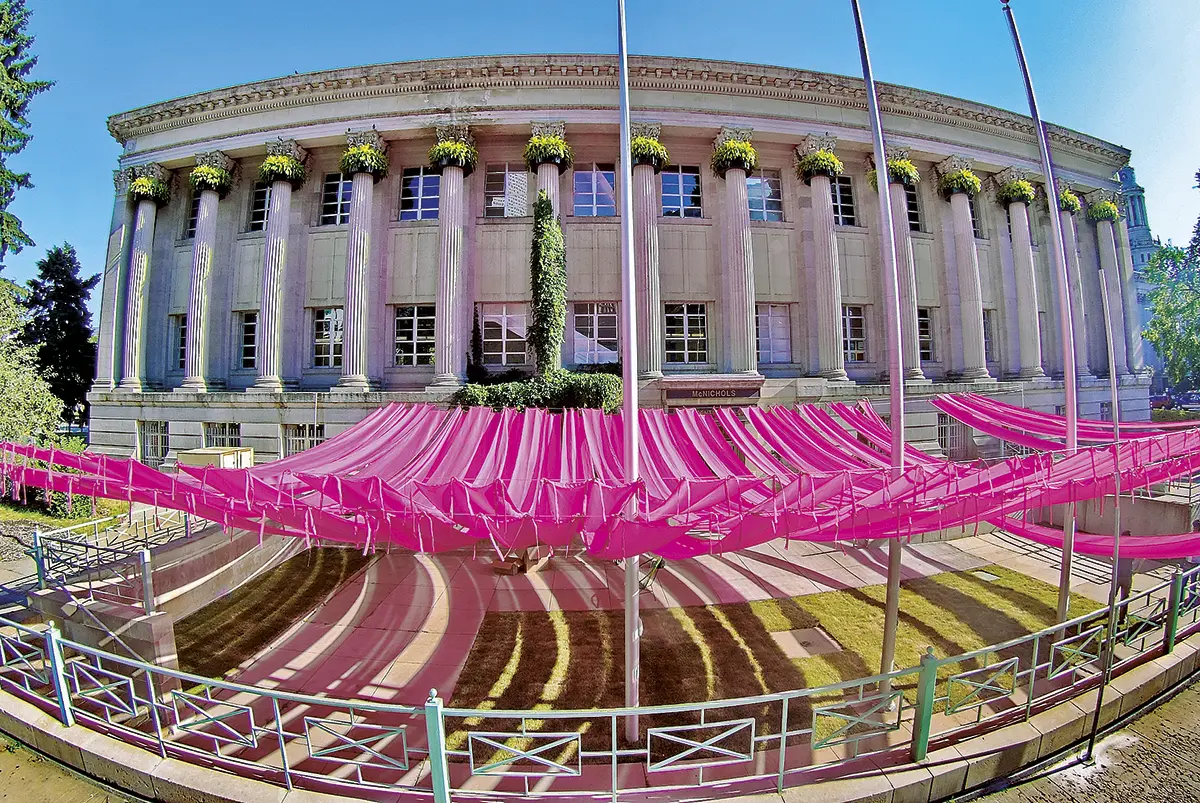
The McNichols, a well-situated building that had been closed for years, was restored for the occasion. The restoration provided 28,000 square feet in three well-lighted levels, which made the visual arts the Biennial’s flagship. The building’s neoclassical front was approached by Jerónimo Hagerman (Mexico, 1967). Lime Green Corinthian Over Saturn Dublin (2010), Hagerman’s site-specific installation, reveals a personal conception of space, a celebratory focus, and an interest in inhabited ecology.
Inside, we don’t find an abuse of videos. In Untitled, 2010, Teddy Cruz (Guatemala, 1962) explores his own bi-cultural experience and reflects on the use of media in housing integration. Bienvenidos a Nueva América/ Welcome to New America, 2009, a video by Rubén Gutiérrez (Monterrey, 1972), deals with an isolated, original community in the outskirts of Lima that has gone through a struggle for the land. It is an ironic document sustained by a naïve point of view and an overwhelming desire for political neighborliness, seen from a soccer field with doors that display the names and flags of the various countries. Local Code: Real Estates, a 2010 work by architect/urbanist Nicholas de Monchaux (Brooklyn, 1973) dedicated to technology, nature, and features of the city that offers a conciliatory gaze through available spaces that are nevertheless ignored, accumulating social and ecological dysfunctionalities. It proposes to revisit and reincorporate these zones for a variety of benefits. More and more, architects express themselves in the visual arts at the same time, and their proposals respond to real problems and include their desire for aesthetic practice. Hijos de la nada, 2010, is a Pop-flavored social experience by Gabriel Acevedo Velarde (Lima, 1976) about vandalism in the Chan Chan archeological site by a group of youths. The artist unpacks a hypocritical idea of identity—based on the color of their skin, vandals are considered more or less punishable— and reveals the segregation that characterizes Peruvian society and shapes its government. This is expressed through simple drawings, documents, rhymes, and the statements of those who are Hijos de la nada.
I’m an ignorant punk and I deserve to die
a bastard, scum, ordinary, cholo, an Indian
I live in a void, on outsider
I am a cholo, wanna be a gangster
I am a child of nobody
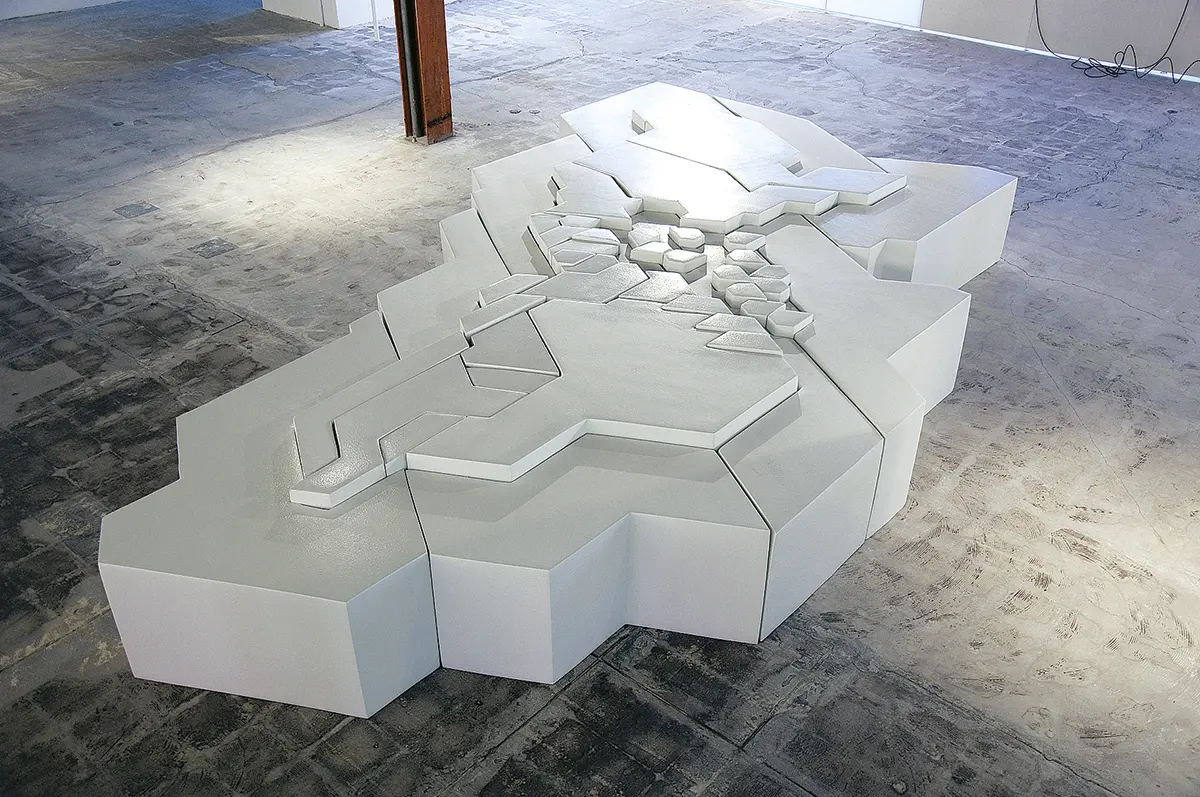
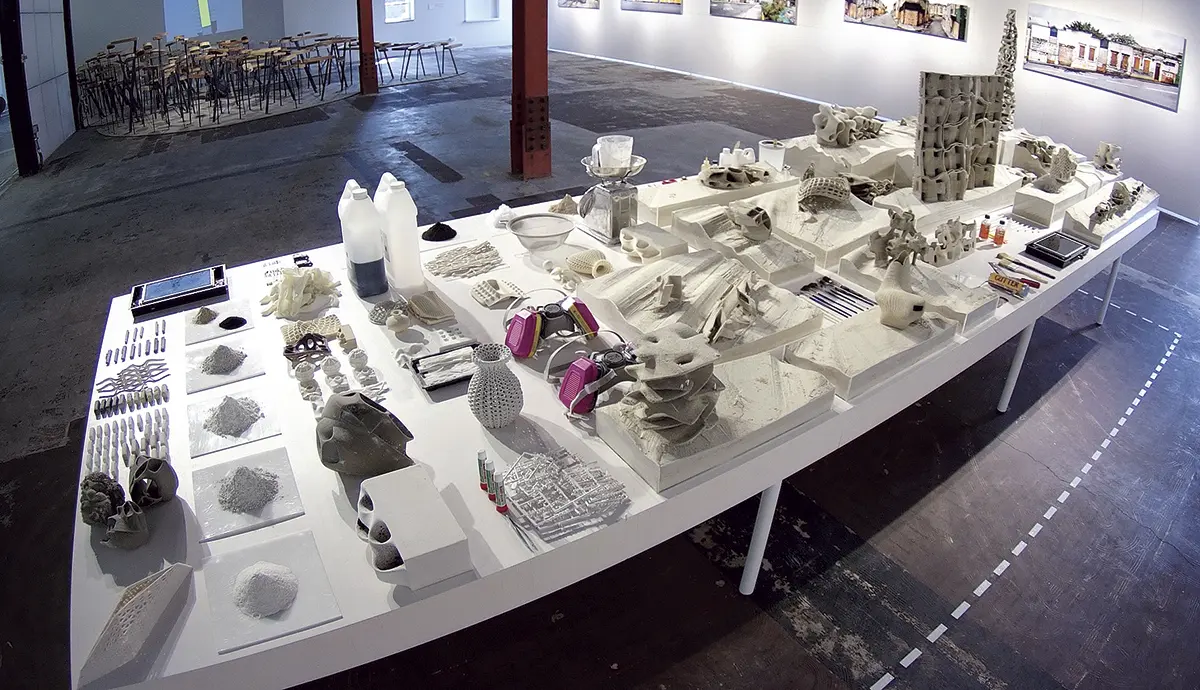
The Biennial included several strong, flexible, reminiscent, and sustainable installations. The one by Pedro Reyes (Mexico, 1972) features 20 shovels and 5 videos. Palas por pistolas, 2008, is a mirror of the anguish between parents and children, something, unfortunately, more common every day. The Oakland-based architectural studio of Rael San Fratello presented Earthscrapers of Unnatural Building, 2010, a unique real/sidereal installation using Computer-Assisted Design (CAD) and Computer-Assisted Manufacturing (CAM) in the creation of seamless models—in clay, ceramics, and cement—and an anthropogenic treatment of the landscape.
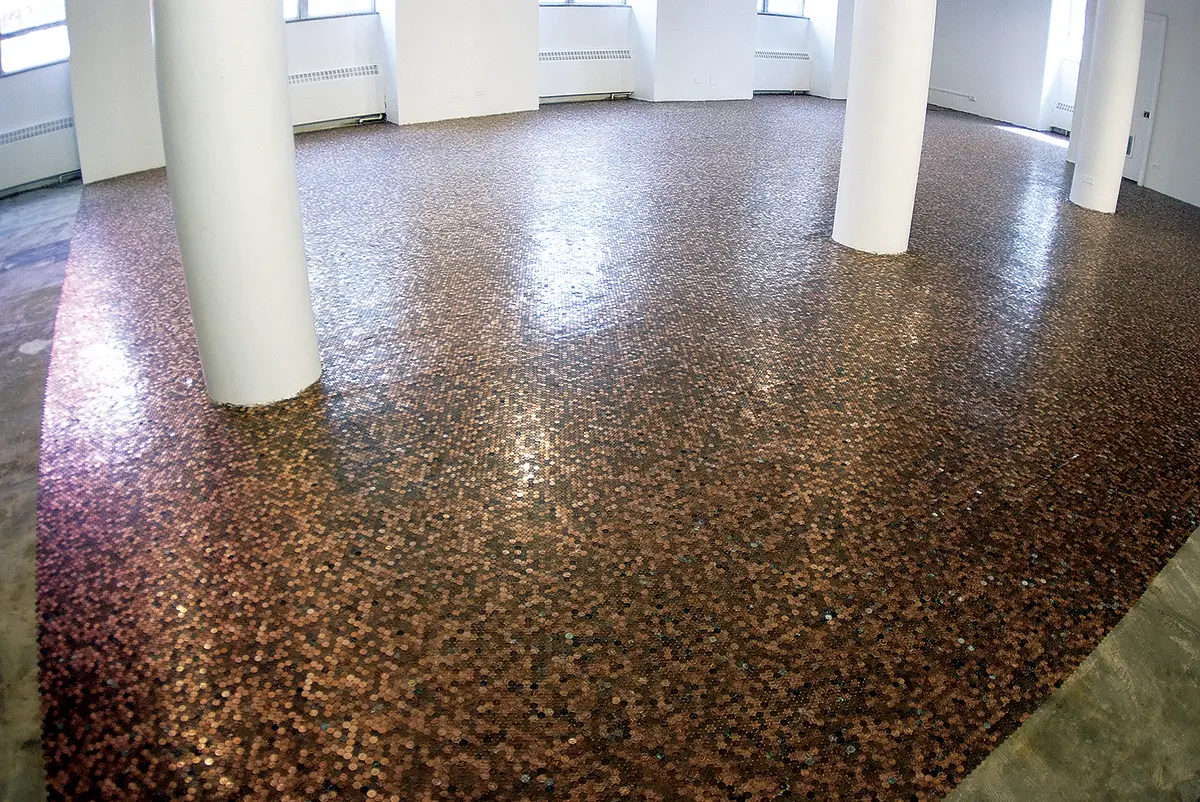
At the entrance to the McNichols, to the left, a large room seems to have been left empty, inhabited only by a few columns, until copper-tinted reflections capture our gaze. Sandra Nakamura (Lima, 1981) created E Pluribus Unum, 2010, an installation of pennies, as a symbolic record of taxes paid by undocumented aliens living in the United States. Nakamura emphasized respect for workers by placing each coin by hand. They are not glued, because the artist didn’t want to alter them in any way. “Each coin has its own history” and the symbolic charge of their former value of one “green” cent. The title, inscribed on pennies since 1975, refers to the foundation of a nation with a will to integration and diversity. And the metal extends its meaning to a different period in the history of Latin America, more than 500 years ago, when copper, gold, and silver were the drivers of conquest and European domination.
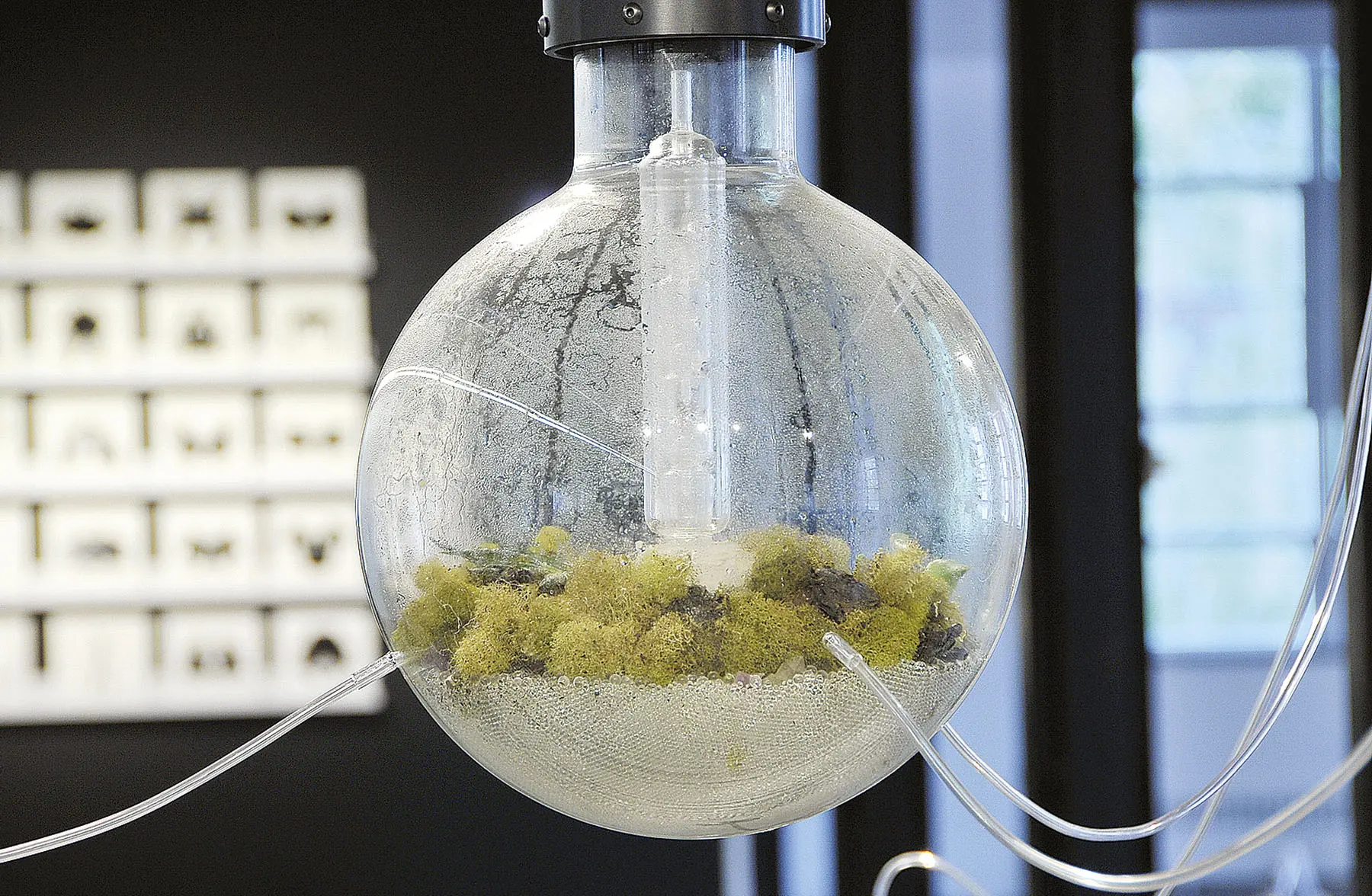
Clark Richert (Wichita, 1941) is the one artist with a pictorial presence at the Biennial, and also the author of a video installation projected on a hemispheric screen. In both media, this notable artist combines science and art in a playful and original manner. Amman Lines and AC Triancon—acrylic on canvas, 2006—and Geometría esférica, 2010, recognize Buckminster Fuller’s theories of spatial expansion, arriving at results that deserve special attention. Two Boulder artists are present with antithetical works. Joseph Shaeffer (Sioux Falls, 1968), with The Epoch of Encroachment, 2010, about reality and science-fiction in ecological, psychological, art, and science topics. This installation of glass elements refers to the laboratory where the artist works on issues related to the behavior of nature under attack by humans. Organic and inorganic materials come together in this biosphere and bring to mind proposals by Gyula Kosice of saving civilization through hydro-space habitats. The interdisciplinary study Chapter 13, by Alex Henry (1981), Todd Berger (1975), and Lucian Foehr (1988), emphasizes relationships from the less useful to applied art. United, 2010, cataloged as a sculpture, is a three-dimensional object and involves the application of design to art in a symbolic confluence of the continent’s map; we are allowed to “sit and rest” on the idea of the Americas.
Darío Escobar (Guatemala, 1971) presented Dawn (2009), a wall-and-floor installation using baseball bats. Entertainment and menace, the tension between social classes, which Escobar develops through these everyday objects he idolizes even beyond the realm of sports, treating them with golf and decorative motifs from the Sixteenth Century Guatemalan Baroque. Gregory Euclide (Cedarburg, 1974) created the unique installation Because There’s a There, Here’s Just Fine, 2010. Martín Alonso (Chile, 1976) separates high technology from play and promotes an against the accelerated pace of today’s world in Slow Walking Machines, 2010), his floor installation of 12 wooden objects and automotive parts. Miler Lagos (Bogotá, 1973) goes back to a daily newspaper’s rotary press and the large paper drum on which the news is to be carried, including Silence Dogood, 2010 (the title alludes to Benjamin Franklin’s pseudonym) in his tribute to those who use the pen to express essential ideas.
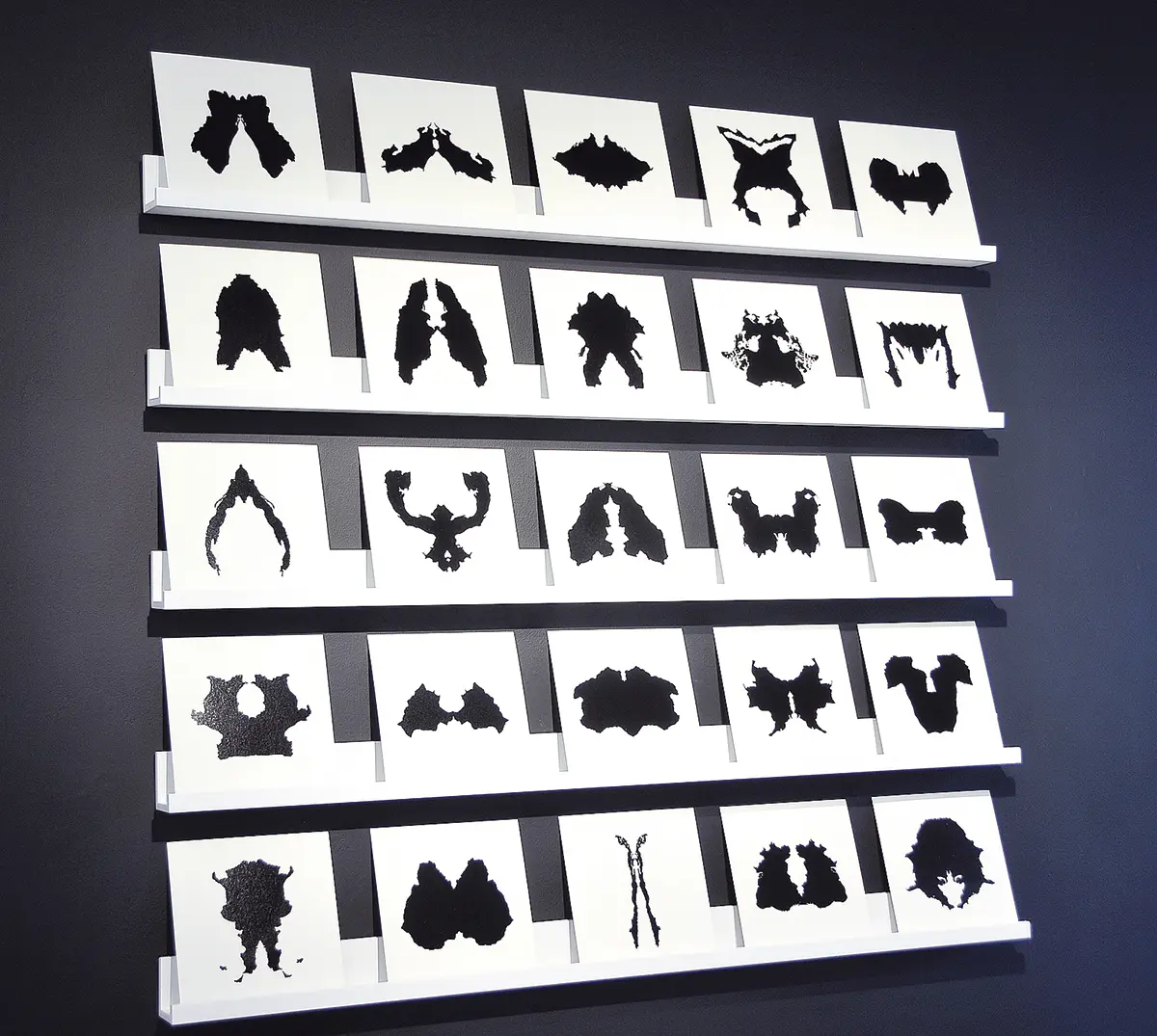
Rorschach America, 2009, by Armando Miguelez (Tucson, 1981) brings to memory the eponymous inkblot “test”—these are silk screens of the mirror double of the maps of certain countries in the continent. In this way, Miguelez deals with the subtle perception of relationships between official discourses and the fragility of narratives, as well as between preconceptions and tension in various countries. Víctor Muñoz (Medellín, 1981) presents six photographs from the series Clausurado, 204 to 2919: these are the lodgings of people who were forced to flee by the War on Drugs in Colombia; the artist manipulates the images and distorts the perspective in order to communicate the feelings of anguish that originated them. Karlo Andrei Ibarra (Santurce, 1982) was present with Continental, 2007-2010, a solar panel that feeds a neon light that reads Vivo en América. The deformation in the use of “América” means The United States marginalizes all the other nations in the continent.
Estefanía Peñafiel (Quito, 1978) presents Anticipación de incendios a venir, 2010, a mixed installation of video and gestures on the wall with security matches. The title is suggestive and the work is the most subversive —might it be for this reason that it is almost impossible to photograph? Lucía Koch (Porto Alegre, 1966) created Riso Arborio, 2010, photographs of cardboard boxes, producing interesting spatial trompe l’oeil effects. Alexis Rochas (Buenos Aires, 1974), in None of the above, 2010, refers to reconfigurable, low-ecological impact architecture using units of the OCTA.bot constructive system. Brigita Baltar (Rio de Janeiro, 1959), with Po’e Paisagem, 2010, is a forceful exponent of conservation. On the walls of her former house, she excavated the shape of her own body, and in those performances, she gathered the brick dust to be used in the construction of other works, including those presented here, a series of floor interventions, and the shape of various Rio de Janeiro hills, who came to the encounter to their sisters in mountainous Denver.
Santiago Cucullu (Buenos Aires, 1969) traveled through Milwaukee and photographed local heroes, Mexican leaders, and Vietnamese populations in an encounter of cultures that resulted in Milwaukee Murals Refitted, Scene from the Hazy Prism of Passing or Lucretius We Hardly Knew You, 2010, a large mural sketched in white vinyl against the black wall, updating Mexican muralism with the current segregation of undocumented aliens and the issue of human trafficking. Cucullu, along with Felipe Mujica (Chile, 1974), Rochas, and Nakamura have outlined and articulated the major physical spaces in the Biennial; Mujica likes to call these works “temporary architecture.” He emphasizes alternative construction, creating rigid or flexible panels in which color is very important. Exhibiting with other artists, his work commingles with the ones next to it; on this occasion, the canvases respond to Brazilian Constructivism, as he shared his area with an artist from that country. Subversion, transformation, rescue, flexibility, communitarian construction, a common border, are all concepts present in this Biennial.
*All photos illustrating this review are by Steve Crecelius.
GRACIELA KARTOFEL