Fourteen years after the 1997 Medellin International Art Festival –in which he participated as a member of the Los Carpinteros collective– Cuban artist Carlos Garaicoa (Havana, 1967) was invited to present his work at the new building that houses the Talleres Robledo, part of the renovated Museo de Arte Moderno de Medellin (MAMM). A remnant of the industrial boom that occurred in the city during the first half of the Twentieth Century, the building has been successfully converted into a museum by the Utopía architectural firm of Patricia Gómez, Jorge Mario Gómez, and Fabio Antonio Ramírez.
From the beginning of May until August 8, the “Tate paisa” (or Local Tate) –that some optimistically call the museum– presented an individual exhibition by Garaicoa titled Bienes Mostrencos (Waif Properties). It became one of the highlights of the program of exhibitions that the museum has offered to the city and to the cultural world, as the new place in town for cultural exchange and for showcasing prominent international artists. Other prominent figures, including Beatriz Gonzales, and Doris Salcedo, are also scheduled to present exhibitions here by the end of the year.
Because of his contemporary relevance and a discourse founded on his investigative experience, the expectation generated by Garaicoa’s exhibition was positive from the beginning, especially among young artists, students, and architects – who see in his work reflections that are concomitant with the reality of a city like Medellin: historically destroyed and continually in the process of transforming its urban landscape. It is a city that in recent decades was funded with the ephemeral froth of drug trafficking, but that has been able to see the light at the end of the tunnel, through an urban and social transformation led by progressive thinking and the right choices of its developers. Today, Medellin is a city that is internationally recognized in specialized publications for the architecture of its universities, parks, libraries, and cultural centers.
It is perhaps this metamorphosis; the ever-changing landscape and architectonic mutations, that led Garaicoa to accept the invitation to exhibit in a secondary city, to see whether he would either install a project that would reaffirm such a successor one that would simply rejoice in the permanent ruins of the city. Such was the fuel to jumpstart this investigative project and to develop a discursive construction. “I am interested in attracting a certain type of public to not solely walk around an apparently empty city –that is nevertheless filled with political symbols and signs– but to question its own history,”1 affirms the artist. As a representative of Cuban contemporary art and of the post-Special Period generation, Garaicoa employs a multidisciplinary approach –centered on the study of architecture, urbanism, and history– to address cultural and political themes.
While the main subject of his reflection had previously been the city of Havana, Medellin represented a singular phenomenon –given a past inscribed in the dynamics of drug trafficking– that this contemporary thinker thoroughly exploited by delving into its history, as he developed an inventory of the buildings abandoned by the capos and their front men. These are constructions that today are regarded as white elephants, ones that are at the will of the city also referred to in the legal jargon as waif properties: “possessions that were once owned by private individuals, but that were physically and legally abandoned with no knowledge of who the owner was.”2 Garaicoa proposed a dialectic game that used them as unfinished, confiscated, confined, stigmatized, forgotten, architectonic structures that have even been erased from the collective memory.
Despite being a proposal that questioned the city and that forecasted interesting processes to come by Garaicoa, it was not convincing in the end as a general concept for the exhibition, for it was not capable of becoming the articulating force behind the remainder of the pieces of the exhibition, which were left on their own to search for the cohesive axle. Nevertheless, the magnificence of the works by Garaicoa in the past –such as Nuevas Arquitecturas (New Architectures, 2003), a luminous installation with architectural forms suspended on paper and wire– achieve poetic and suggestive environments that transport us, along with his Bend Cities, to the utopic and invisible urban landscapes of Italo Calvino, and lead us back to experience once again a memorable and elevated art.
Carlos Garaicoa’s aura has shined on Medellin despite the organizational shortcomings of a curatorial effort that, by including a capricious and inconsequential collective exhibit at the same time, underestimated the importance of a renowned international figure such as Garaicoa in an effort to fill an exhibition calendar or, unjustifiably, to comply with the demands of curatorial committees3 that, despite its best efforts, drags in out-of-touch figures such as Alberto Sierra – who should stand aside and let a new generation of curators take over, while he still has the chance to retire with dignity, and for the sake of the local art.
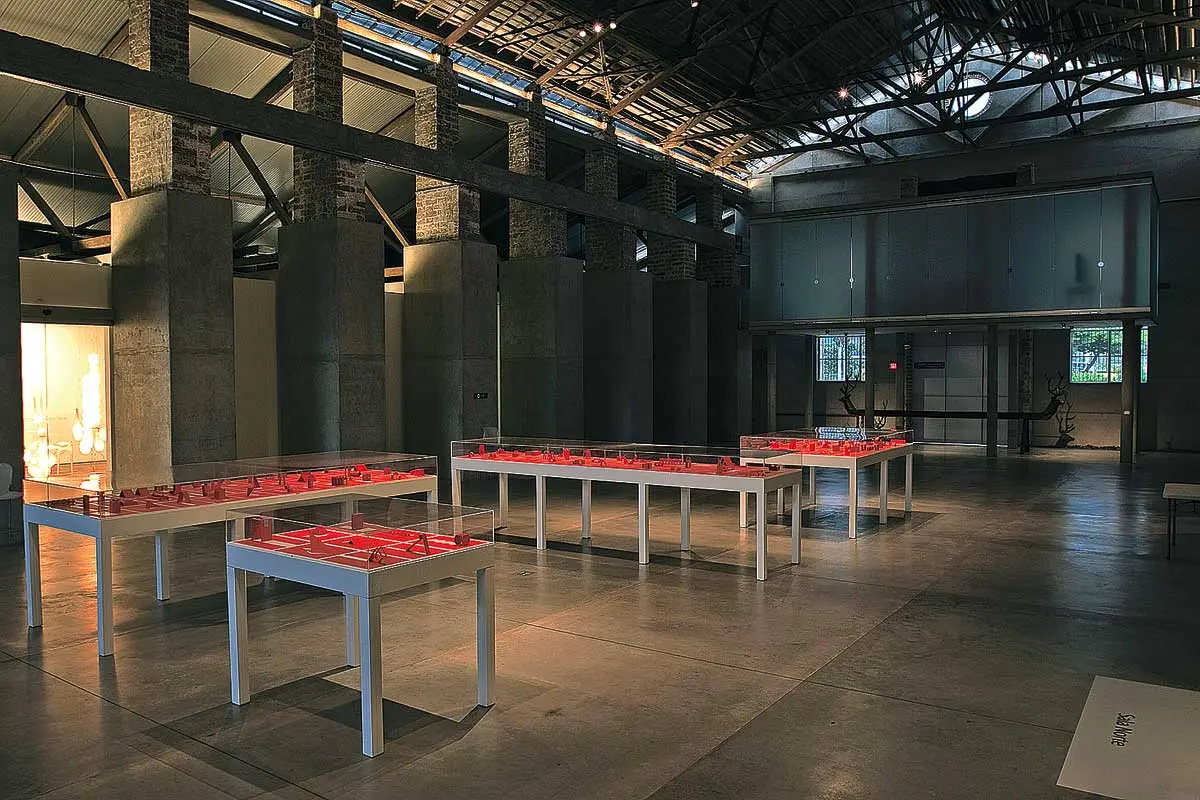
There is no doubt that these contradictions in the interior of the new museum are worrisome. A venue as complex as this, with only two exhibition spaces and a nave –formerly the foundry of a one-hundred-year-old factory– must be adapted to multiple spaces that can handle several activities. The fact that the decision was made not to grant the whole exhibition space to an artist as important as Garaicoa, demonstrated a lack of organizational foresight that ultimately denied the cultural community the chance to appreciate the large and generous pieces by the Cuban artist, along the entirety of expanded walls of the renovated building, instead of the inconsequential confined area, not suited for proper appreciation of the pieces, where the work was actually presented.4
NOTES
1. Carlos Garaicoa speaks about his work at: http://www.cnap.cult.cu/galeria/artistas/garaicoamanso.htm
2. Article 706 of the Republic of Colombia Civil Code.
3. In addition to Alberto Sierra, the Technical Committee also includes Óscar Roldán (appointed curator), Marta Lucía Ramírez, Imelda Ramírez, Carlos Arturo Fernández, Julián Posada, and Gerardo Mosquera (international adviser), among others.
4. The works mounted in this confined space were Bend City (Red), 2008, and Guattari/Deleuze: Fixing the Rizoma, 2004.
CARLOS URIBE