
Writing a review that actually passes judgment on the paintings in this show feels a little silly. It’s like going to the nudist beach and writing an article on skin cancer. Disregarding the obvious--naked bodies in one case, paintings as stand-ins for an ongoing performance in the other--would keep one from addressing what is "really" being proposed here. It’s been a long time since Diego Singh has made anything intended to stand on its own to scrutiny. (Just look at the collaborative, no-effort paintings he exhibited last year in LA.) One doesn’t even need to go to the gallery to get the work. The paintings exhibited are fine, competent, collectible. They’re insouciantly abstract and have the right range of sizes. They employ oil paint and recently-fetishized spray paint--the burden of history and the evanescence of the carefree. Their references are timely and knowing--a little Isa Genzken here, a little Josh Smith there.
All that matters with these paintings, however, is that they are all equally skilled at signaling that the studio isn’t the important place of activity for Singh. It’s the performance of being an artist--whatever that means these days--that is at stake here; the performance of constructing a particular subjectivity at a time in which such a prospect seems to have been foreclosed on and against the void of a missing dense social field on which such an effort may have once found tracking. This performance is the only work that is happening here. That it goes unmentioned in the show’s press release is hardly surprising, as even the press release is a part of it. The exposed, reflective aluminum surface of the immense Presentation (2009-10) should be enough to let us know that the gallery is being treated as a mirrored rehearsal space.
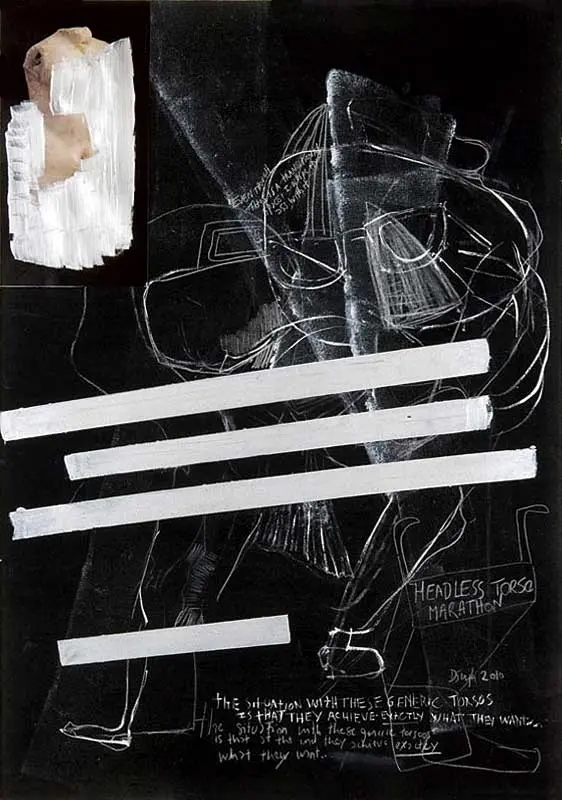
Singh’s performance, however, is a repeat performance. And as it happens with all repeat performances, the audacity is spent and only the unsettled and unsettling parts remain. The original version of this play took place in Cologne, two decades ago. Knowing it was a comedy, Josef Strau titled it The Non-Productive Attitude and the original cast included all the famous Cologners from Martin Kippenberger to Kai Althoff (see Make Your Own Life: Artists In & Out of Cologne, [ICA, Philadelphia: 2006]). Singh adapts the play for our times but replaces the “artist-bohemian” with a different type: the white-wine-glam-fag who performs against the absence of a “dense social field” produced by oppositional communities of artists. He embodies this void, takes it for a walk.
But in the repetition, as always, is the difference. Or rather, the massive insecurities of those who trade in hand-me-downs, who always turn things awkward in the end, who can’t keep their anxieties from cracking the cool surfaces they’re after, generate elusive glitches that resist eager dismissal. These glitches are most noticeable when the performance is toxically over-done when theatrical pose becomes a personality when hyperbolic raconteurs deform into pathological liars, when “the life of the party” devolves into a stalker of collector types when “don’t-give-a-shit” becomes “are-my-eyes-bloodshot-enough-for-people-to-think-I-was-glamorously-drunk-last-night-or-should-I-rub-them-more.” In short, “when things go too far”; when they’re so fake that they slip the spaces where authenticity still matters.
Just as Singh went in the studio to make paintings for his show in a “real” gallery, he has casually established a fake gallery and identity. (Real and fake, of course, maybe interchangeable terms in this world.) Last year, along with artist Clay Deutsch, Singh opened Terri and Donna--a gallery in which an exhibition may be composed of five paintings and 200 pounds of blueberries spilled on the floor. The main activity of the space, closed most days, happens on a blog (terrianddonna.blogspot.com), in which, Singh and Deutsch (presumably it’s them) as Terri and Donna, two Jersey Girls, type their love problems away and post “sexy” pictures in hotel rooms in Venice. It’s Thomas Mann warped by the filter of a hormonal teenage worldview. It is here, in artworld performance derailed into Jersey Girl territory that we find the volatile concoction of strangeness and stupidity--that is, the optional suicidal tendency as serious cultural producers, the liberating disregard from professional obligations, the inversion of all sorts of values--that make the paintings even worth thinking about. Singh’s “abstractions” are pictograms of the parlor game played by those of us who got to the party much too late. A text on them is a litany of our generational anxieties, and maybe, if it rubs up against the air-headed-subversiveness of the Terri and Donnas out there, prolegomena to a future science of escape routes.
GEAN MORENO