The worker and the Kolkhoz woman travel to Havana. They visit several strategic points there but are unable to remain at any for long. They do not receive the reception they expected. Disappointed, they return to Russia: the “Motherland.” It is the end to the imaginary “vacation” that became the narrative inspiration for the exhibition Holiday, by artist Duvier del Dago (Cuba, 1976).
As I recognized the emblematic figures, the name Vera Mujina immediately came to mind. On the other hand, the first time I saw a work by the artist, I did not realize it was his. More precisely: I was unable to see much of him in the masterful carnivalesque drawings on kraft paper, exhibited at the Centro de Desarollo de las Artes Visuales-C.D.A.V. in 1998.
This occurred to me not because I witnessed a new poetic type – that should have been a reason for more curiosity about who authored the works. Mainly, this blunder on my part was something else: the work’s authorship was obscured by a voluntary decision to present these as collaborative creations.
Del Dago created these works jointly with Omár Moreno, his classmate at the Instituto Superior de Arte. Diachronically, the collaboration derived from an academic tradition that generated more than one artistic collaborative effort – such as that between René Francisco-Rodríguez and Eduardo Ponjuán. On the other hand, synchronically, the Omarito & Duvier duet was the result of a new kind of educational experience developed in this institution and one that led to their participation in Desde Una Pragmática Pedagógica (From a Pedagogical Pragmatic) at the D.U.P.P. Gallery.
This migratory “gallery,” headed by René Francisco-Rodríguez – in his role as a teacher – developed projects always presented to the public as part of a collaborative effort in which neither ideas nor results were attributed to a single individual. This was the case with the 1,2,3… Probando installation, for which D.U.P.P. was awarded the 2000 UNESCO Prize for the Promotion of the Arts.
Another proposal, Grosso Modo, represented the coherence of a collaborative authorship that, nevertheless, could not avoid revealing sparks of specific identities. And Duvier’s hand in this work became clearer a posteriori, once the Omarito and Duvier duo split and Duvier’s individual artistic trajectory advanced.
Following this “separation of artistic property,” del Dago revealed his prodigious talent for drafting. Resolute, angulated lines – a certain inclination toward expressionist hyperbole – del Dago figurations denote an affiliation for cartoons that he continues to draw on flat surfaces to date. But his drawings moved into another dimension: the spatial, a volumetric conception he has worked on for some years now and that he used in Holiday, presented from May 14 to June 19.
A video installation, the exhibition was paradigmatic in several ways. Through the transition into three-dimensional drawing, Duvier reaffirmed his contribution to a contemporary Cuban art tendency: breaking free of the sameness found in artistic disciplines and dismantling orthodox conceptions to investigate other expressive potentialities.
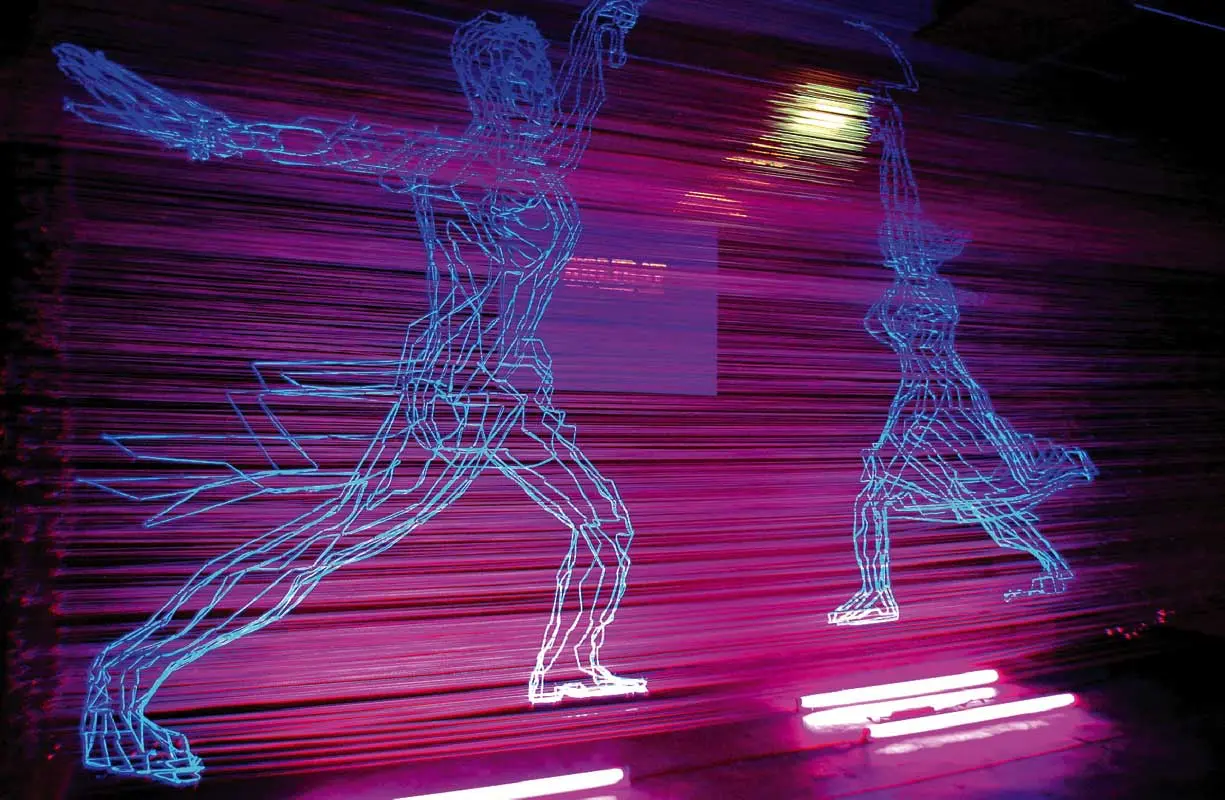
Besides breaking free from the “flat” manifestation’s alleged limitations, Duvier also rendered light differently from conventional chiaroscuro. He arranged fixed lamps as light and color sources that changed when the projection’s light beam passed through the drawing’s grid.
While Duvier’s proposal usually wagers on merging different media and incorporating “new technology,” he does not renounce traditional artistic media. He ingeniously relies on his artistic craft to combine digital media – video – with hand weaving, with threads to structure and support his three-dimensional drawings, resulting in representations like objects and figures in 3D – although these are only created on flat supports through holography or through the using hardware and software.
Duvier has succeeded in converging objectual with virtual reality. With collaborators – without relinquishing his artistic vision and mark amid the collective process – the artist conceives and elaborates grids. He develops webs that, because of their operational implications, can be equivalent to virtual webs in a semantic or nominal sense.
In Holiday, Duvier reinterpreted iconic figures of the worker and the Kolkhoz woman in two ways. He relied on three-dimensional drawings to anchor these “like statues,” employing “animated drawings” to achieve the illusion of movement. This projection counterpointed static with kinetic, presenting avatars of sculptural symbols that crowned ideologically relevant buildings in the former Soviet Union, icons also used in the “Mosfilm” film studio’s logo.
Full of irony, the animation reveals Duvier’s narrative or diegetic ability, ranging from allegorical to explicit. Likewise, it revealed the sense of humor of an artist who – aside from cartoon work – has done independent audiovisual work. With Holiday, del Dago questioned (successfully) the effect of socialist realism in contemporary Cuban art.
ISRAEL CASTELLANOS LEÓN