
According to Javier León, “there are two visual dimensions: sight and gaze. Images satisfy sight, and when seeing becomes difficult –when images disappear or become a blot– it is then that gaze takes over. What one sees is what one sees, whatever there is to be seen is what there is to be; but what one can see is not everything.”
The brief paragraph cited at the beginning of this review is part of a conference given by León, in which the artist defined the purpose of his most recent exhibition titled What You See Is What You See Is Not What You See, presented at the Galería La Cuadra, in Caracas, from March 25 to May 2, 2010. The proposal represents an attempt at rereading –through abstract art– the modernity in Venezuela, an effort that, in this writer’s opinion, failed due to the irresponsible attitude of the social and political players.
Javier León is known for a body of conceptual work in which the theme of abstraction and references to emblematic figures from this artistic current is always present. The exhibition is presented as a continuation of another individual effort by León –shown at the same gallery in 2008– titled Obra Inédita (Unpublished Work). In this opportunity, León proposed art as the essential expression of an idea and its material as the work’s raison d’être.
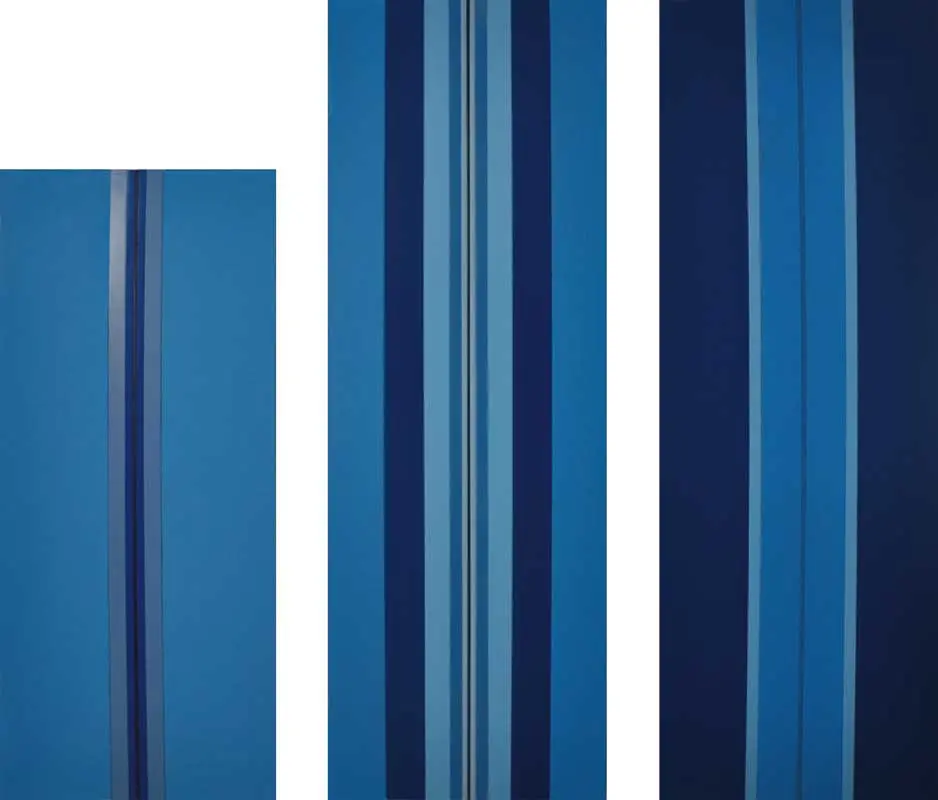
Such a proposition is more markedly present in this current exhibition. It is a search that links León’s work to the vast and diverse experience achieved by international painters from the 1950s and 1960s and to their important research within the so-called Post-pictorial Abstraction and Minimal Art. His approach is also closely connected with a Venezuelan group of artists working during that crucial period of modernity, who saw abstraction as having a revealing purpose and transformative power.
This exhibition by León reveals a dual goal: the presence of two approaches or tendencies that could perhaps be seen as divergent –a notion supported by the fact that they are shown as two distinct groups of works. While one group underscores León’s decreasing interest in the use of color as a central element of his work, the remaining group conversely stresses its importance, although it never allows color to become relevant in terms of the pictorial purpose.
The first group consists of works created on jute, fragile support whose warp can be observed through the paint. These pieces are created by setting bands of paper on the fabric and then by applying several shades of white. Afterward, the paper bands are peeled off to reveal a work León named Líneas Verticales Enmascaradas (Masked Vertical Lines). Also in this group are other pieces created with the paper bands, which have already been stripped off of that which they previously hid.
Also characterized by its vertical linearity, the series titled Los Tablones (The Planks) –a succession of wooden ribbons treated with automotive industrial paint before being assembled– defines color as an objective fact, while León’s intentions are revealed through tonal contrasts. In the work Tablones Azules (Blue Planks), the visual effect is intense despite it having been created solely to represent colored ribbons; in other words, to convey color for color’s sake. With these works, Javier León is found in the realm of the hard-edge aesthetic –as defined by U.S. art critics– of artists such as Frank Stella and Ellsworth Kelly, among others. Likewise, these works possess something of the abstract works created during the mid-1950s by Venezuelan artists Carlos González-Bogen and Jesús Soto, and they especially shared something with the series Coloritmos (Colorhythms) by Alejandro Otero.
To support the exhibition, León has expressly communicated the conceptual component that substantiates it. He proposes an inquisitive look back at art from the past that, according to the artist, is relevant as a social manifestation. But it is not about form, about the artwork as a proposal that contradicts the present reality; it is, rather, an attempt to show, through abstract art, the image of a lost conscience that speaks of a just, stable, and therefore modern– a society whose permanence the contemporary official rhetoric attempts to deny.
According to Javier León, “the mirage of a disappearing Abstract Geometric tradition has become one of the newest myths of our visual arts; paradoxically, this very mirage has also served the purpose of affording to it surprising continuity.”
In societies subjected to multiple tensions, creators assume –from an aesthetic perspective– the role of critics; and here Javier León, once again, attempt to demonstrate this.
FREDDY CARREÑO