
Drama Turquesa (Turquoise Drama) is the most recent exhibition at Ivorypress Art+Books by Cuban artists Marcos Castillo and Dagoberto Rodríguez, aka “Los Carpinteros.” With more than twelve sculptures and installations, as well as nineteen large-size drawings, it is the largest exhibition that this collective has shown in Europe. It is a sophisticated and exquisite mise-en-scène that impeccably combines the conceptual density of each piece with the surface virtuosity, which has come to be identified more and more with their work. Little is left of the early traces of identity, in which traditional methods of carpentry and painting represented the distinguishing characteristic of an artistic production able to recover art’s very conflicting aesthetic paradigm that was projected onto the 1990s Cuban art scene. Without abandoning this premise of articulation –fundamental to objectivity and to the meticulous treatment of the emphatic surfaces– this current proposal reaches a level of sophistication that emulates and rivals several discursive fronts of contemporary culture and its simulation and sublimation mechanisms. Here the object and its representation are great allegories that function with absolute autonomy at the discursive level. Seduction appears to be the leitmotif of each narration, an exercise in visual complacency that demands to be observed without having thus to renounce to the enunciations articulated in each of these emphatic artifacts.
Drama Turquesa, therefore, becomes a text with infinite semantic nuances that not only questions the persons viewing such pieces, but the very art system as well, its axiological fabric, and its categories of usage. The expanded sculptural is a principle that diagrams the proposal and emphasizes its mise en scène attributes, as well as the ability to push the ontological boundaries of the artistic language. The artists themselves, addressing the conceptual backbone of these pieces and their very clear polyvalence, have written: “they are objects that have apparently been exposed to high temperatures or to a transformation that has melted them. We say melt, but in fact it is something broader; it is something that has been dirtied, corrupted, and has lost its physical unity.” Obviously these warnings inevitably point to the crumbling of an entire orthodox national ideology, which based its rules on the fabrication of virtuous ideals that today are known to be in crisis. The work itself is a substantial and lucid metaphor that describes, on the one hand, the insubordination of impetus, while on the other, underscores the crumbling of everything that was once believed to be solid and immovable. The melted and exultantly viscous landscape becomes the affirmation of the end of a historic narrative that found, in the arrogance of its voices and the forge of Vulcan, an extremely excluding and suffocating hegemonic model. Luckily –and this exhibition is a good example– any ideology, any ideal of emancipation, breeds –de facto– its own sclerosis.
The use of elements that are highly symbolic within the Cuban context does not lessen –as some have thought– the reach and power of their current work. To the contrary, it confers meaning and eloquence to a group of works that –without such modulations, insignificance and contextual referents– would otherwise lose eloquence, amid a lethargic international art scene filled with the excessive cult to purist works that continually abdicate to the requirements of an art market inclined to satisfy the dullest and elemental of tastes. Gathered under the title Drama Turquesa, all of these works by Los Carpinteros ironize their most immediate referent; they play at simulating and pretending, flirt with the voracity of the conversers in turn, and turn the art object into an unwavering and relentless discursive proposal that expands onto the global scene.
One of the persisting goals of this collective is to reduce the profitability, permanence, and appeal of certain iconographies in the world of, for instance, politics. Castillo and Rodríguez tame such iconography in an attempt to rid it of its original meaning and subvert its status by means of demystifying and eliminating their dramatic undercurrent. According to these artists, “We created something domestic from dramatic and socialist iconography. We turned it into something truly mundane;” thus, the ludic feeling elicited by the series –drawings and sculptures– titled Barbacoa (Barbecue). Here, aided by an aura of consecration and the most vulgar kind of stoicism, the objects become everyday artifacts used in gardens, ordinary domestic elements that suddenly expand and rejoice.
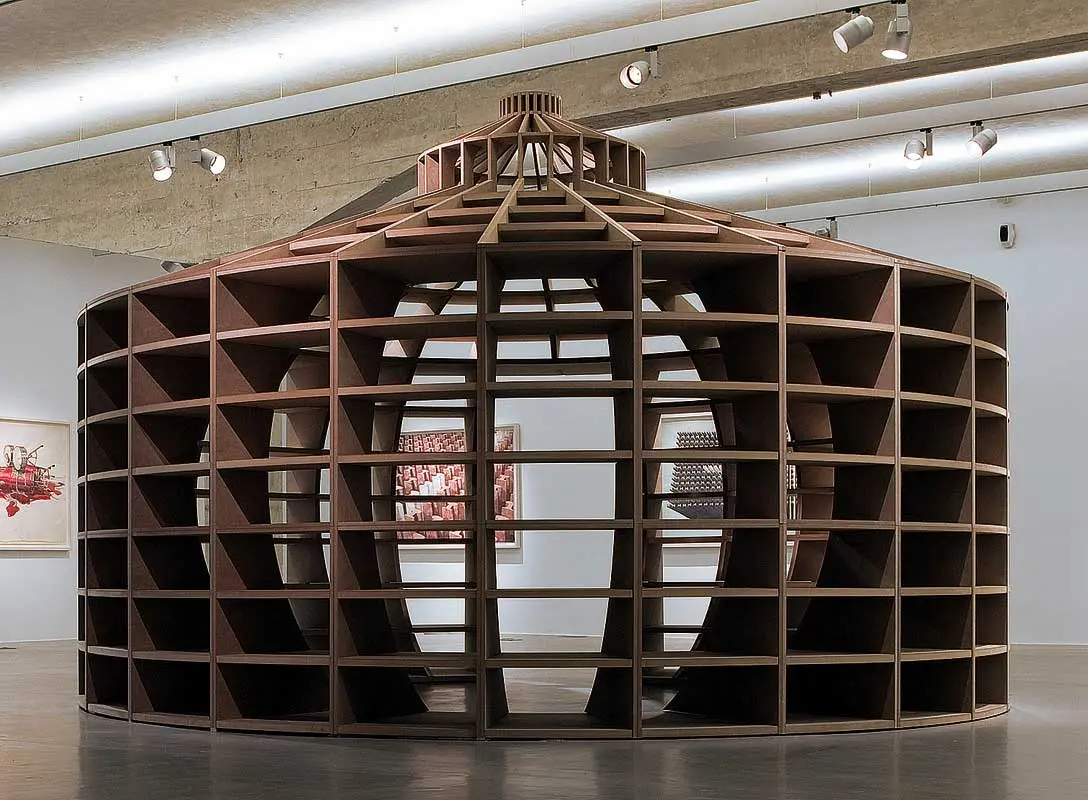
The piece titled Sala de Lectura (Reading Room) –in my opinion, one of the most superb and daring works of the entire exhibition– is inspired in the model prison on the Isla de la Juventud (Isle of Youth) and reproduces this jail’s circularly-shaped panoptic structure. Here, the irony is highly nuanced, as this reference –and its social implications– is denaturalized. What was originally a corrections facility for vectorization of the mind becomes a shelf, a sort of rack for utilitarian and social purposes –but of a very different nature with respect to its use. Several meanings that affect the very idea of history– its mechanisms and repressive strategies –as well as the cyclical ontological characteristic so pervasive in any island, and especially in Cuba– where history appears to continually repeat itself, outlining the paralysis of a grimace that freezes and extorts– are amplified in the work’s internal dramaturgy. Drama Turquesa is a great exhibition because it transforms art into a written passage, a testimonial, a reaffirmation of culture.
ANDRÉS ISAAC SANTANA