
The volatility in the paintings of Luis E. Camejo (Cuba, 1971) reminds me of how ethereal the painter himself was when I attempted to reach him to offer him a solo show at the Arte 7 Gallery. It was 1994, or even 1995. I did not know Camejo or his work when a friend recommended him to me. I was unable to find him at the Instituto Superior de Arte (ISA), where he was supposedly living and studying. According to some of his friends, he had just married and none of them knew how to locate him. Thus, the planned exhibition vanished with him.
Later on, other exhibitions, catalogs, and magazines introduced me to his work and I had premonitions of his brilliant future as an artist. I remember a painting of his that depicted the police investigating an alleged crime at the ISA. I also remember Camejo’s persistent interest in the impressionist mark: from Seurat-style pointillism to Monet’s evanescence, from the patient and caring construction of large-format images with dots of color to smudged forms suggesting a fleeting moment.
I even saw Monet’s influence on the artist at his exhibition Estaciones (Stations) at Galería Villa Manuela. Monet’s interest in train stations, in the smoke columns with which the locomotors transformed the atmosphere, are somehow also present in the train stations that showcased the Cuban artist’s work for the first time in this gallery. With misty colors, pastels, and impastos, the work La Gare Saint Lazare (Monet, 1877) traveled a path into the Cuban artist’s memory that may have been similarly traveled by Camejo when he created the paintings shown – for less than a month – at Galería Villa Manuela.
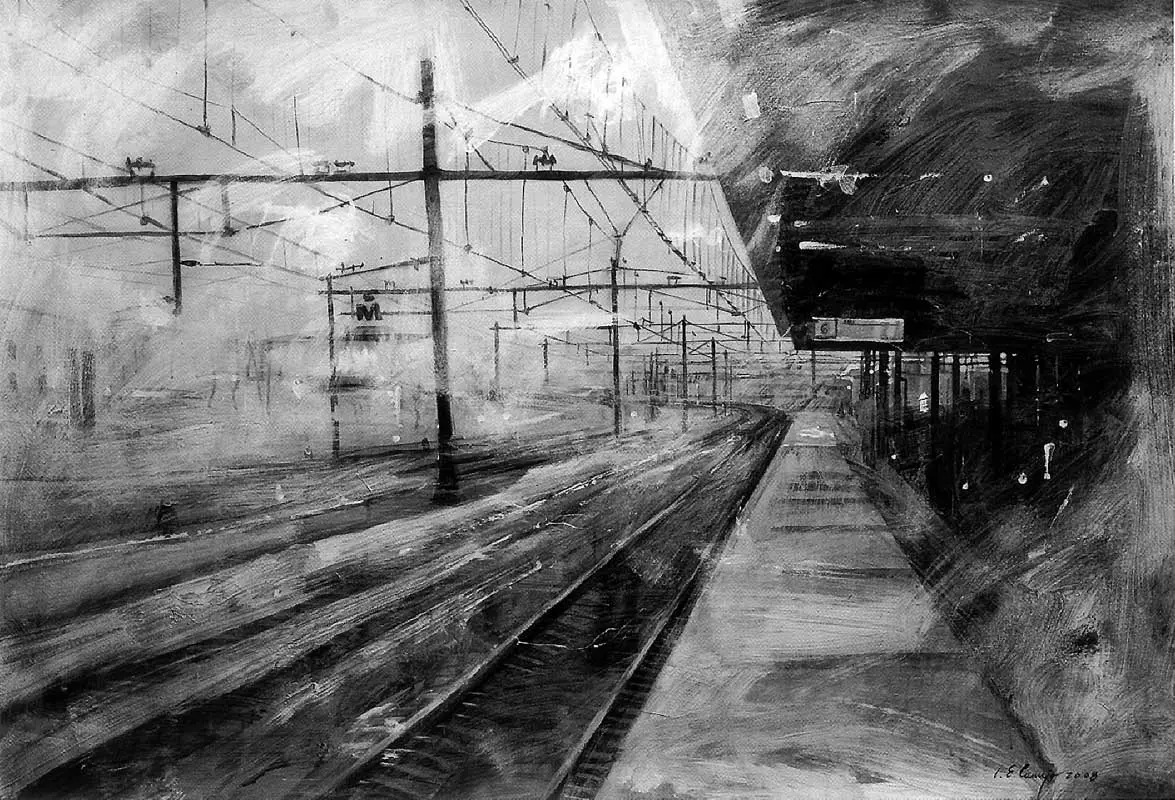
Capturing the climatic and unrepeatable instant was perhaps the most pressing undertaking in Monet’s painting. The scene appeared as if it were frozen and not due to the weather. The locomotive, the people, and the smoke were jointly suspended in the epiphany of the train, the same one that, later on, filmmaker Lumière was able to capture as if it were actually moving. The visions by Camejo also depict dynamism. But more than aiming at reaching a culminating or defining point, the Antillean painter appears to be more interested in the means than in the end. The station ce n’était qu’un repère (is nothing more than a reference point). It was nothing more than a passing reference, a landmark, which is not necessarily a destination. Its name did not really matter and was not even suggested by the work’s title. It was a rootless non-place, a drive-through spot in the affective memory of the crows that passed through it at any given hour, without ever making it their own.
Camejo’s stations could be something in between singular and differentiated entities. But they lack the same prominence of the person who built and used them. In fact, this person rarely appears on their platforms. Whether urban or rural, the landscape also lacks belligerence. It is more like a sketch, an illusion, or a circumstantial presence. The leading role is played by the sinuous, malleable, and tortuous “iron road.” The “train of life” must pass through it, fast or slow, modern or obsolete, be it a passenger or a cargo train with many cars or just a few. In these trafficable and transitive rail tracks, Camejo appears to consider guidelines and options simultaneously. He showed fast and (di)verging communication highways, and proposed dislocation, escape, and crossroads.
The point of view centers on the road and not on the waiting. Penelope is inconsequential here. Penelope, with her brown leather bag and her high-heeled shoes and her Sunday dress. Penelope sits on a station bench as she waits for the first train to arrive... The important thing here is the incomplete trajectory, with no beginning or end, marked by turns. The visible fragment is bare of interest, whether it is the section already traveled or that which waits ahead. Where does it come from? or Where is it going? are rehashed and yet unavoidable questions that, this time, utilized the train as their vehicle. The automobiles were left behind amid asphalt tread marks, tunnels, and artificial lights. It is, nevertheless, still possible to observe automobiles crossing the railway sleepers when there is no train in sight. It is a circumstantial exit that, nonetheless, ratifies that the direction either way is the fundamental issue.
The train stations by Camejo emanate bile. Perhaps due to the grey and ochre tones – or even because of the solitude in them – they appear to be clouded by nostalgia. It is not the nostalgia of a withdrawn individual in the midst of a mob, but rather, that of a subject unmasked by the absence of other subjects. It is the solitude of the station itself orphaned by the lack of passengers. It is also the solitude of the locomotive, which rarely comes upon another like it, not even in the distance.
Camejo is interested in mutating surroundings. With the continuous passing of trains and cars, the tracks that he paints are never the same. The flow changes dialectically – like the celebrated waters of Heraclitus’s river – but its currents navigate under the additional principle of mechanical and human speed: vertigo, something that has also seduced futurists.
ISRAEL CASTELLANOS LEÓN