
A byproduct of many centuries of culture, of political and social maturity that led to the Nineteenth Century industrial and urban revolution and paved the way for the development of capitalism, modernity attempted – among other things – to democratize the design and production of household objects. It is well-known that conditions in the greater part of Latin America were barely sketched by the time that modernity was already well established in Europe. Therefore, it is useless trying to find parallels between European and Latin American modernity, for the phenomenon as it occurred in Europe could never have been replicated on the new continent.
It must be said that there indeed were attempts in the Americas at modernization by certain Europeanized sectors: a truly small portion of society – some professionals, intellectuals, thinkers, and artists, who had either studied abroad, were well-informed or were born in Europe. But only some glimpses of modernity were evident here and there on our continent in a precarious, limited, and partial manner, because our history made it impossible for these developments to take place.
In Venezuela and perhaps in the remainder of Latin American countries as well – given their condition of places recently emergent from colonialism and with incipient industries – nearly everything came from abroad – notwithstanding that Venezuela did come through with some valid solutions of its own in the field of industrial design. Modernity cannot exist unless it spreads across the entire society and influences civil discourse. It must be an infrastructural reality that, long term, generates superstructural forms and a radical change in the way of thinking and feeling life.
According to research by Néstor García-Canclini, modernism in Latin America “is not the expression of socio-economic modernization, but rather, the way in which the elite classes manage the convergence of several historical temporalities and attempt to elaborate with these a global project ” which is, nevertheless, full of contradictions that must be recognized and conciliated (Culturas Híbridas [Hybrid Cultures], Paidós, p. 86).
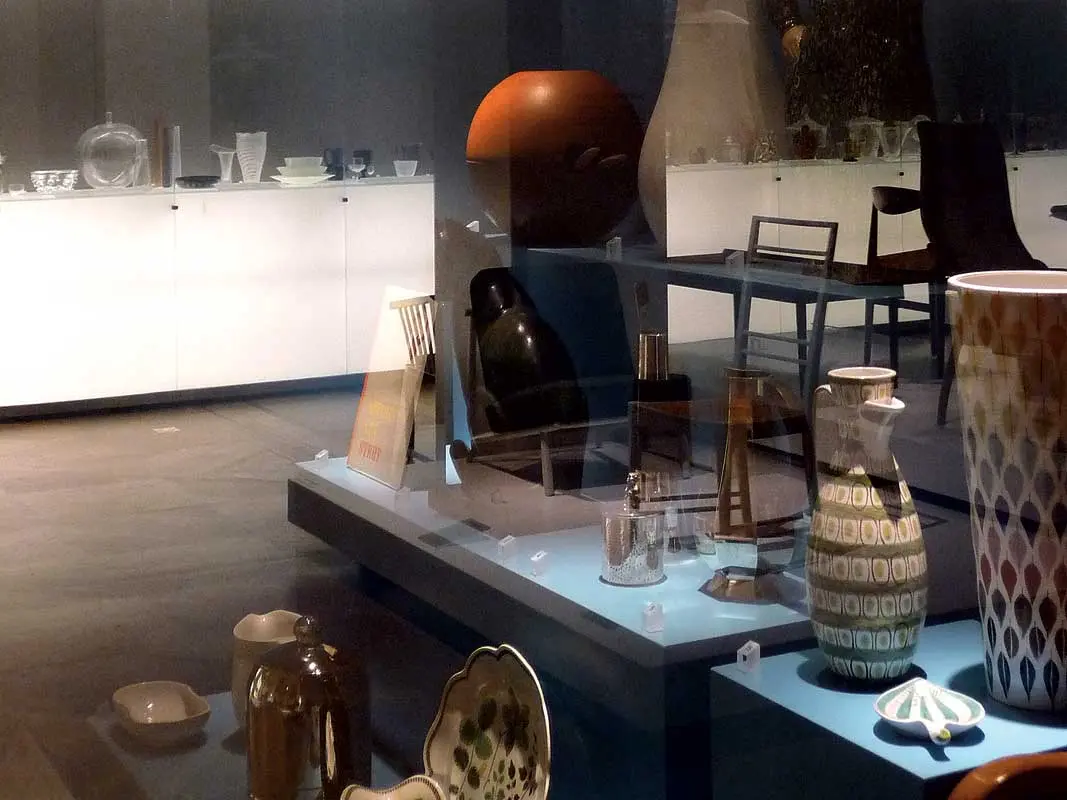
It would initially appear as if, with this exhibition, Mauricio Lupini wants to point out an unfinished and, therefore, failed Venezuela’s modern project. Despite this apparent negative take on modernity, the exhibition could not avoid prompting our own experience of it and filling us with nostalgia. We did not have to look hard to find the essence of how modernity occurred in Venezuela. There, where the ample and modern spaces found in many constructions in Caracas; at the entrance, we find the philodendrons that even today welcome us – as in the exhibition – too many houses or quintas in Caracas. There are the Stack Chairs with Gio Ponti’s 969 Chairs – the very simple but beautiful Superleggera, also by Gio Ponti, were impossible to acquire for this exhibition, and even the modernist lamps we used to like so much – never mind that these are unplugged, without their cables, and unable to perform their functions. There are also the sounds of La Onda Nueva (The New Wave), the Bossa Nova made in Venezuela. Most importantly, there are – even if just their shadows – the silhouettes of furniture by Charles Eames, Alvar Aalto, Eero Saarinen, Ludwig Mies van der Rohe, and Alf Svensson, among others, which was the highlight of northern modernity, and the 2009 video Hägring (Mirage) that according to Julieta González, the exhibit’s curator, deceives us with its “veils and reflections” and presents us with the household objects that achieved such success among us.
Finally, there is another video titled London, Tuesday 9 December 1997 (Plaza Collection, 2010). It intermittently shows the appearance and disappearance – without the option of stopping such painful vanishings – of information labels and prices – fortunately without showing any art images, as that would have been too painful to watch – that belong to a marvelous collection of eighty-five works by Morandi (oils, drawings, and prints). The collection had been promised in 1971 to the Museo de Bellas Artes in Caracas by a private collector. The donation would have transformed this institution into one of the most important museums in Latin America and would have offered the world the opportunity to learn firsthand about Giorgio Morandi’s work. But it was not to be so, thanks to the incompetence, ignorance, and tightfistedness of the governments that have always served Venezuela.
This is my feeling about the exhibition: it is the vision of a fragile, inconsistent, and phantasmagorical modernity that failed without ever been able to coalesce, but one that we still remember as fabulous and impressive.
IRIS PERUGA