
Miler Lagos was born in Bogotá and has continued to work there for more than a decade. Lagos’ work has explored the issue of appearance, focusing primarily on the cultural and ideological background that determines it, in order to understand what motivates people to propose dispositifs wherein a given situation or fact simulates its belonging to a different category of experience.
The reasons behind Lagos’ interest in this type of cultural situation are related to his interest in identifying cultural legacies that are acknowledged as legitimate in Colombia, and the social behaviors into which they translate.
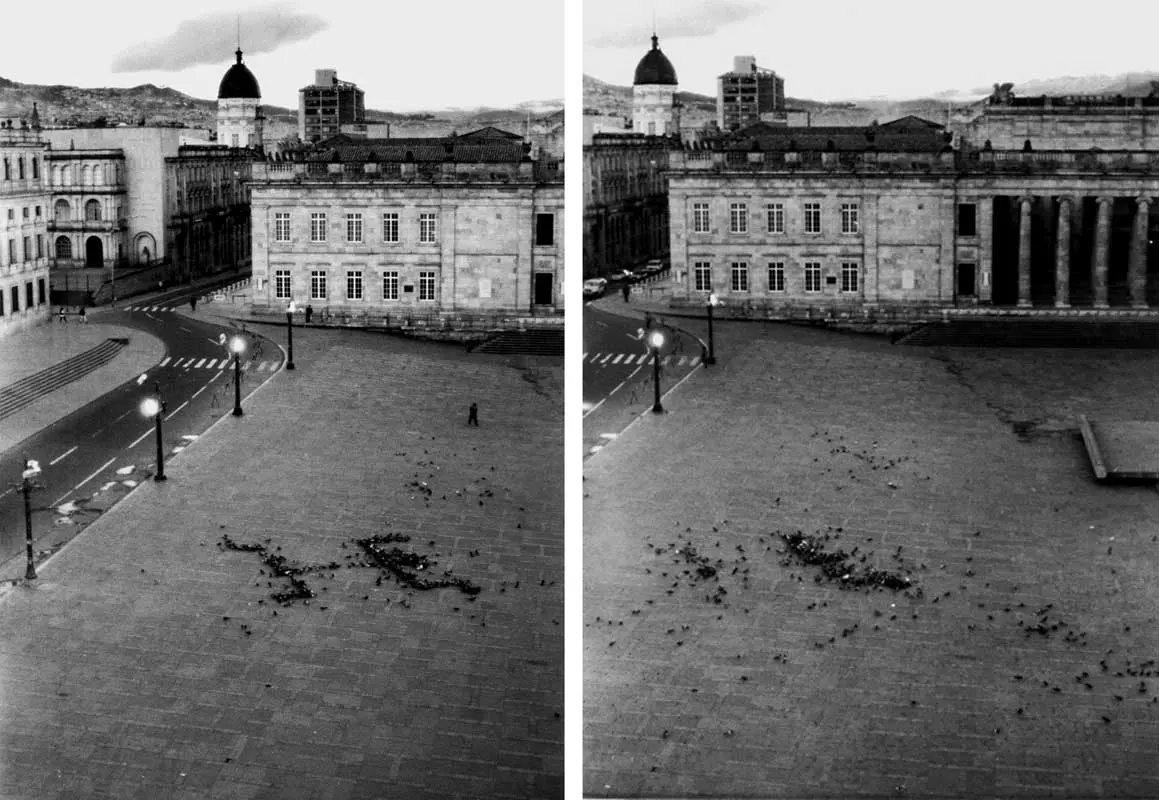
One of Lagos’ earliest works, perhaps a landmark in a path he still follows, is the project Columbas (messenger pigeons), created in 1998 at Plaza de Bolívar in Bogotá. This project makes it possible not only to characterize his insistent attention to processes of cultural identification, without a de-colonializing discursive framework but also to see how it determines a modus operandi in the construction of his works or in the selection of media. Columbas was a drawing, almost 20 square meters in size, that induced hundreds of pigeons to alight on it so as to become the very elements that form the work in visual terms. Given this process, which happened around dawn, the work itself is a photographic record that captures in three successive steps the process of un-making of the image—the figure of an emblematic pre-Columbian tunjo. This name, commonly applied to all anthropomorphic figures from the Muisca ethnic group, which inhabited the region around Bogotá before the arrival of the Spanish colonizers, took up the Plaza’s central section but dissolved progressively. Lagos’ interest in temporarily intervening in the site had its evident origins in the cultural, political, and historical weight bearing on the Plaza, beginning with the symbolic presence of Pietro Tenerani’s statue of Bolívar and ending with the branches of government represented in the surrounding buildings: the Congress, the Justice Palace, the city’s Mayoralty, and Colombia’s Cathedral. The architectural features of these buildings are characteristic of the colonizer’s culture (Baroque, neo-Classical, Modernist), which intensifies the absence of references to the colonized in such an important locale. This is why the transitory nature of the image formed by the pigeons emphasizes that absence.

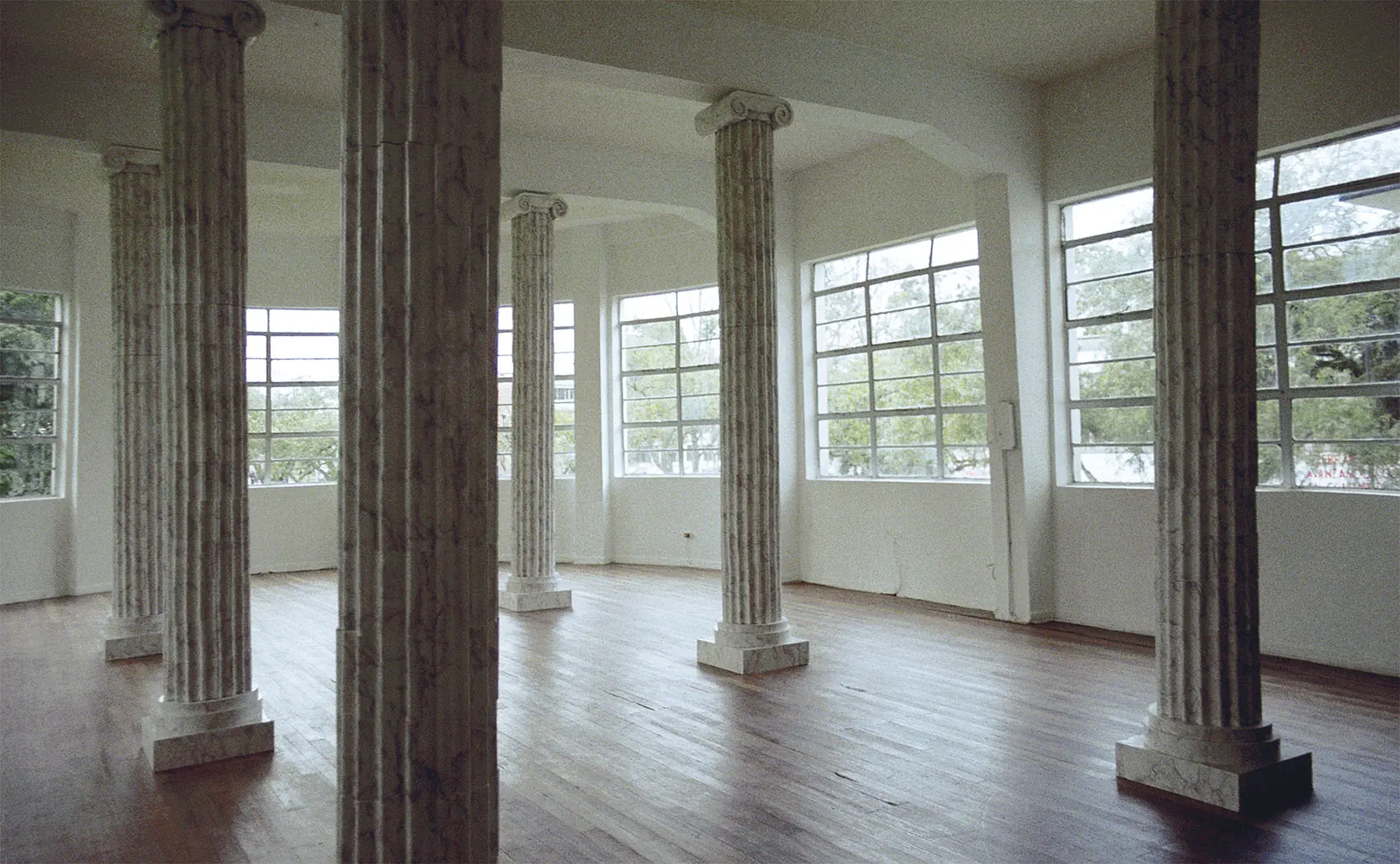
Miler Lagos says that this work is directly related to his project Lugares soberanos, created in 2002 as his graduating thesis, because it told him how the processes of social exclusion that have determined the character of hegemonic culture in Colombia (which he identified in the architecture of Plaza Bolívar) can be traced back to the affiliation that has occurred around the adoption of cultural models, such as those that characterize the history of art and architecture. It is significant as well that the word Columba, which is a kind of pigeon, has morphological echoes with the word columna, or that it evokes the word pre-Columbian. Lugares soberanos was an installation and it functioned as a site-specific work. It consisted of the placement of a set of six columns as if supporting the architectural structure of space within a modern building. The columns were made in a synthetic material, Formica—whose appearance imitated rather skillfully that of marble—that had been subjected to a thermo-molding process (in fact, a hand-made process by the artist himself) in order to imitate the striations of Ionian columns. This material is nothing but a sheet of printed paper, covered by plastic surfaces, which was premonitory of works he was to develop years later. At that point, the generation of cultural interconnections was crucial for Lagos, since the material evoked a series of social uses that extracted such architectural echoes from their usual references. This idea of fiction or simulacrum that ends up supporting material reality will follow different pathways in later works, but the connection between her work and the processes of an expanded concept of sculpture, such as the attention to a matter that gives shape to his works and their transformation due to different human gestures, will remain constant in his oeuvre. Lugares soberanos was one of Lagos’ earliest works to circulate with relative efficacy in different exhibition contexts, and for that reason, he started to make it known in the Colombian art scene.
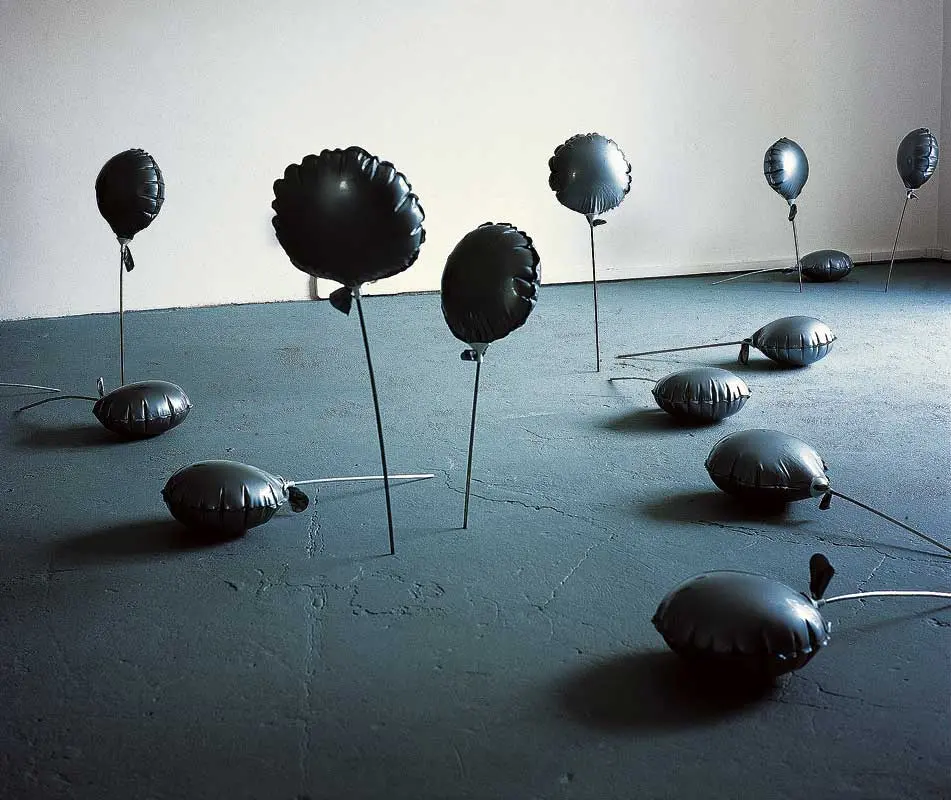
Some time afterward, Lagos’ concern with the chasm that lies at the foundation of appearance, in cultural terms, drove him to revise a type of apparently harmless cultural practice, such as toys, paying attention in the process to the terse, weightless surfaces of balloons. In 2002 Lagos produced Nivel Zen, where more than dozen silver-colored balloons emerge from the ground or seem to have returned to them as their helium content weakened, in a kind of cultural translation, in terms of class and ethnic group, of the lightweight image of Warhol’s Clouds. Viewers who stepped up to touch the balloons were greatly surprised by their enormous weight (approximately 7 kilograms), which made evident a new dimension of appearance in his work. The complexity of the creative process—to fill the balloons with concrete without altering their shape—was safeguarded from the curiosity of viewers, thus intensifying the strangeness of the experience. This procedure was to be revisited in 2005 by Lagos, with a series of changes under the title of Levedad insoportable.
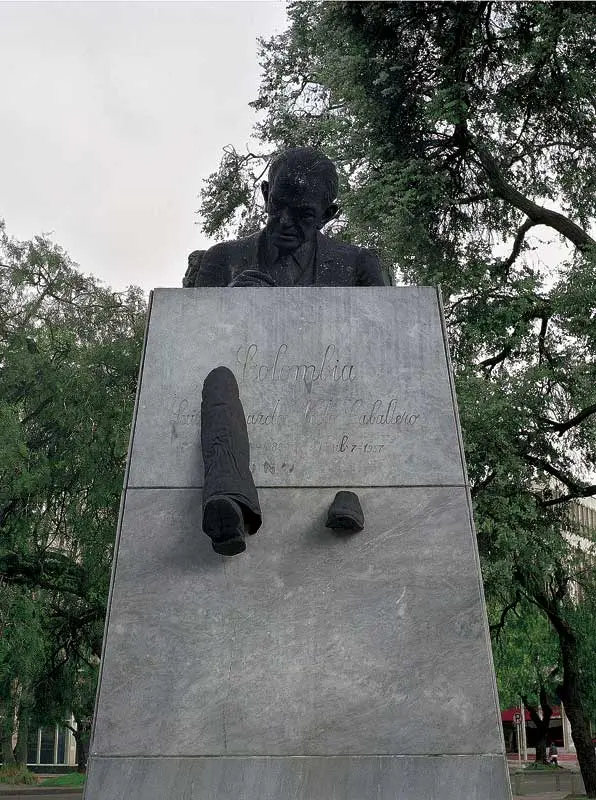
Perhaps the process described above helped him pay attention to a certain kind of public monument in Bogotá, or more concretely, busts of historical characters, often precariously made. Looking at them randomly, Lagos noticed that the rest of the body seemed submerged inside the block of stone or concrete, like in the archetypical reprisal favored by gangsters in Hollywood movies who set their enemies’ feet on cement. One of these busts grabbed his attention, the monument to politician Luis Eduardo Nieto Caballero, since the arms are leaning directly on the pedestal, as if on a desk, which makes the base and the iconography inseparable. Miler Lagos made a projection of the body into the pedestal’s volume and noticed that, if the body were complete, a portion of the right leg and the tip of the left foot would stick out. Thus, he proceeded to mold in polyurethane those fragments of the body and attached them temporarily to the pedestal, recording the results photographically.
He made an analysis and similar interventions in connection to other monuments in Bogotá, and later in Medellín, and the resulting photographs comprise his project Inmersos, created between 2004 and 2008. This project is related to Columba through the use of photography to document a temporal intervention as if it were a sculpture tactic and develops a latent aspect of Lugares soberanos: the rhetorical omnipresence of power.
In Los términos del Juego, Lagos used rubber red and blue balls, revisiting the interest in toys he had explored with the silver balloons, and paid attention to the way in which ball games, being competitive, function as simulacra of war-like impulses. The selection of these elements was preceded by his analysis of some sketches made by Leonardo da Vinci for the design of catapults, which from the standpoint of engineering seem precarious or inoperative. Miler Lagos had known these images before entering the art field. The purpose of the work was to generate a spatial situation where the position of two sides (expressed by the colors of the rubber balls) whose mutual border would be formed by a barrier of paper blocks printed with Leonardo’s sketches. Strangely, in formal terms, the balls used were evidently analogous to the projectiles in Leonardo’s sketches, which seemed to parody the inefficiency of weapons design. The work involved a game of meaning that contradicted its appearance since once the thousands of pages were printed with Leonardo’s drawings, Miler Lagos wanted to prevent a distance between the edges of the real paper and the edges of the paper on which the drawings had been made, the latter frayed, fragmented, and made imprecise by the passage of time. This is why he pressed the printouts into blocks and trimmed the excesses with great precision, using a sander. As a consequence of the heat produced by the sander’s disk, these paper blocks resembled wooden planks that later revealed themselves to be, rather, loose leaves. The rubber balls, piled up in different configurations, also surprised us with their enormous weight, due to their concrete filling. In Lagos’ words, it was possible to see the work as a reflection on the absurdity of war and the seriousness of play.
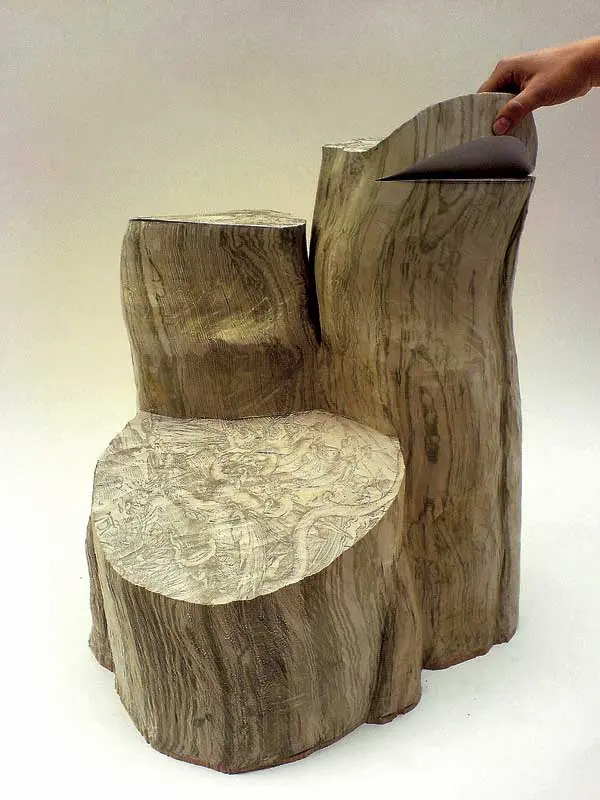
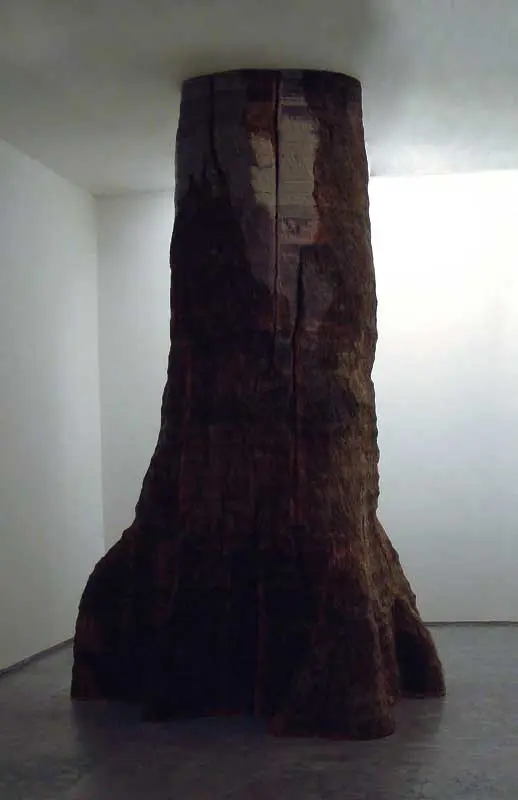
The project is known generically as Cimiento, undoubtedly the most resounding and widely accepted in Lagos’ career, has among its precedents the previous project. One of the earliest works in the series was a printing of Albrecht Dürer’s engraving Melencolia on 5,000 sheets that were later trimmed into the shape of a tree trunk, with their outer edge resembling the bark. Lagos was able to visit Germany, bringing this work along, and placed it in front of a series of sites connected to Dürer’s life. With the help of video, he recorded the way in which the wind dispersed the sheets throughout the city, in the same way in which the books printed by Guttenberg had been dispersed many centuries before. The wind “leafed through” each one of the pages and slowly took them away, with the effect of making the trunk disappeared. Other dimensions of the project emerged later as images were found that commented on the possible relationship between the tree, the paper, and the diffusion of ideas, and Lagos began to use different cutting tools that generated subtler formal features. Within this project, he created a number of works that have circulated widely in the international art scene.
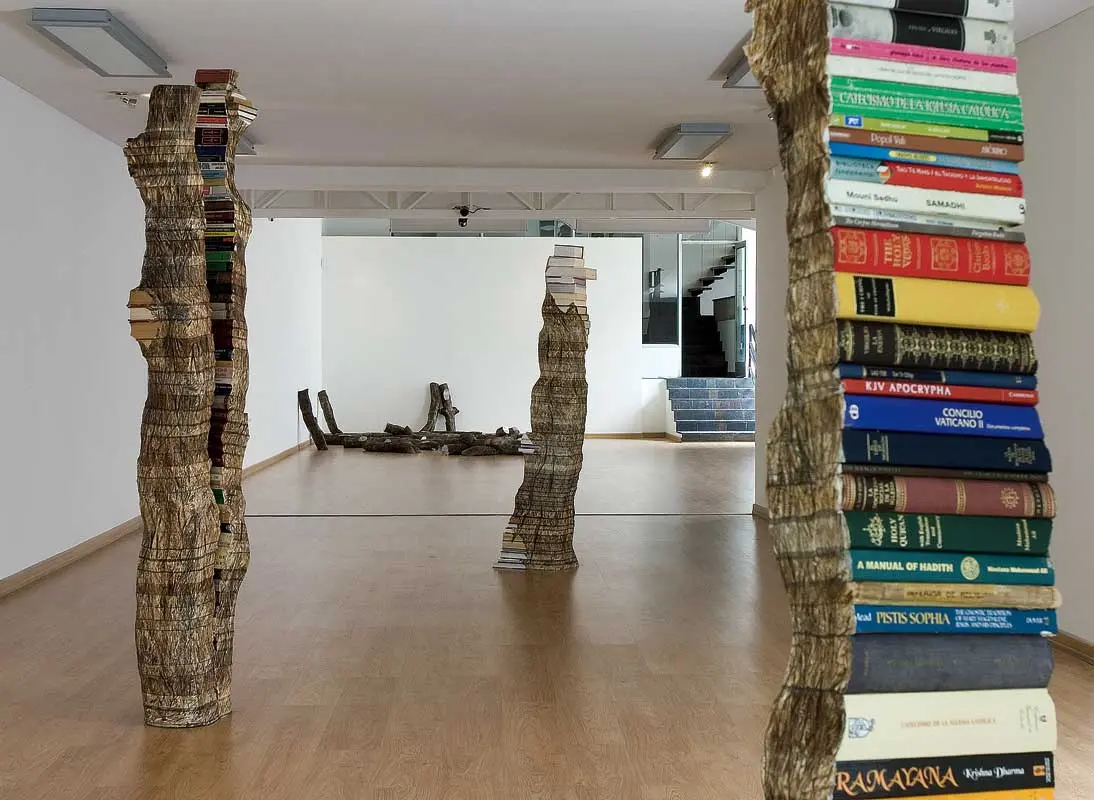
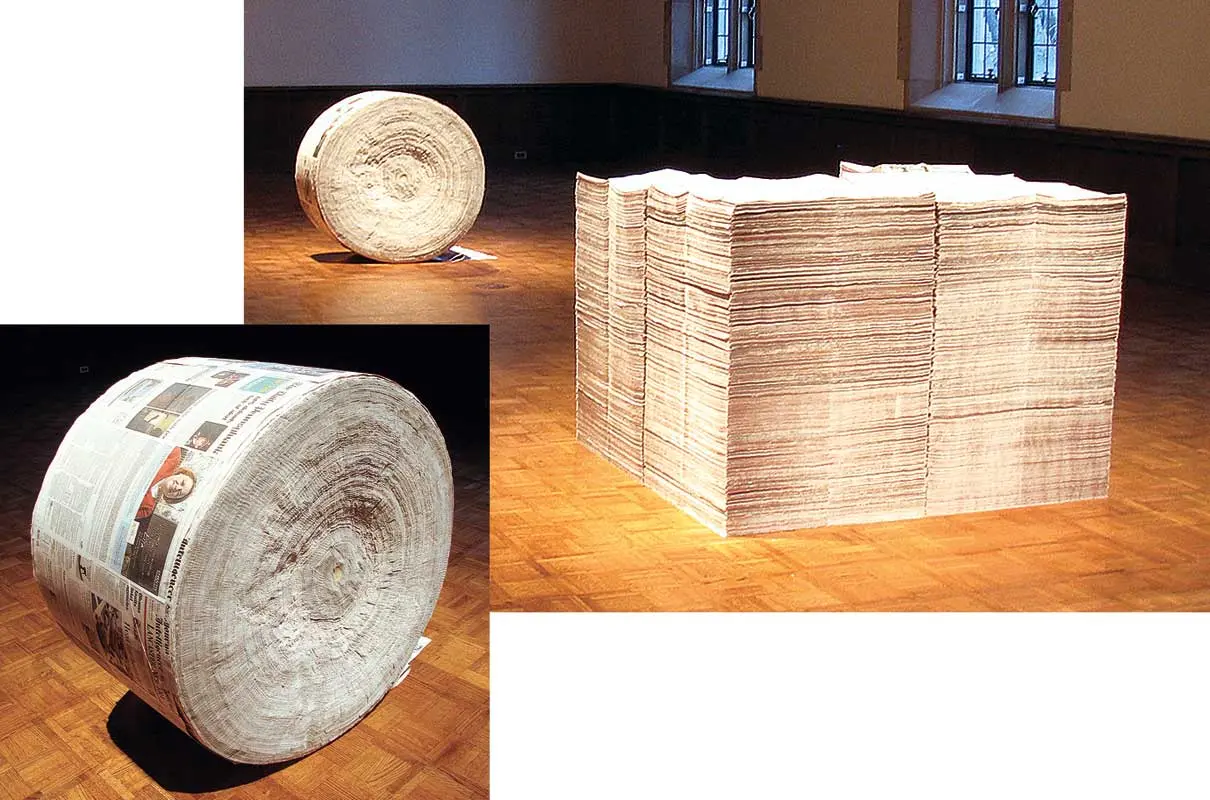
A couple of pathways emerge from Cimiento: the exploration of printed media such as books and periodicals with attention to their content, or the idea of the print run of a periodical publication as a way of approaching the configuration of its ultimate source, the image of the tree. As an example of the former, we have his project El papel aguanta todo, where Lagos piles up books with significant ideological content, such as books on religious topics, and trims them in such a way as to evoke the image of the tree trunk, leaving the spines visible to achieve an interweaving of meaning. A standout in the group is Fragmentos del tiempo, which alludes to the name of the newspaper from where he has taken the material and resembles the root of some kind of mangrove. Along the lines of the second pathway, we have Lagos’ large installations, which he has named Semillas mágicas and resemble comic strips where a gigantic plant grows in a very short time. These impacting works explore the fascination that we feel for trees such as the Ceiba, whose dimensions sometimes seem impossible. In a similar direction, we find his project Silence Dogoog, presented earlier this year at Philagrafika 2010, where he joined together pages from local Philadelphia newspapers until they reached a length of 2 kilometers, and then rolled them up to generate the image of a tree’s time rings, silent witnesses of the history of the world, which is in a certain way also true of newspapers. There was another pile in the shape of a throne that established a connection to Benjamin Franklin —referring to a monument erected in the same campus— who used newspapers strategically in furthering his causes, and one of whose pseudonyms is used as the title of the work.
In parallel to his works on printed paper, Lagos has continued exploring photography and video in order to deal with the same issues that have characterized his work overtime. In Attraction, we encounter a slow-motion video of a heart-shaped red balloon falling on a large body of water. The balloon falls slowly, as if it were weightless, but blows up violently as it enters into contact with the water, thus revealing its true density. It is accompanied by a series of sculptures, similarly shaped and molded in tar, that look like they are melting. Once again Lagos reminds us of the way in which nature inevitably defeats human understanding. Many of his recent projects go unmentioned in this text, but in closing, I would like to mention Vista en planta, conceived for Intervenciones Valparaíso, an event whose visibility was very low due to the earthquake that shook Chile a few days before its opening. Lagos explored the crossroads of the abandonment of architectural structures and the expansion of wildlife that is not necessarily of local origin, which seems an apt metaphor for the processes of colonization. The project was based on the investigation of one of these “colonies”, to make them identifiable and legitimate by means of labels that informed us of their belonging in the plant domain. Once again in this case the “natural” appearance of a fact gives way to the historical and political forces that generated it.
JAIME CERÓN
Art critic.