In 2008, young artist Ricardo Yui (1983) graduated in photography from the Centro de la Imágen – an institute of higher learning equivalent to a university of photography. This is Yui’s second solo exhibition. It is titled Espacios Intermedios: Los Talleres SNFC 2008 (Intermediate Spaces: The 2008 SNCF Workshops) – SNCF being the French acronym for the French National Railways. To create this series, Yui spent four months completing an artistic residence at the École Nationale Supérieure de la Photographie (ENSP) in Arles. He sought artistic beauty in the remains of the forsaken buildings and in the ruins of the SNFC dating back 160 years. The series is titled Espacios Intermedios because Yui emphasizes the architecture of the place, a space with interior and exterior sections that are in transition because of the intermediate time in which they are found, a lapse of time that will only lead to even more deterioration.
Yui searches for and relies on natural light to reinterpret the ruined buildings with his photographs. While it is true that beauty can be found everywhere, it is through an artist’s gaze that we are able to see this. Yui succeeds with this series because there are photographs for every taste, printed in large, medium, and small formats. The majority of the photographs are in black and white, although a few of them are also in color. While all of these photographs reveal the neglect and erosion of the buildings, there is also beauty to be found in them in the treatment of the natural light.
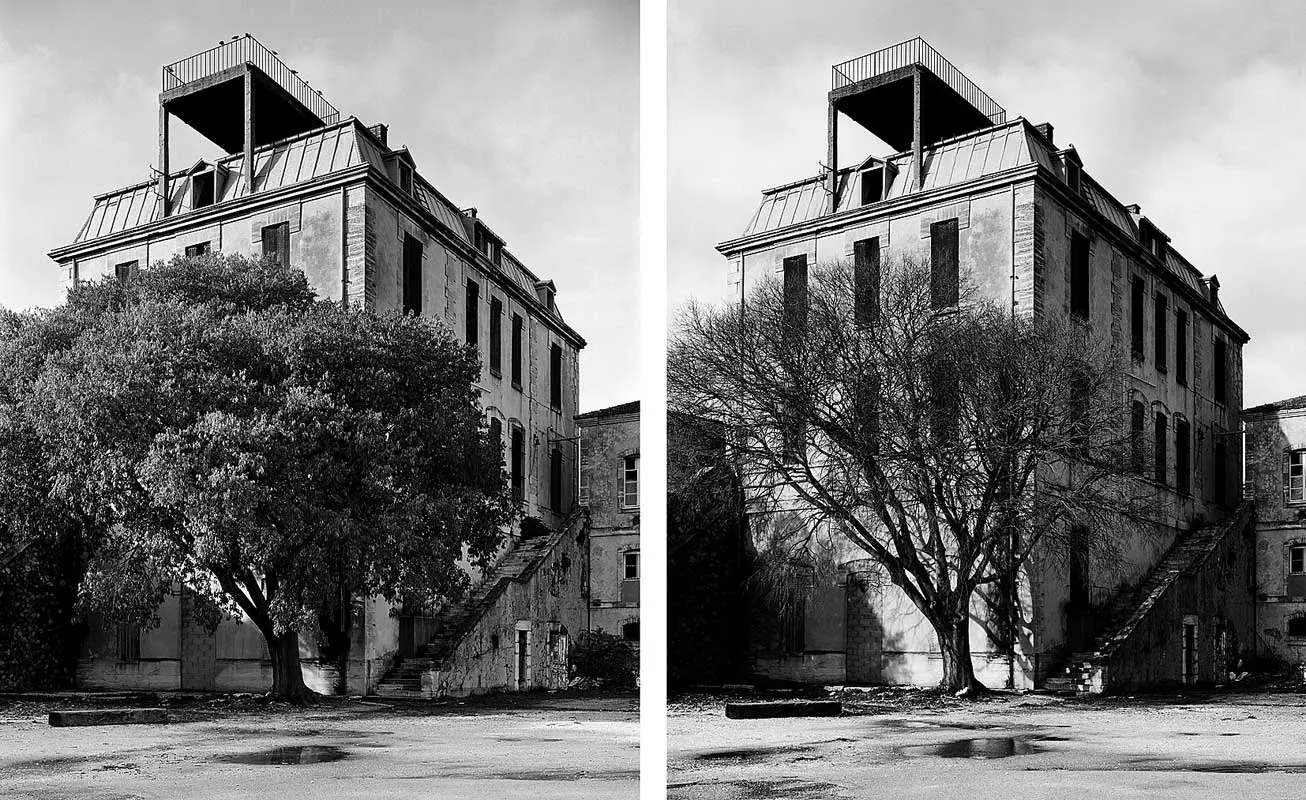
There is a diptych that consists of two photographs of the same image but that was shot showing that same tree now bare because winter has come. These photos set the beauty of nature against the ruins of the building in the background. These images are at once imposing and charming. The work wins the viewer over after the first glance. An artwork that is imposing while also aesthetically pleasing can only be liked.
Yui’s images continually present us with a dichotomy; exterior/interior; ruins/nature; light/darkness, far/near. Such dualism through the use of light becomes the most important element in his work. In the few color photos shown in the exhibit, the white sky mutes the colors in the photograph. The green grass, for instance, set against a white sky renders this duality between B&W and color intriguing. A large-format photograph shows a tunnel and railway tracks; a blue sky covers the upper part of the image and is the only color element of this photograph, as the remainder of the composition looks like a B&W photograph. This is the magic of Yui’s work: its duality.
Some of his photographs remind me of works by famous artists. One image of a room with a wooden floor reminds me of Gustave Caillebotte’s Les Reboteurs de Parquet (The Floor-Scrapers). The walls in the photograph in question show the same perspective used in Caillebotte’s painting, and the window also appears in the same place. Another photograph of a large, dark room with a door letting in some light reminds me of the rooms rendered by painter Fernando de Szyszlo. Likewise, there is a photograph of bare trees and snow covering the ground that evokes the work by Harry Callahan. And in another photograph taken inside a dark room, the only thing that can be seen is an open door letting in a lot of light that, nevertheless, only illuminates the area immediately near the door, thus leaving the remainder of the large high-ceilinged room in darkness. This photograph can be the embodiment of the entire series: exterior light/interior darkness; abandonment; the exterior space; the emptiness of the interior space; the immediacy of darkness, and the remoteness of light. Yui’s work belongs to the “Straight Photography” movement because it seeks real images that are not staged or intervened.
None of Yui’s works show symmetry, a characteristic that is rare among photographers. He approaches his work in a different manner, but his compositions are nevertheless successful. Nearly all of the photographs are of exterior or interior doors and/or windows shown allowing light into the image.
All of these works are untitled because the series must be observed as a “sequence because the survey of the images eventually suggests a narrative of transit over the space. This way, the work can be read as a whole that is gradually and subtly formed as one walks through the exhibit.”1
Yui demonstrates that what may not be good for society – namely, the ruins or decay of certain industrial buildings – can actually become the theme for a good work of art.
NOTA
1. Interview with the artist, March, 2010.
AUGUSTO CHIMPEM