
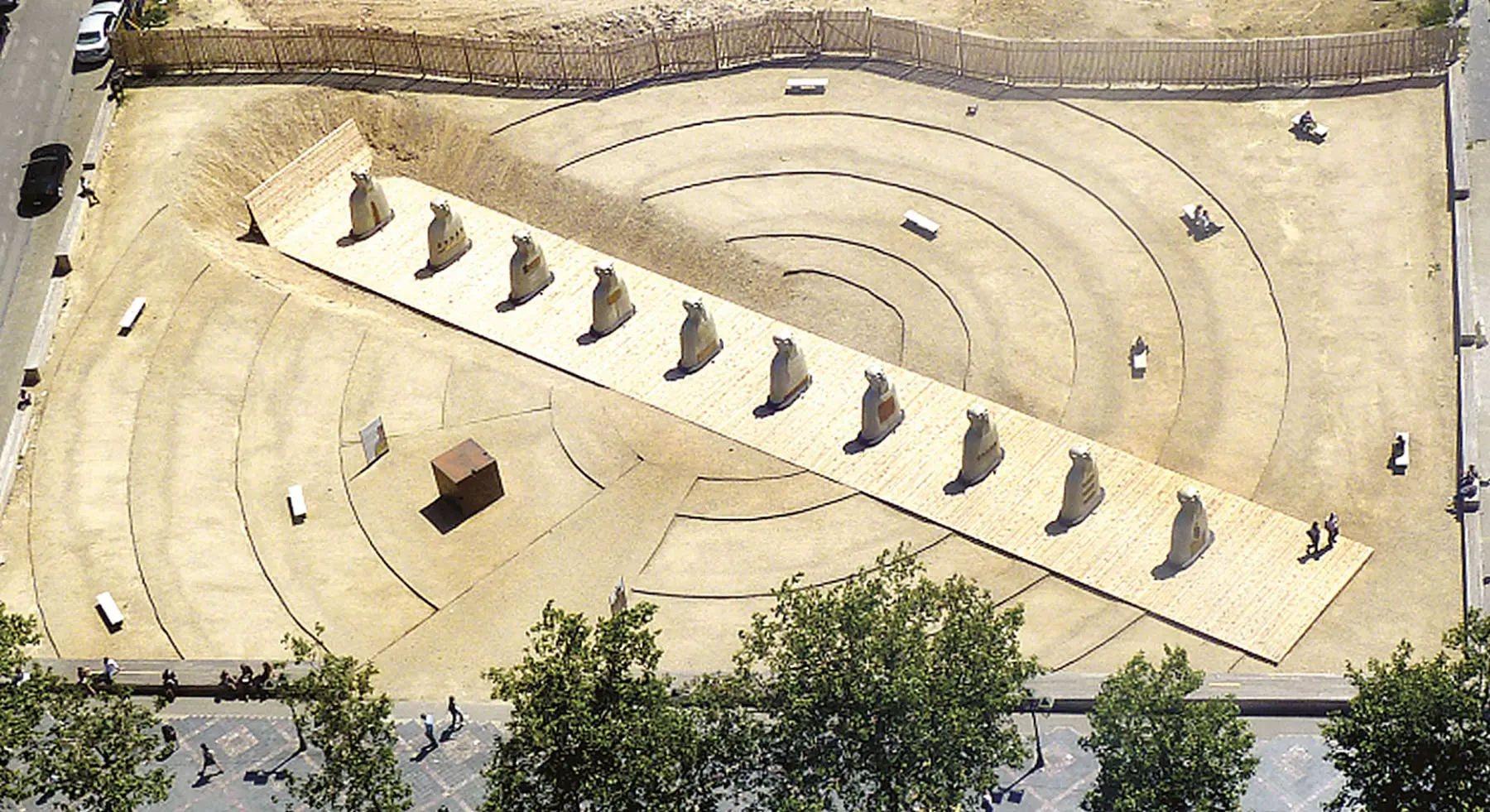
On Friday, May 14th, at 18:00 hours, on Toison D’Or Avenue, in one of Brussels’ exclusive and most commercial areas, a large group of Iranian residents rallied against the execution of five students at EVIN prison in Iran. Carrying placards, flags, and photographs of the victims, children, women, and men—some with their mouths covered by packaging tape—protested under the cover of the “guardians” created by Mexican sculptor Rivelino (Jalisco, 1973). The imposing figures of Nuestros Silencios claimed for themselves the authority and attention of being heard outside their local space and became ambassadors of the kind that have no voice in the parliaments and hallways of international politics.
Very seldom does a non-permanent public art installation transcend its location and turn into such a potent symbol of political representation. And without recourse to conceptual speechifying or pamphleteerism to open its meaning and its polysemia to the intervention of the street, which many in contemporary art are prompt to call “site-specific” art. A specific site of what? A large majority of these interventions is not sustainable outside the context of the gallery or the art institution. What a paradox! Nuestros Silencios is anything but silent voices; it is an argument and a complete turn of the screw of what public art ought to be in its full dimension: an interpellation of the viewer/passerby, communication, forceful visual proposition, integration into the urban space and the political or social context of the intervened location, and retention in the memory of the city as part of its “urban legends.”
From its first presentation in Lisbon’s Marques del Pombal square, and later at Juan Carlos I park in Madrid, Nuestros Silencios has been received with great interest, although its reception has varied widely from city to city. This is to be expected for a work of public art that takes carefully into account each one of its sites and the place of its installation. At Toison D’Or avenue, in the Louise neighborhood, there has been for several years an empty lot symptomatically known as “Brussels’ wound,” a place that embarrasses the locals and whose owners can’t come to a final decision as to what to do with such an expensive piece of property. In three short weeks, Rivelino and architect Héctor Velázquez Graham transformed the empty lot into a powerful attraction with their urban intervention, thus healing the wound. Yet Nuestros Silencios has questioned public opinion in the site of the European Union’s capital, where so many unsolved international conflicts are aired. And moreover, this work has run away from its author to be appropriated by the residents of neighborhoods that desire their permanence.
For this specific 5,000-square meter site, architect Velázquez Graham designed a highly symbolic plaza in the shape of three concentric circles that stretched towards the center of the circumference. At the center, an axis with the shape of a wooden ramp served as the base for lining up the “guardians” that, imposing, gazed towards the building of the Brussels’ court, and, farther away, the European Parliament. The urban intervention was more than the mapping of the site because it included the intention of becoming a “cosmic” space in its symbolic dimension. The concentric circles with an axis, Mircea Eliade, said, signal the “sacred site,” the center of the world; there where chaos and amorphousness reigned, the beginning of life was organized and the forces that generated beauty and the beginning of everything intervened actively. The guardians, as their name indicates, protect the balance.
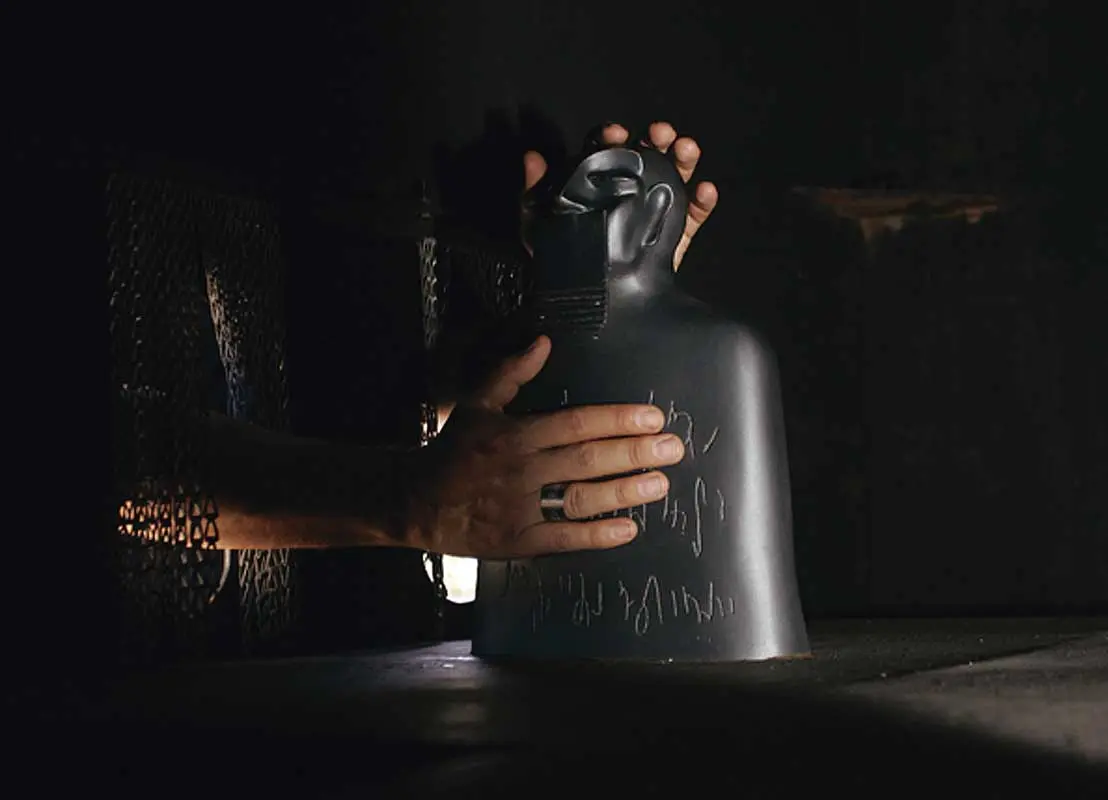
The guardians, ten colossal sculptures (3.5 x 2.3 x 1.1 meters each), were smelted in bronze and later covered with a fiber that made them seem pliable as clay and soft as porcelain. Where the mouth would have been, a kind of almost rectangular plaque was placed; it impeded us from “hearing” the voices or resonances. Each plaque differed from the others in the signs and graphics they were inscribed with, lines or writing in some forgotten language that nevertheless spoke to us secretly of that which they hid. The signs also appeared on the voluminous body of the sculpture, a powerful, closed abstract shape that unified the ten guardians. The head corresponded to the same design, which unified the synthesis of features. After a study of the five predominant ethnic types, Caucasian, Black, Asiatic, Native American, and Arabic, a representative "prototype" was built. Perhaps they remembered the utopia of a single race, the meaning of which is to be found in a single phrase: the human being. It is accompanied by the Tactile Box, a 2 cubic meters steel structure in whose interior are four small-scale sculptures reproducing the larger ones. The Box, created specifically for the blind, not only presents four cavities containing the volumes but also invites us to the pleasure of touch and of discovering on their surface Braille messages inscribed on the guardians.
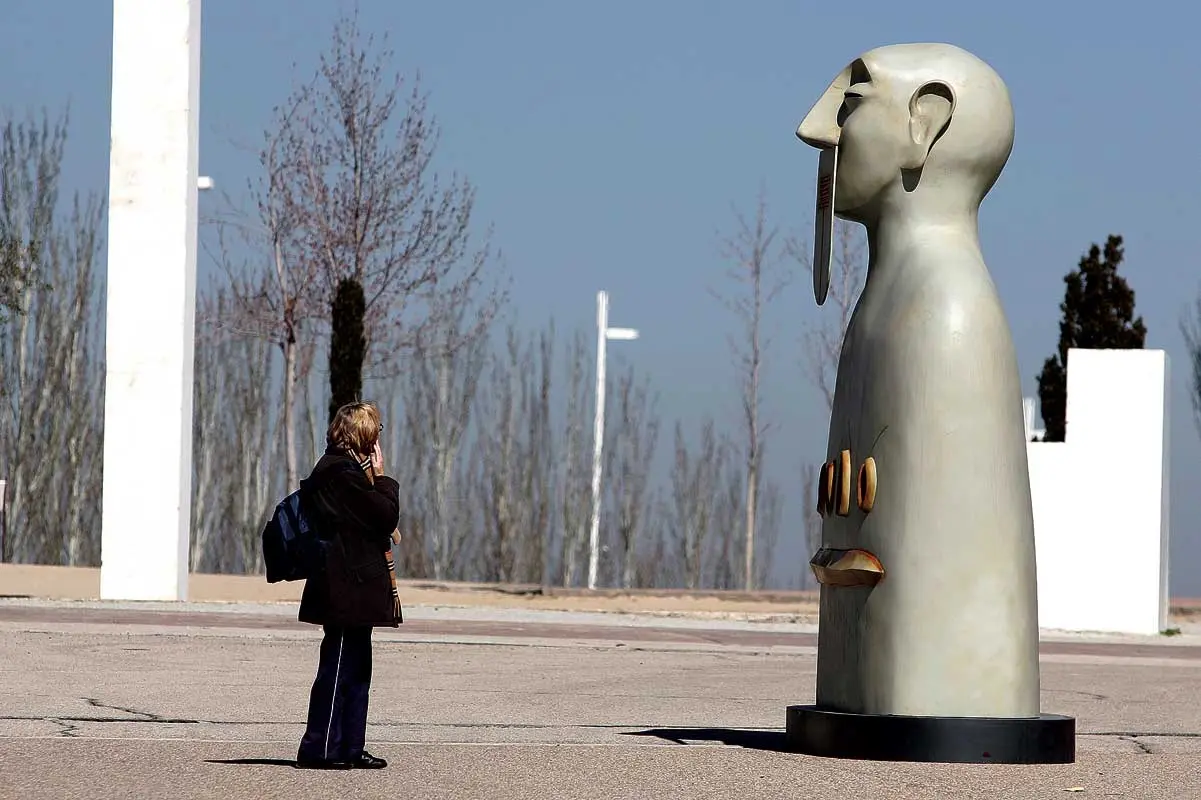
Of special significance is the monumentality of the sculptures and their reference to ancestral traditions of American sculpture, especially those that exalted stories of foundation and initiation, many of them have lost their meaning and language today. In Rivelino we appreciate the influence of the monumental Olmec heads and of the Toltec artists in the almost frontal treatment of sculpture, its massive volume, and the abstract synthesis of the human form. Perhaps Rivelino aspires to bring back a collective connectedness through the entirety of his oeuvre, especially in his sculpture and its materiality (bronze, clay, steel). Returning to a tradition that enriched Mexican culture links him to the resurgence of the avant-garde and to those monumental projects of the Muralist crusade. Like Diego Rivera, Orozco, and Siqueiros, Rivelino appeals to the social, committed sense of art, an art that confronts us from its very roots, its identity, and, why not, its subterfuges.
With Nuestros Silencios, the Rivelino of the Americas has returned through the ocean to Europe, not only as of the representation of a utopia forgotten by the Europeans in their dream of democracy and equality, the desire to build it in a newly-discovered paradise having been soiled by the brutal conquest of the New World. In a global context where, apparently, we are all interconnected, Nuestros Silencios is the response of a silenced majority deprived of access, mere witnesses to decisions that affect them but pay no attention to their opinions. Silences travel from one city to the next, from one country to the next, connecting millions of citizens forgotten in their private lives, severed from a growingly less participatory public sphere. Art has neglected a deep principle that gave it meaning throughout its history: to be a communicator of the reality of the present and to build a readable visual space for the many rather than just for a consumerist elite.
DERMIS PÉREZ LEÓN
The Curatorial Bureau, curator, and independent art critic.