Under the general curatorship of Ana María Battistozzi and designed by Gustavo Vázquez, the show Recolección-Restitución. Citas por América Latina was presented between April 27th and May 30th at Buenos Aires’ Centro Cultural Recoleta’s most relevant exhibition space. This mega-exhibition of works by Teresa Pereda (Buenos Aires, 1956) was programmed as part of Argentina’s National Bicentennial celebration and was one of the “main courses” on the agenda for 2010.
Starting in the early 1990s, Pereda has been exploring a kind of “collective landscape memory,” with its own complex derivations, fluctuations, and developments, all across this nodal section of the subcontinent. From that multiform perspective, open to the use of all the languages of today’s art, the effort of this artist settled for decades in the area of Lincoln is certainly to be noted an effort resolved and matured in a more than positive way in this show, conceived as a summa artis of her material, performative, objectual, photographic, and filmic poetics.
Essentially, the works on exhibit — the large sculptural object (large wool spools), the allegorical wall photos, and the videos — possess great delicacy and appeal, again and again, to the sensorial enhancement of the tactile and the visual, while presenting a pointedly “ceremonial” character, based on a quick succession of performances with the participation of the visiting public, thus permanently refreshed yet always “guided” by the script painstakingly designed by the multi-media artist. In that sense, Pereda says: “I am driven by the intention to establish a system of communication, not strictly verbal, nor visual, but more profound and intimate, more direct, a state of being and feeling the world and its energy, transforming through the possibility of sharing an action, where the work propitiates a space for movement and reflection whose capacity for anticipation mobilizes common desires and wills, outlining possible futures.”
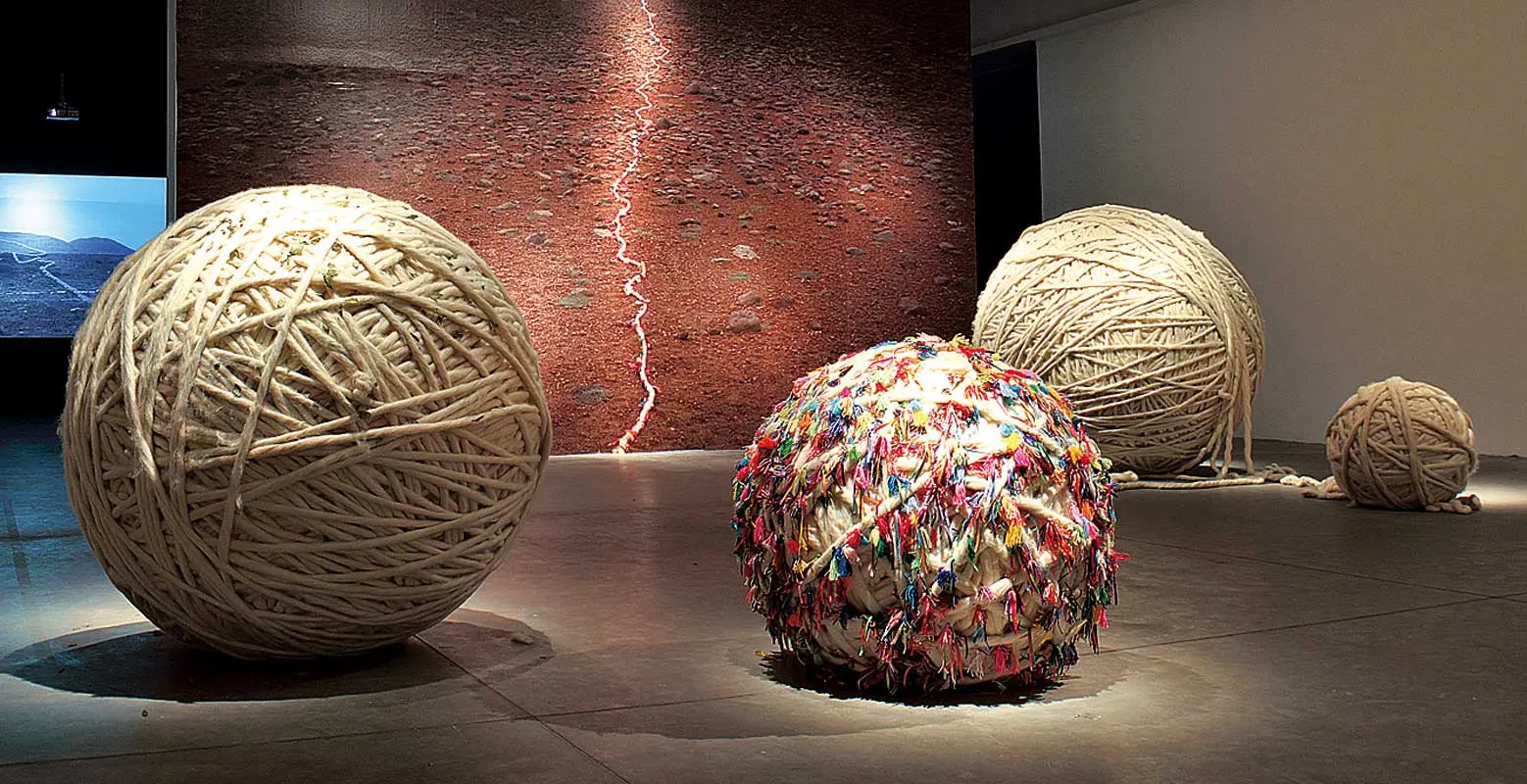
Pereda’s actions, with clear objectual referent and site-specific in character, become a rhizomatic line of “grid” execution from Tierra del Fuego, through Uyuni (Bolivia), to the Amazon Basin (Brazil), to land on a fourth station in the city of Buenos Aires, within the Cronopios Gallery’s own “framework.”
Such nomadism of the performance is the embodiment of a navigatio vitae proposed in a self-referential key. It is in a sense the idea expressed by British poet Young, who refers to the fact that it is precisely the landscape, and more specifically the sea, that functions as an experiential indicator destined to reflect “the melancholy face of human life.” Because, despite the shared effort of different ethnic groups in the “aesthetic instances” generated by Pereda, we are left with the memento mori the remembrance, the reminiscence of something that has already occurred and been documented through photography and video, which is to say, through her own “system” as referred to in her self-manifestoes, structured and conceived in the manipulation of recomposed fragments. From that perspective, earth and wool are analogous materials that establish unmediated proximity with the other, the neighbor. A degree-zero of materiality as such, later transformed, alchemically, into donation and communion with others.
Pereda’s reticulated pathways, her linear interventions on the landscape, establish differential labyrinths, sites, where the loss and re-encounter of self are always a possibility. The visitor to this at Cronopios Gallery must have surely been confronted with a continued rhythm that has much of personal journal, of travel notebook, of the testimony of a kind of work that moves in a spiral, concentrically, and intends to recover the essence of the image and the “bodies” of art.
This large-scale exhibition comes accompanied by an outstanding bilingual catalog that includes a profuse iconographic and documentary repertoire of the artist’s actions in these three locations; a critical essay by the curator, Ana María Battistozzi, titled Travesías. En pos del rompecabezas que nos representa; a four-way interview by Battistozzi with Pereda, Charly Nijensohn, and Juan Pablo Ferlat; several self-texts by Pereda, dated, according to their “route charts,” with their respective “recollections” and appointments, in this way: first in Bosque de Yatana, Ushuaia, Argentina, as part of her work presented in the first edition of the Bienal del Fin del Mundo (April 1, 2007), then Cita en Jaruma in the Uyuni salt mines, Bolivia, January (2008), Cita en Morena, Amazonia, Brazil, December (2008), and finally Cita en Cronopios, Buenos Aires, Argentina, April-May (2010), an appropriate locus given the historical relevance of the Recoleta neighborhood. The tome is completed by a detailed Cronología de viajes and updated biography of the artist.
CLAUDIA LAUDANNO