
The Dot Fiftyone Gallery presented two suggestive exhibitions during the month of June: Tablaux by Amalia Caputo and Sesera by José Luis Landet. Both exhibitions centered on the self-referential aspect of the creative process and approached the subject in an inquisitive manner. Both proposals were also prominent because of their unique characters.
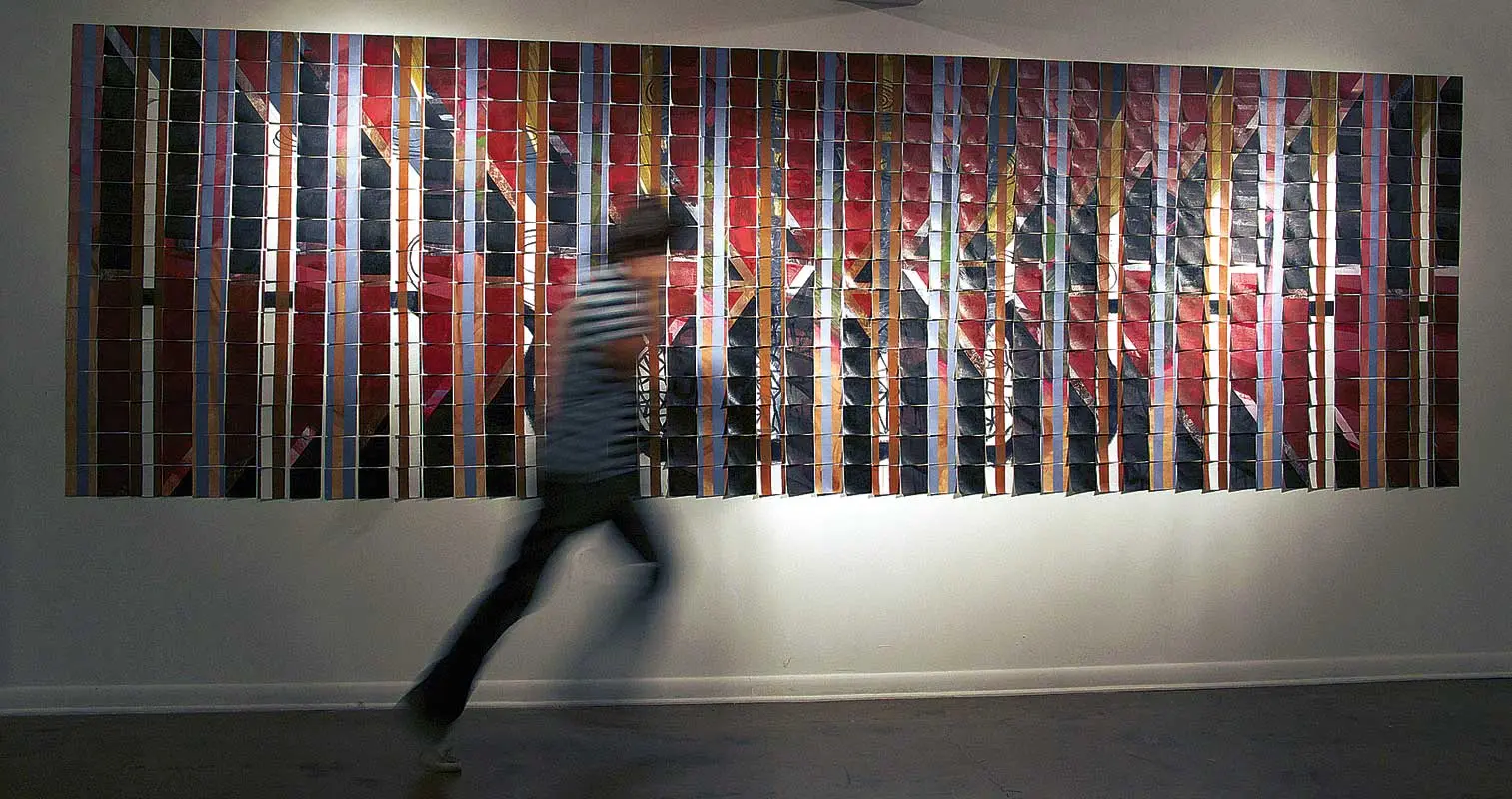
Sesera is a visceral exhibition in which Landet scrutinizes the complex grid of memory. The artist draws from the constructivist aesthetic –Russian in origin– and the world of the poster, the latter closely associated with the synthesis of information and direct transmission of the message. And this is because Landet is interested in analyzing the communication process, thus his employment of iconic figures that instantly set clear associations in motion in our mind, namely rapidly recognizable signs that repeat time after time with minimal variations.
In a secluded and dark exhibition room –as if in the presence of the platonic myth of the cavern– Landet presents The Reason of the Will/La razón de la voluntad, a video that shows an endless parade of familiar icons that interrogate us as they are projected on a wall. The fast tempo and the absence of color that stresses the idea of the shadows so dear to the platonic myth ensure our becoming aware of the distortion and manipulation inherent to any communicative act. The Reason of the Will constitutes a sort of intellectual exercise that forces our mind – and our gaze – to adapt continually. Here, Landet plays with the associative process inherent in memory, the leitmotiv that fuels his entire artistic proposal.
The works by Landet are characterized by their simplicity and masterful use of color, simple forms that the artist breaks down and rebuilds in an act of creation and destruction that functions as an analogy for memory and oblivion.

Notions such as cutting, fragmenting, recomposing, serializing, and reiterating are some of the core concepts Landet employed in his inquiry into the intricacies of memory. His works are reconstructed canvases. Once the artist finishes his work, he then proceeds to cut the canvas into identical portions; these will be combined with fragments from other canvases to create an entirely new work. Once reconstructed on the wall as a result of meticulous recomposition, this new piece emerges as a sort of visual grid of graceful and alternating rhythms.
Amalia Caputo’s Tablaux also delves into the notion of the icon. She draws from masterpieces in art history – paintings, to be more precise – that she has chosen to revisit through photography. While photography has historically been associated with these works simply as a way to make such works known, here the artist proposes a different purpose for the medium. Caputo utilizes it as a critical device not solely limited to the faithful reproduction of the original, but one that also offers its own version of the work, in addition to new readings of the theme.
In this respect, the Tablaux series (2008-2010) participates in the central problem as pronounced by Flusser surrounding the birth of the technical image, and the radical transformational effect is exerted in the history of Western culture. While traditional images – i.e. painting – corresponded to each other through a phenomenological interpretation, in the case of the technical image, we attend to a conceptual reinterpretation. We find ourselves before unprejudiced, post-historical meaning.
From Fontainebleau to Michelangelo, from Magritte to Goya, Amalia Caputo reinterprets clichés from the history of art. She recreates the original atmosphere of the work; the poses; the simplest gestures; the folds of the fabrics, even the subtle use of light that imposes a sort of sfumato. Nevertheless, Caputo does not attempt to hide the artifice. Behind the bodies, the flat background of the green-screen makes us aware of the critical commentary in which we are participating, that where the quote implies an effective dialogue throughout history.
Sesera and Tablaux are two excellent exhibitions presented at the Dot Fiftyone Gallery. While both exhibitions are beautiful from a formal standpoint, they are also conceptually substantial, as they represent an invitation to our keen enjoyment.
JANET BATET