
Our most immediate experience in this exhibition of Mexican painter Aníbal Catalán’s (Mexico City, 1973) most recent works is vertigo, the sensation of being immersed in infinitude. As soon as we enter Drexel Proyectos we notice that the gallery space expands indefinitely due to the drive towards openness communicated by the works on exhibit. We find ourselves suddenly in a plateau where the borders between “inside” and “outside,” between inner and outer space, have dissolved. Catalán’s works invite us into a space that is not closed or quantifiable in terms of the conventional measurements of domestic or urban habitats; on the contrary, we are placed in a new environment that seems to progressively emerge in a spontaneous way.
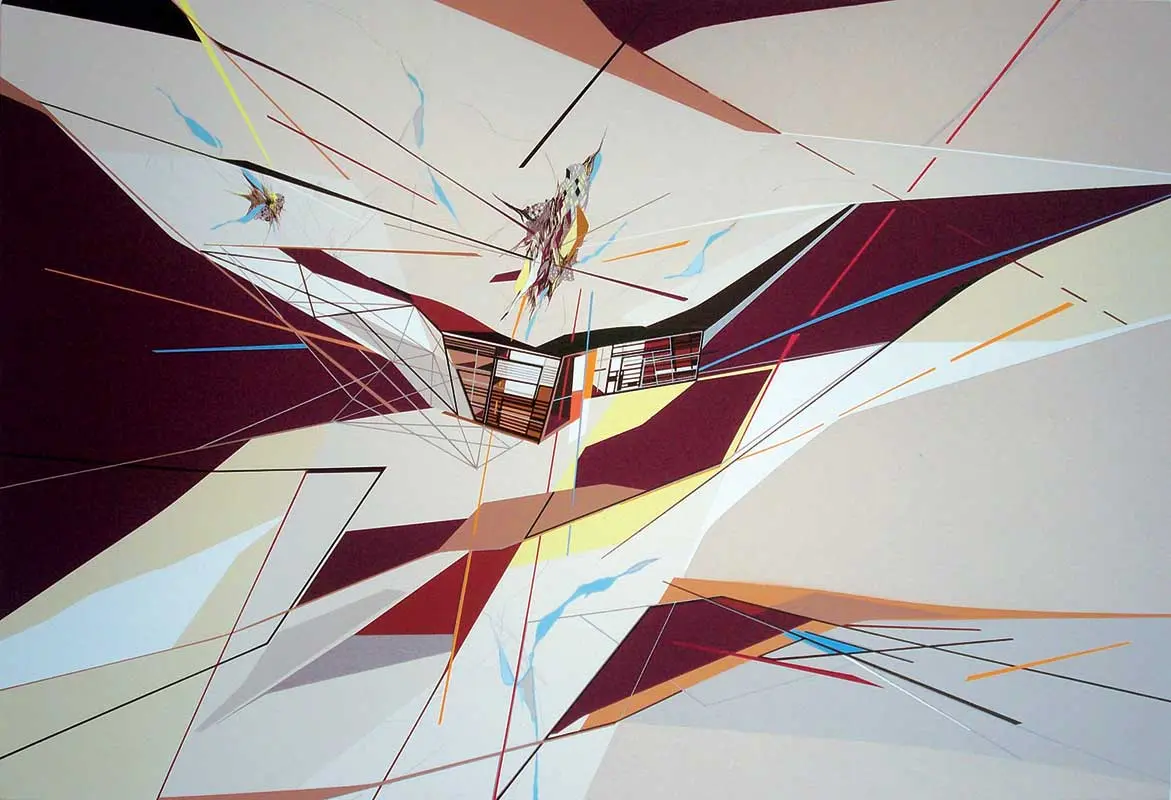
This is because Catalán’s personality as an artist is deeply permeated by his education in architecture; thus his constant concern with the spaces we inhabit and the spaces around us. It is impossible not to notice how this concern renders urban speculation playful, as it mixes architecture’s conventional forms with the symbols of diversity, of heterogeneity: the tension between these opposite directions or contrary forces gives his work mystical, ideal proportions. Catalán’s entire work is filled with this mysticism that alternates and confronts the materiality of the city with mathematical purity; what results from this diverging communion between the concrete and the abstract is an alternative, diffuse, and fragmented geometry that rebuffs any measurement. We could choose randomly among any of Catalán’s works, filled with suggestions and traces, and the result would be the same: we intuit the space, yet not as a site for habitation, but as a progressive shifting construction. Morpho series takes us to this succession of conceptual explosions, restless and colorful shapes come and go, creating in their abrupt shifts a kaleidoscopic hallucination that functions as an alternative to any accommodating vision.
Our perception, used to define space in terms of longitude, is frustrated by the dissolution of borders operated by Open Sky a painting that could be easily labeled abstract but which demands from us, not a rational interpretation of hidden concepts but an understanding of them through emotional sparks and immediate sensations. The horizon thus revealed does not feature any directional signals, it is an ethereal field, hybrid of city and cosmos, where we move tentatively, intuitively, through a landscape devoid of any demarcating extension.
Spatiality is made to emerge from this breakage of proportions: this is the secret revealed by Red Cross an installation that suspends the dividing terms between object and periphery and bursts suddenly into a homogenous space. Our attention is immediately captured by its ethereal stillness: we suspect it to be a symbol of cosmic reach where the attraction and unification of what is around remains a latency, its materials subjected to a play of deconstruction of symmetries and contours.
This same exercise in the suppression of dimensions takes the shape of an optics of disproportion in Russian Power Tower, a sculpture that, although of an evident constructivist ancestry, incorporates chance as a basis on which the artist erects a construction that evokes the Babel myth in his search for the communion of earth and sky. We perceive the collapse of the structure, but this failure of matter, overwhelmed by the horizon to which it points, expresses the tendency of form to project itself towards infinitude; its height has surpassed the framework of conventional architecture and signals a trajectory towards a place that is all expanse.
Undoubtedly, Catalán’s oeuvre calls us towards an attitude of estrangement, of suspiciousness, in the face of the familiarity of hermetic places, those that reduce space to closed measurements and contained volumes. There is an interest in freeing the form of any material vestment in order to reveal its geometric nudity, and such is the principle governing the works in this exhibition: to blur borders, to dissolve materiality in order to liberate space from the confinement that reduces it to “commonplaces.” The territory proposed here is ethereal, it is the topos uranus of the unlimited spatiality that emerges from violated, voluble, transformable form. Our perception moves, contemplative, around a space that overtakes it; it is impossible to delineate a precise topography for space where all pathways are possible because any route is ephemeral. Vertigo, disorientation, displacement are all terms that partially express the surprise of finding ourselves in a zone of distended, vanished borders; we are immersed in spatiality itself. At that moment, all sensations are muted, and the feeling of being part of the infinite cannot be expressed in words, because it is just the gratifying view of an inexhaustible open horizon.
EDUARDO OLIVA ABARCA