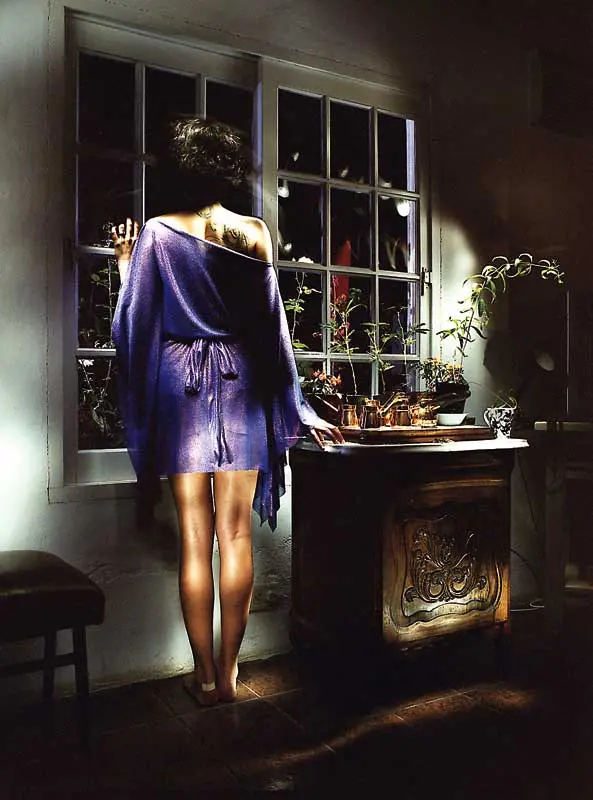
Arturo Aguiar’s photographs are mysterious, both for what they reveal and for the secrets they guard. Displayed in Praxis International Art, the eight compositions in La luz argentina confirm that the artist (Argentina, 1963) works in photography as if it were painting. His works “pay homage to the best tradition of Baroque painting,” notes Juan Ravnik, director of the Photogallery at the Teatro San Martín, in Buenos Aires. With almost theatrical lighting, Aguiar underscores chiaroscuros, highlights spaces, fixes the scenes, counterpoises interior and exterior, and captures an image that he then copies in large formats, up to 120 X 150 centimeters.
A decisive factor in art and in life, light, in Aguiar’s hands, composes seductive images that are the product of elaborate shots where nothing is left to chance. “My technique could be called ‘painting with light’ or ‘direct action shots’,” Aguiar says. “I create my photographs through long-exposure shots that introduce human temporality in the photographic register and allow me to intervene physically, directly, in the creation of the image during the shot itself, lighting the scene manually and creating a space of subjectivity through light,” he tells ArtNexus.
Although it has been in use for more than 40 years, today this tendency to “make” photographs enjoys a renewed centrality, and it is what French philosopher Dominique Baqué calls plastic photography. The term refers to the artist’s intervention during the preparation of the image to be photographed, in the development process, and even on the finished product. But the manipulation of photography is not new: already towards the end of the Nineteenth Century there appeared what was known as pictorial photography a practice that imitated printmaking and painting. Back then, black and white or sepia photographs were created using new technical processes and special effects: different kinds of filters, lens covers, superimposition of negatives. But up until the 1960s, photographers limited themselves to producing works that manipulated photographs, such as montages. In the 1960s and 1970s, the basic concepts of the medium were brought into question, and gradually photography became another tool in the expressive arsenal of artists from any discipline. In fact, Aguiar was educated as a physicist and began his art career as a painter, using, he realizes now, the same saturated colors present in his photographs.
Clearly, photography is for Aguiar a crossing of genres. It is a research tool that mostly constructs its own motifs, portraits recognizable characters, quotes the classics (such as Jeff Wall, a master of the mise-en-scene). Ascenso is the image of a stylized staircase, in wood, covered by a red carpet, which between lights and shadows takes us to an enigma whose seductive power the artist finds impossible to resist. The reference to Marcel Duchamp is clear in Siempre es otro el que muere, which won First Prize in the Petrobras-Buenos Aires Photo Award in 2009; this photograph connects with Duchamp’s complex installation Étant donnés and to the phrase inscribed in the French artist’s tomb.
On occasion, Aguiar’s attentive gaze finds the perfect scene to photograph, such as the image La luz argentina which gives the show its title. It is a beautiful night shot taken from a third floor across from the National Congress. Between the apartment where the artist situated himself and the legislative building there are at least 250 meters and tens of trees and lamps that, by chance, suggest the outline of the country’s map. Aguiar also recruits inanimate objects into the category of “found scenes,” which he captures like still life’s (a favored theme in the history of art). Here he presents three, two of them taken in the San Isidro mansion of the legendary writer Victoria Ocampo, where the intensity of colors, the flash of luminosity, and the silence of the shaded areas emphasize the points of attention and the instants that are no longer.
Especta is dominated by the figure of a woman who gazes in the direction of the unknown, perhaps expecting the unpredictable. With an entirely mobile camera, Aguiar once again proposes a question and uses long exposure times, applying artificial light sources and objects—even a flashlight, as he moves around clad in black—in a darkened environment. Aguiar’s compositions alter the natural light of the photographs and incorporate well-defined shadows; far from the documentary, they enjoin us to renew our gambit for fiction and fantasy.
VICTORIA VERLICHAK