
The first retrospective by Cristina Martínez (1938), an Argentine artist living in France since 1962, was not conceived to follow a chronology – although it succeeds in showing the evolution of her work since the Seventies – to convey a mysterious yet poetic trajectory in which lights and shadows alternate. As Rosario Assunto has said, “Any landscape reflects the state of the soul,”1 and this presentation at the Chapel of the Ursulines concretizes its cultural dimension. The artist explains that the great architectonic simplicity and the amount of light in the Chapel’s exhibition rooms were, in part, what elicited a new reading of the work, based on a black, white, and gray palette. Martínez’s subtle use of colors is always present in earlier works that testify to her chromatic sensibility and her unwavering relationship with the light’s richness. The beauty of the exhibition space stimulated her inquiry into appearance and disappearance, the transitioning from light to dark, the mystery of darkness and light, illusion… Her reaction to the place led Martínez to the creation of the Nocturnas (Nocturnal) works.
The first exhibition room stands out for the use of the black and white, cosmos and constellations, but there are also other remarkable works by Martínez that the artist created with dead butterfly wings. Whether it is the painting titled Le Fleuve (The River, 1999), or the ink works titled Constellations (1998), Miroirs d’Étoiles (Star Mirrors, 2006), or Colonne de Vent (Wind Column, 1999), the drawings appear to emerge from their supports as if driven by internal energy that expands and binds together “little branches,” “droplets,” strokes, segments, scratches, gleams, shades… trapped in an impulse. Nevertheless, everything is in motion – inside a vortex – and nothing remains static. A permanent tremor has been bestowed upon the rendered space; the drawing is a gushing of streaming strokes. The use of butterfly wings can be interpreted as a reference to the transient nature of beauty and the mystery of metamorphosis. Cristina Martínez is not particularly interested in the mythic origins of the butterfly. However, it is impossible not to see here the symbolic correspondences between the soul (Ancient Greece), salvation (the Christian world), and – in more general terms – the world of dreams and chimeras. But to Martínez, this solely represents a graphic element that she employs as a sort of formal vocabulary that splashes the white paper surface with fragments of brownish-grey butterfly wings. On the center of the piece, we find an in situ installation that consists of ink drawings, which is inspired by and bears the same title as the renowned calligram poem by Stéphane Mallarmé’s renowned calligram poem 2, Un coup de dés jamais n’Abolira le hazard (A Throw of the Dice Will Never Abolish Chance). Here, Martínez transforms the spatial disposition of the text into abstract images, but maintains the original’s title, as the dark areas (blacks) and light areas (white dots) echo and replace the phrases and their words. Cristina Martínez respects the words of the poem and actually installs it in front of her visual interpretation of this poem. By ratifying both the conceptual – title/chance – and formal – the constellations – the artist creates a new work, a visual duplicate of Mallarmé’s poem. We find ourselves before anesthetic, tactile, and audible evocation of the poem.
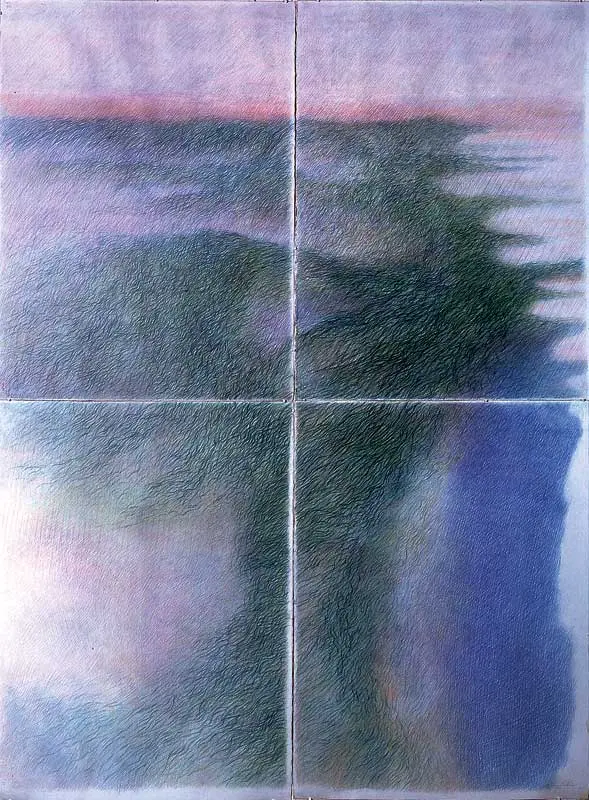
The second exhibition room contains an installation specially designed for the space titled Trait de Lumière, 2010, 19.70 feet by 8.20 feet). Occupying the wall at the back of the room with an imposing and radiant aura, it is the successor of another installation presented in 2006 titled Trait d’Ombre (Stroke of Shadow). The blank space at the center of the composition – like a path of light – twinkles as it contrasts with the hundreds of paper disks – each 2 to 4 inches in diameter, drawn with Indian ink, and impregnated with touches of marbled ochre – that are scattered over one or the other side of the virgin surface. Here, Martínez stresses the absence of symbology, as she describes the installation as essentially graphic. On the lateral walls, there are other works associated with nature, such as Forêt (Forest, 1982), Buisson-Sphère (Thicket-Sphere, 1984), Arbre (Tree), and Déplacement (Movement, 1983), among others. In these, the elements merge to create moving and trembling universes of soft colors dominated by internal vibrations and resonant modulations.
Present for some years now, Martínez’s affirmation of a coherent artistic discourse – both conceptually and formally – enables a search and a sensibility through which invented lines are linked with each other, one after the other, one over the other, at the service of the gesture of the moment, and to form a ball and weft that are musical and formal. Cristina Martínez loves nature and is able to capture it in its most abstract dimension, with what only the most intimate of gazes can elicit. It is as if we observe nature through a magnifying glass straight through to its heart. Martínez subtly weaves images that are apparently fragile and that allude to an art that is ephemeral.
NOTES
1. Filósofo italiano de la naturaleza (1915-1994).
2. Compuesto en 1897 y publicado en 1914.
CHRISTINE FRÈROT