
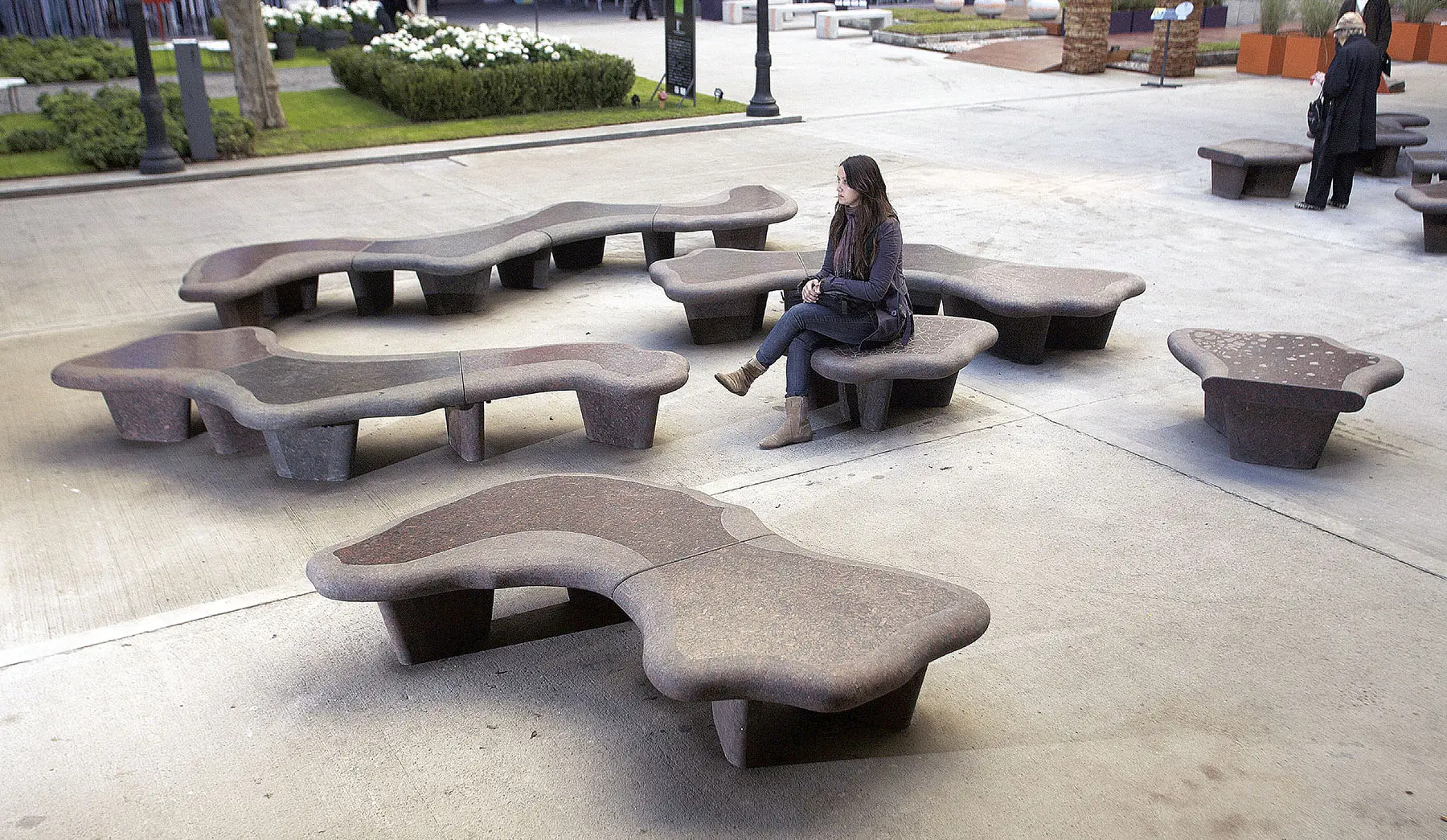
It is at the coordinates of public space and behavior where we find the key information required to understand Diana Cabeza’s projectual effort, which seeks to provide people with useful supports for their rituals of encounter in the city or in the openness of another landscape.
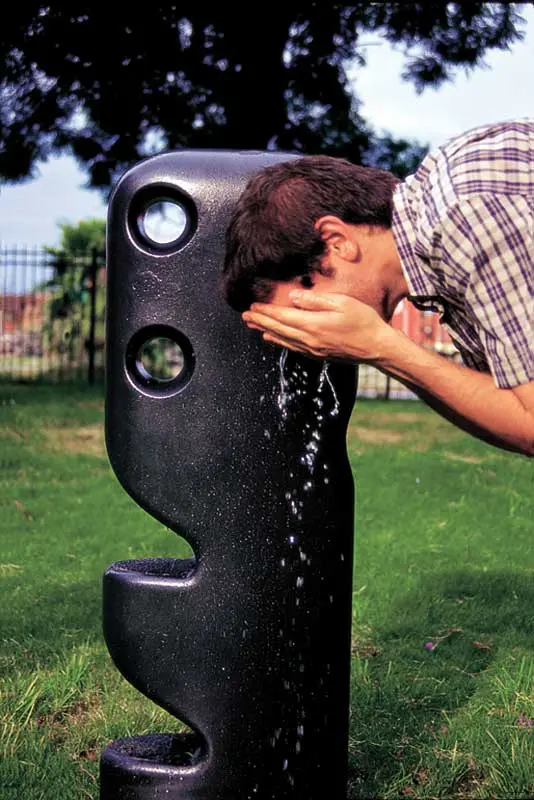
A drinking fountain, a bus-stop shelter, a disabled-access ramp, a tree cover on the sidewalk, a garbage bin, benches, and other resting places, street lamps. Designers around the world who specialize in city equipment—everybody’s furniture—are few and far between. Diana Cabeza, from Argentina, is one of them. Key for her to get to this specialty was this dual education in architecture and fine arts, but also an anthropological tour of duty in the Argentinean high plateau, where she discovered the value of the non-object, an appropriation of the landscape and of constructed space for community rituals. After that discovery, which took place five years into a career as a household furniture designer, she found herself unable to think of her production in terms of the individual rather than in terms of the community. And, if by definition the elements of the city help build a common symbolic space and participate in the construction of a physical space that renders singular that which would otherwise dissolve in indifference (the street, the wait, the people), Dana Cabeza’s design work is, also by definition, a democratic one.
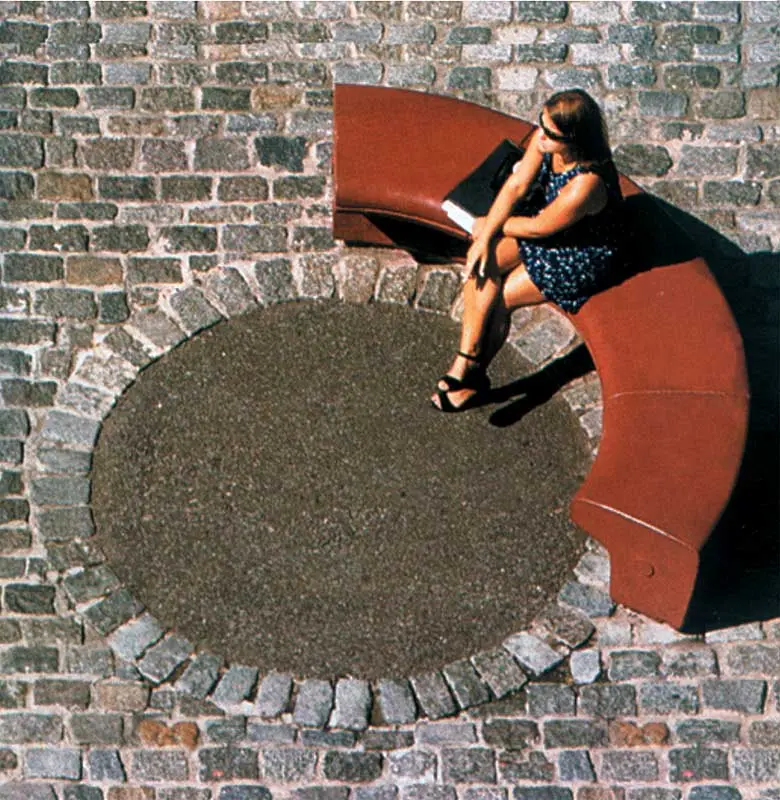
Something Louis Kahn said seems tailor-made for Cabeza’s work: “Design is not to create beauty, beauty emerges from the selection, the affinities, the integration, the love.” Renowned internationally for this specialty, which she approaches with civic sensibility and at an urban-planning scale, throughout Cabeza’s career we find three human-centered concerns: a search for roots, a reflection about community-use spaces and their rituals, and a solution on which beauty and functionality are one and the same thing. Later, another overarching theme would emerge topographies.
Her exploration of the relationships between body, space, and design started in drawing. Besides her passage through the Fine Arts school, in Buenos Aires, she practiced with living models where she had to do block drawings, making space to look like the negative image of the body. As she tells it, that deep delving into the intersections between matter and body made her start to see space as something that is active. Also from that student period comes another foundational event in her specialization: the observation of the needs of the inhabitants of the city. Diana sent hours watching someone in the La Paz Bar or in Plaza Francia, drawing them, paying attention to their behavior. And even today Cabeza continues to be surprised by what happens to her own furniture in a city: “I learn a lot from the various uses that people give them, and, at the same time, those modes of appropriation speak of cultural shifts.”
Once graduated as a Drawing and Painting teacher, she started to study architecture, assuming that it would be a good vehicle to capitalize on art and place it at the service of people. But, shortly after finishing her studies, she realized she “needed a scale that could be verified with her own body,” she says, as the first experimenter with all her models and ergonomic prototypes.
A couple of tables she projected while an architecture student was followed by exercises around Gerrit Rietveld’s famous Red Blue chair. Already within the framework of a rattan line, she also started a committed approach to her materials, another essential chapter in her project, and environmental behavior. Around that time, in the late 1980s, when the design world was still looking towards Europe, Cabeza directed her quest towards local materials that, through design, could help revitalize regional economies and preserve traditional hand-based labor forces.
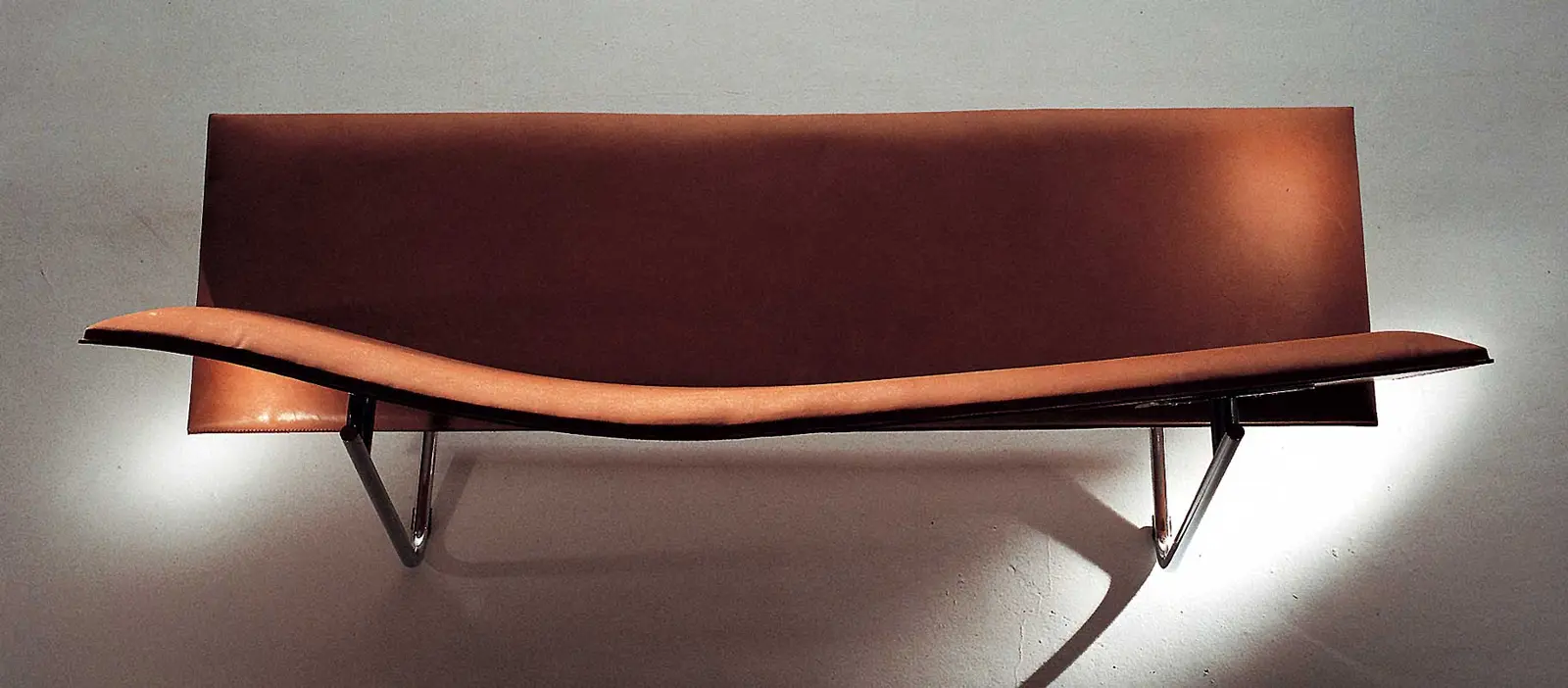
Among those experiences, she approached the rattan and rattan workers of the Tigre River Delta. And this is how she extended her first memories of the use and observation of public furniture: the popular Mar del Plata chair to which, like so many of her compatriots, she is linked by a special affection for summering in the Atlantic coast. Possibly connected to another beach-friendly chair that became a regional event, the Galletita is a proud successor to the rattan chairs created by Catalan designer Antonio Bonet for the Solana del Mar beach resort in Punta Ballena, Uruguay. Yet it is with Sensual pampa (1989), already an international contemporary classic, that Cabeza achieves her best American synthesis of language, material, and landscape. With this couch, which encompasses elements of a public square bench, she wanted to approach the countryside through the use of leather and the traditional way of working with it. The post-formed laminates in the chair’s seat and backrest are covered in natural sole material, their exposed seams made by traditional leatherwork artisans. At the antipodes of a fluffy sofa, the Sensual favors contact with a surface that, being an animal hide, changes over time. Inspired on the soft undulations of the Pampa plains, this work consolidates for Diana Cabeza a link to the expression of the landscape and its reading, something that would soon become one of the axes of her approach: the observation and the rising of Argentinean topographies from that culture of the non-object that is implied in using the soil and its particularities as support.
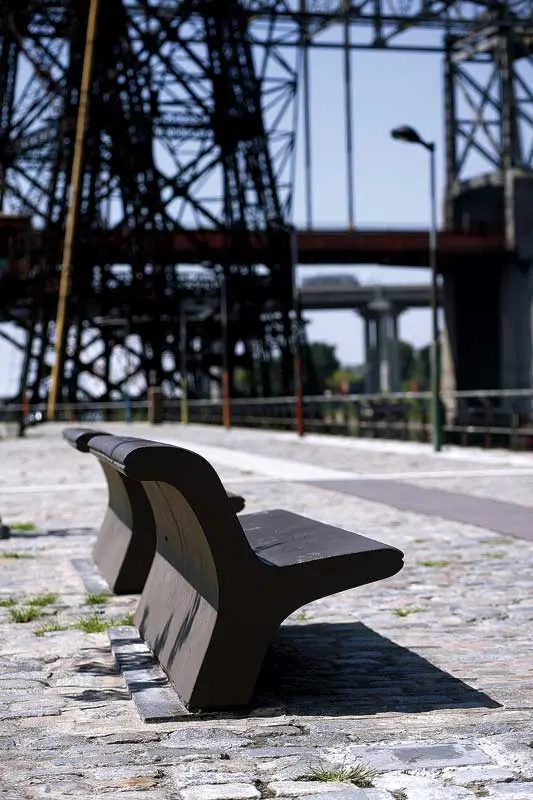
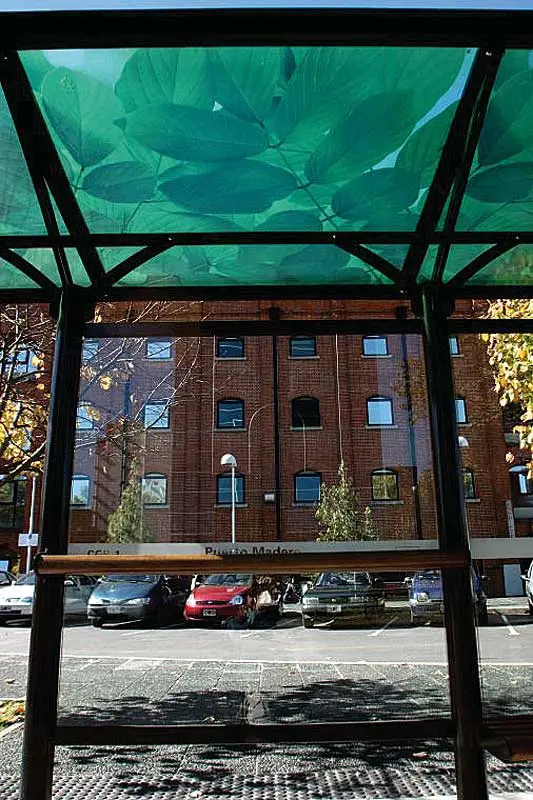
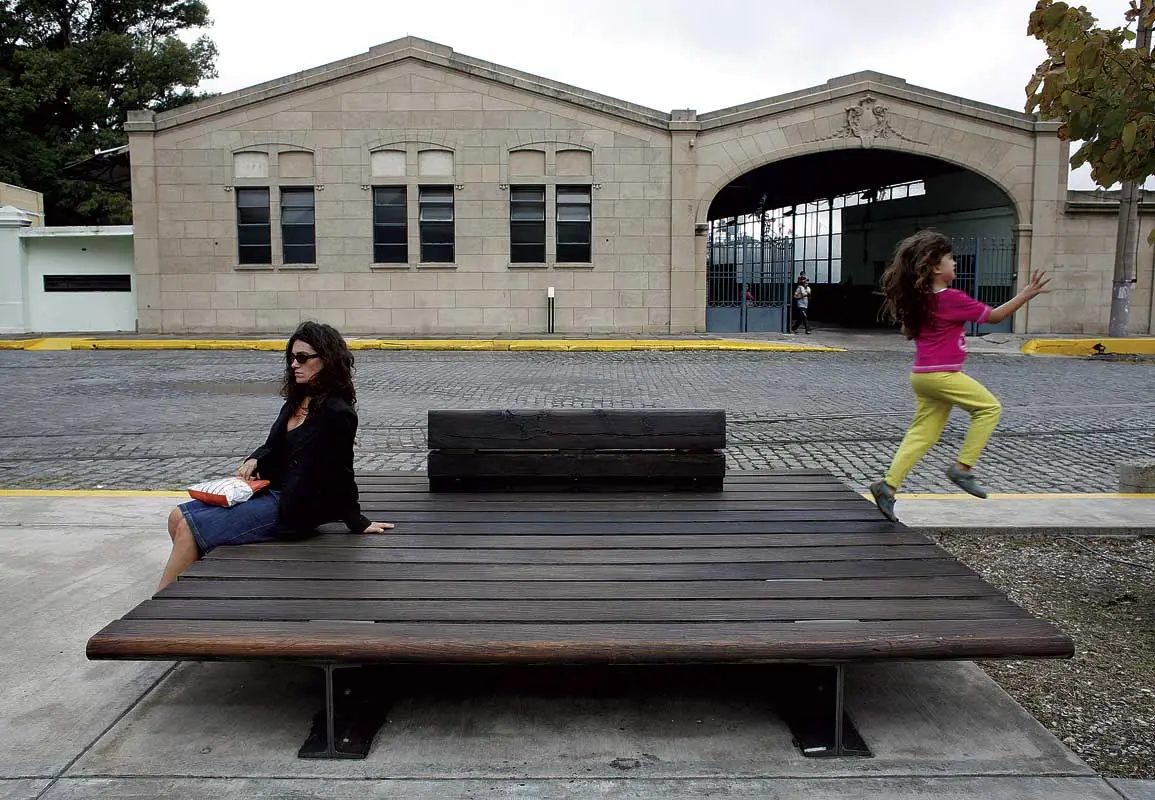
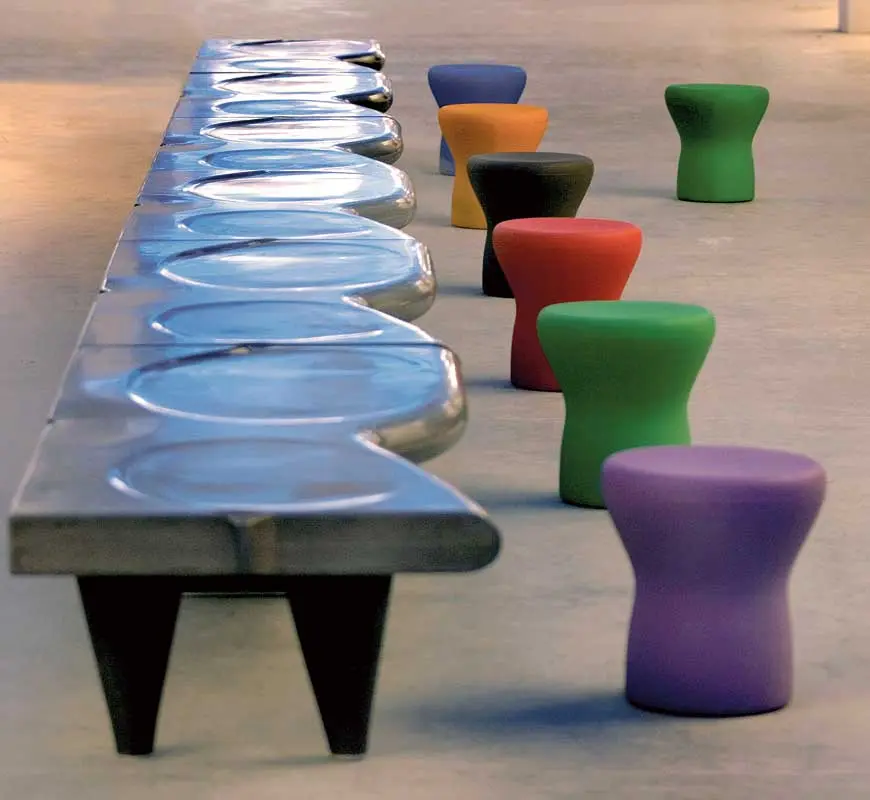
As the 1990s got underway, Cabeza made her initial approaches to city equipment in Buenos Aires, and around one of that city’s most significant features, as is its character as a major port. In that powerful context, the equipping of Puerto Madero takes lessons from tradition and updates them by means of design. Cabeza began by raising a relief of the site and its things (this is a former port area that in the early 1990s adopted an urban-development plan, with a high level of investment in housing), harking back to the language of old tin, iron, and wood boats both in terms of technology and in terms of materials and evocation. With the equipping of the benches for this new Buenos Aires neighborhood, Cabeza launched a varied series of urban furniture that reached first into several other areas in the Argentinean capital, then to other cities inside the country and around the world: Neuquén, Córdoba, Puerto Madryn, Almería, Pinamar, New York, Bangkok, Tokyo. In her vast oeuvre—in general, comprised not of isolated works but of furniture-space proposals—what predominates are elements of rest: supports with a low degree of determination that makes the user define how to employ them (Comunitario, Rambla, Picapiedras, Almejas benches.) The Banda chairs, from 1997, were conceived as a bunker, at once monolithic and dynamic, for the La Boca neighborhood, which borders marginal areas of the city. By taking into account vandalism as a possible appropriation in use, Cabeza shifted the sign of what could appear as a limitation in design, responding with realism and elegance.
Urbanist Zaida Muxí has said of Cabeza’s work: It is the union of aesthetics and function, the primitive and the metropolitan.” Also, after seeing a large portion of her oeuvre on location in Buenos Aires, Catalan design publisher Josep Ma Serra compared Cabeza’s work to that of architect Lina Bo Bardi 1—whom Cabeza admires, respects, and studies—pointing out that both created their art with whatever was at hand, without rejecting materials and opening up new possibilities of use to common ones such as metal, wood, and stone. “Works that are always respectful,” he noted, “filed with great sensibility, freedom of composition and imagination, with an attitude that is both ethical and ecological.”
In 2005, the application of these values and virtues resulted in Estudio Cabeza winning the Urban Furnishings for Buenos Aires Competition, pending to be produced by the State. “Now the city has its own catalog. It is going to be a rather integral program of urban elements that will weave the tapestry of Buenos Aires,” notes Cabeza regarding the hard effort of generating a general system for such a heterogeneous city. And she produces the un-be-lie-va-ble pile of technical documentation involved: detailed to their last rivet, there we find the bus-stop shelters, the drinking fountains, the chairs, all that will soon be furniture for everybody in Buenos Aires. In the meantime, the government had asked her for some specific works: the cement Topográficos are now along the entire Avenida 9 de Julio, which crosses the city. And on the occasion of the revaluation of Avenida de Mayo during the Bicentennial, she was commissioned to create new benches. Her response was a series of soft pink moldings situated so that they look towards the opposite sidewalk, to appreciate the architectural legacy of this avenue where, among others, Italian architect Mario Palanti’s Palacio Barolo sits.
Cabeza’s love for what she does can be appreciated not only in her production but also in the enthusiasm that her free-hand schematics achieve as each project moves forward, as can be seen in her portfolios of ring-bound tracings and her color pencils, the latter all shortened by the constant use. Leaning on her library of topographical relieves (which include Patagonia, the fishing breakwaters of Mar del Plata, the rocks of the Uruguayan coast, and the Argentinean-Bolivian high plateau) she goes from drawing to the demonstration. Never better used the phrase “to lead with one’s body” than with regards to her projecting process.
It was in 1993, the same year Cabeza began her career in urban furnishing, that she started with her territorial explorations. She began in the Argentinean highlands, where she arrived almost ten years after her dissertation on self-sufficient lodgings for that ecosystem. Her exploration of community rituals in that area, with the use of topographies or of low fences as neutral physical supports, drove her crazy. And ever since she has returned in August to that section of the cordillera to further explore the issue of anonymous design in the region’s production and to enjoy popular celebrations. About that first journey, she says that at a time of the generalized cult of the object, she was motivated to reflect deeply on the act of inhabiting by her discovery of design as simple as the use of natural shapes.
All those stimuli reignited in Cabeza the ideas of contextualism she had cultivated in college, through which she felt philosophically connected to a movement among local architects: “the thought expressed by professor Roberto Fernández, at the UBA; Claudio Caveri’s Christian-Socialist line; Ramón Gutiérrez’s works such as Pueblo de Indios, which gave meaning to my entire research in the high plateau; the vindication of our roots, legacy, and belonging, so well expressed by Jorge Ramos, the Amareida group in Chile, with its freedom to seek what is Latin American,” she lists, among others. As her most important point of reference, though, she names anthropologist Rodolfo Kush, whose Collected Works are her bedside book.
Something else clicked into this quest several years later, in 2005, when Cabeza was invited to reflect about safety in the domestic space for the international show Safety Nest. 2 She wasn’t sure what to do and decided to walk around her other “library,” the city. The experience of the relationship between topography and supports for use reappeared. “Our Latin American cities, with an urban, civilized enclave and a neglected margin-right next to it, produce a somber side, a ‘non-place,’ a piece of public space, unnamed and devoid of identity, that constitutes a vacuum and is available for appropriation,” Cabeza notes to explain that her observation of the keen design used by the excluded for their basic repairs on the folds of the city’s skin was for her “a powerful exercise in thinking about what is essential, which is often forgotten when one sets out to project something.” The questions she formulated then for herself (how is a private world built in a public space? how does one cover oneself with materials rejected by others?) drove her to develop a series of urban nests that, far from attempting to propose lodgings for the homeless, invited us to rethink habitation from an anthropological perspective and its relationship with the bio-environment. Cabeza’s installation caused a strong impression, especially among Europeans.
The artist redoubled her gamble, wondering what it would mean to pose the issue in a different social reality, in a developed urban economy, one with a lesser degree of marginality, a well-ordered public space, and a culture oriented towards the selection and classification of residue. So, she took her proposal to the format of a workshop, Nidos Urbanos, which took place in 2007 for the Twenty-First Housing Laboratory at the ETSAB in Barcelona.
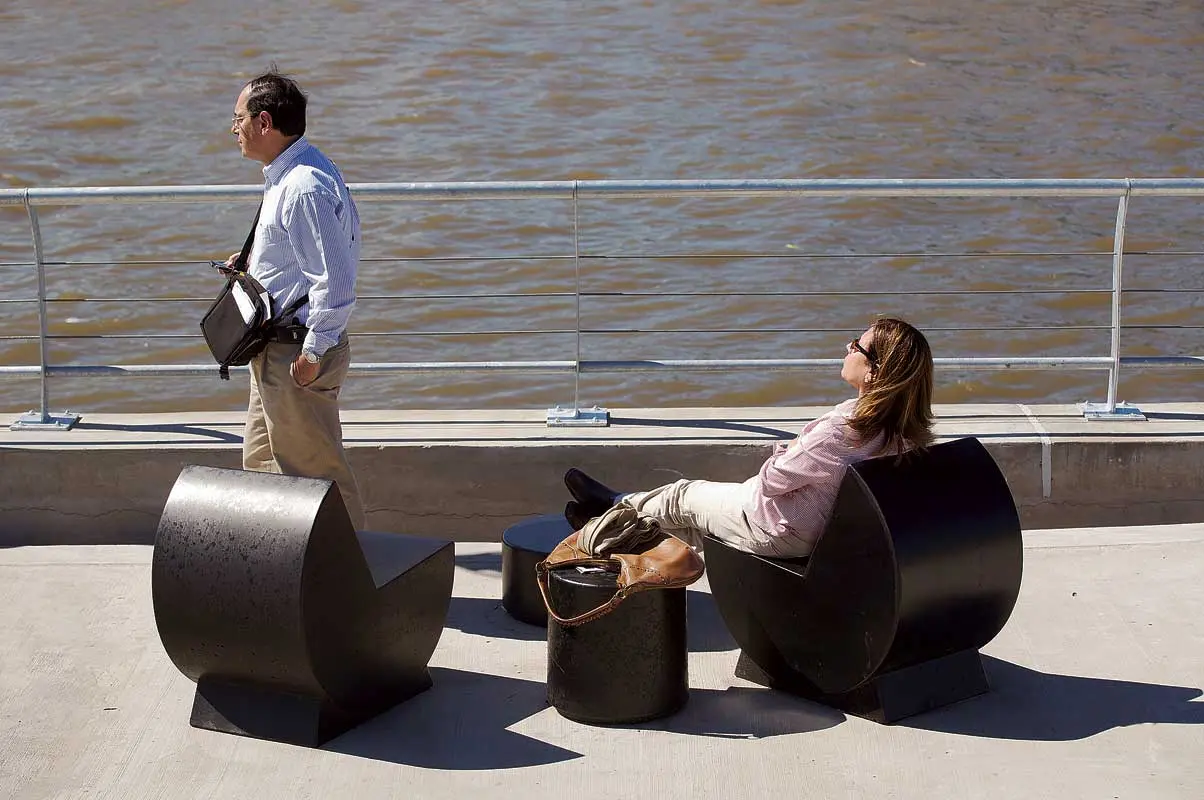
With these topics, Cabeza was approaching her most recent initiative, Ruedas, in which, as in Nidos, she collaborated with architect Andrea Saltzman, who has a long trajectory of reflection around habitation and the body. The project reviews the potential of the wheel as a support for community linkages in the public space. And while the earliest attempts use groups of inner tubes from tractors joined together like pneumatic topographies, Cabeza studies the possibility of arriving at a series of tires made in concrete that retain the comfort of air-based technology and could recreate the traces of the body, positing unexpected uses (who has ever found himself or herself reading the newspaper in a public square with someone watching from above, as in a trundle bed?) An interesting search at the level of the relational proposal, and a challenge in its materialization.
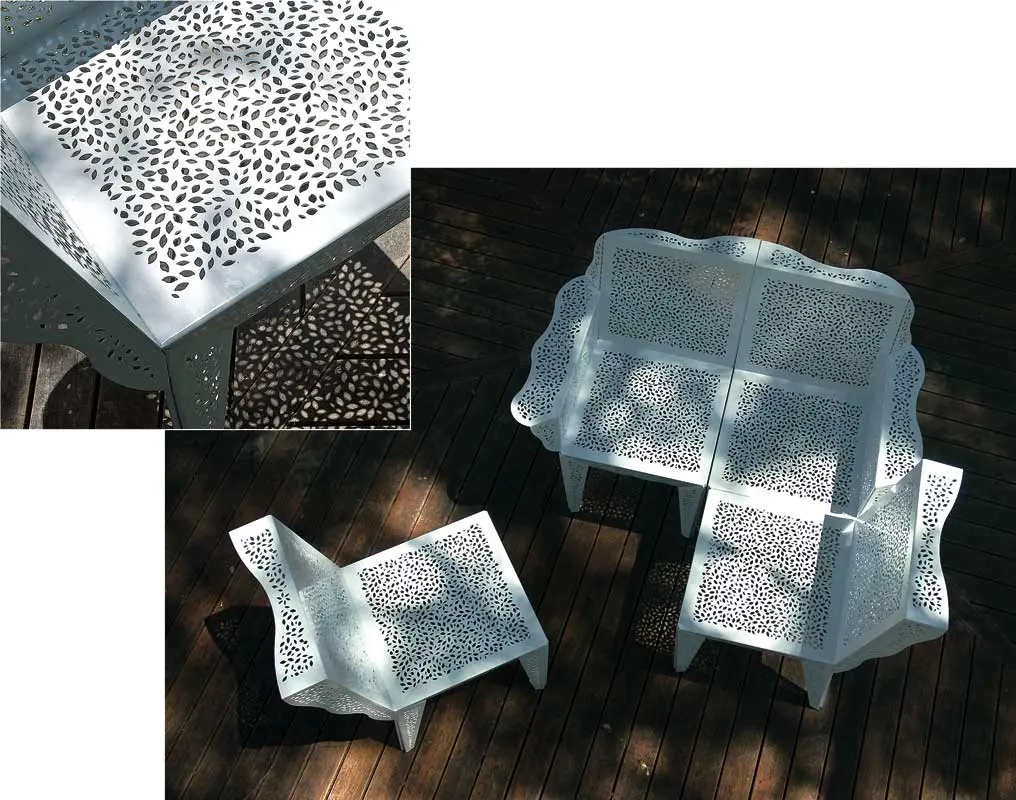
And reaching this chapter, Cabeza pulled back from her initial connection to the materials in the direction of a texture: heavily loaded tempera she had used in children’s painting. She was attracted by how it acquired volume as it dried. Her latest creation, Mantel de Encaje, a set of modular tablecloth and chairs in white, achieves its texture though latticework (it is not digital!) on the folded tin. And, interestingly, this set brings Cabeza back to the intimacy of the domestic sphere, although her focus continues to be in community furniture.
In the process of selecting materials, she begins with cement: “because of its softness, because it lets us leave a trace because it is porous, it gets dirty, it can be graffitied,” she says. About the use of woods, a material she loves, she is direct: “If the issue of sustainability is not resolved, I am not going back to my old dialog with wood, although seeing it gives me great pleasure and sometimes I am tempted,” she says, before revealing that she has to hold back in order not to generate demand. She tells us that not too long ago, her husband had to stop her from buying a stock of ironwood. “Wood is out, we must stop its use until there are consensus conditions for renewal across the world that guarantee responsible management of woodlands.” In this connection, her study developed a special laminate ready for use in exteriors, with funds granted by Buenos Aires’ Centro Metropolitano de Diseño.
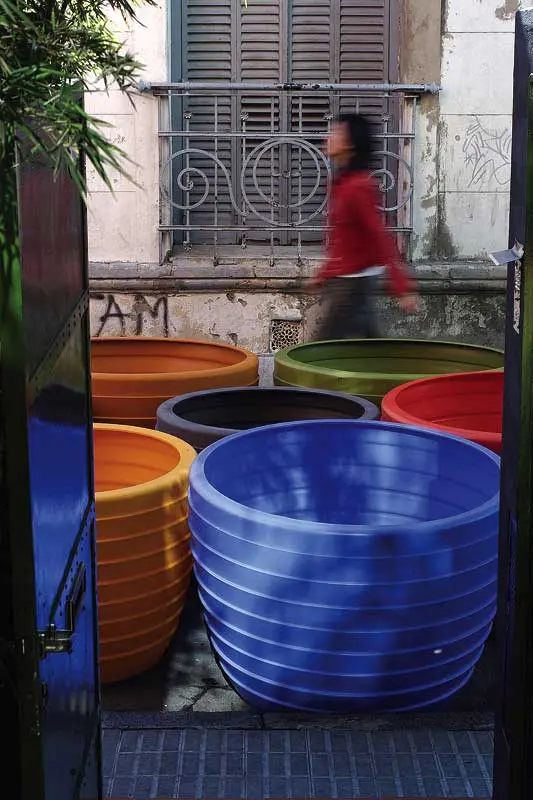
Of plastic, another material that appeals to her, Cabeza says she would like to dematerialize its synthetic character: to make it seem not plastic on its surface. Her sole incursion in plastic is the roto-molded line of giant flowerpots and tiny benches, which seem like sand to the touch and like toys to the eye thanks to a vibrant palette developed by her sister Elizabeth.
The designer says that when she was a small girl she was fascinated by how plastic matrices were injected at her father’s appliance factory, where she was also attracted to the design room, a place filled with boards. Although, if the issue is to find imprints that reach back into her life, something that looms large in Cabeza’s memory is her grandfather Benito Medrano’s general store in the corner of French and Bustamante streets. Her eyes light up when she talks about the place, and soon enough she starts sketching the plan to illustrate in detail each corner of that world of debate, coffee, and vermouth, seated at the counter by her aunt Ñata so that she could see the swan of the tap dispensers… And as she draws and reminisces, she stops: “Here is where I liked it best,” she says pointing towards the threshold between the yard and the sidewalk with tables. There, Diana Cabeza had her first lessons about the rituals of encounter and departure, of conversation and conviviality… all the things that people do as they live the public space.
NOTES
1. Italian architect that emigrated to Brazil with her husband, Pietro Bardi.
2. Nido Seguro, show curated by Nicola Goretti with Paola Antonelli from MoMA as a consultant, in Rio de Janeiro, Cabeza and Sarmiento participated from Argentina.
CAROLINA MUZI
Journalist and independent design curator.