
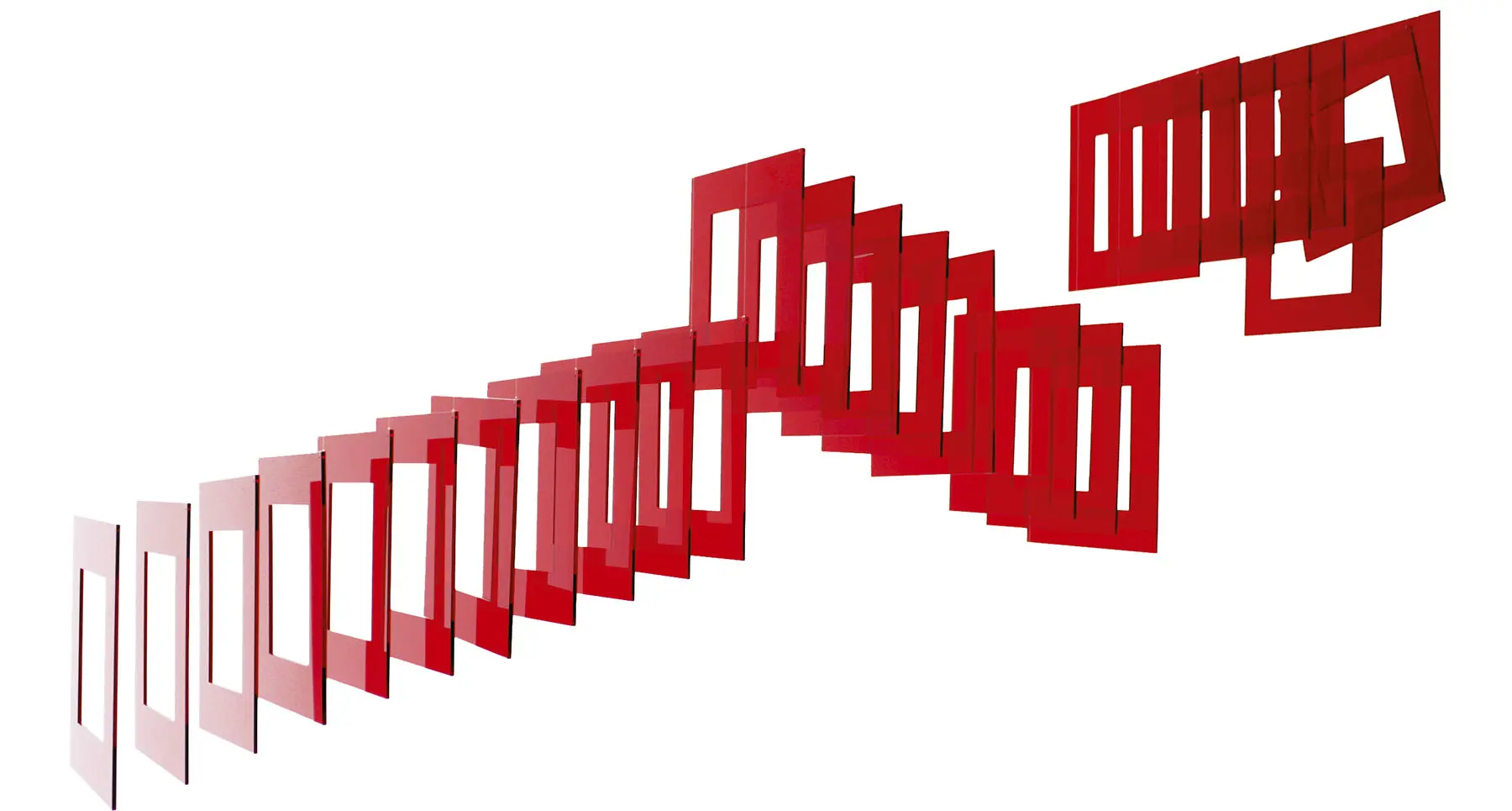
What are they all looking at with such fascination? This always happens at an art show. Viewers gather in silence and contemplate the mesmerizing movements of unexpected shapes that flow and float and, dancing in space, come to embody poetry. Dance and poetry define the work of Venezuelan artist Elías Crespín, who makes space his own and “paints signs in the air” with geometric reminiscences—lines, surfaces, volumes, parts of structures suspended from the ceiling—that create worlds, seize our gaze and liberate our minds.
Always unique and unfailingly suggestive, Crespín’s electrokinetic sculptures are rooted, in turn, in the aesthetics of movement and the principle of equilibrium. But, unlike Marcel Duchamp’s bicycle (the first work of kinetic art, as well as the first ready-made?), Naúm Gabo’s machine-like sculptures with electric mechanisms, Laszlo Moholy-Nagy’s shadow projections, Alexander Calder’s mobiles pushed by the breeze, or Jesús Soto’s works—which require the viewer’s movement as well—the mechanisms behind Crespín’s works are animated by electronic systems (hardware) controlled by computer technology (software) designed by the artist himself.
An Artist Without Labels
Crespín’s aesthetic gesture provides a fascinating and baffling sensorial experience. It mesmerizes viewers who, without any need for discursive explanations or programmatic definitions, let themselves be carried away by its evident magic. It unsettles those seeking to label the work of an artist who belongs in a class entirely of his own. The day after Argentine collector Nelly Craveri, in May 2008, bought Crespín’s Trianguconcéntricos (2008) and donated it to the Museo Nacional de Bellas Artes (MNBA, Argentina) because she “didn’t know where to put it” in her house, the artist’s name was in every newspaper as well in the mouths of art-world denizens and consumers of cultural news.
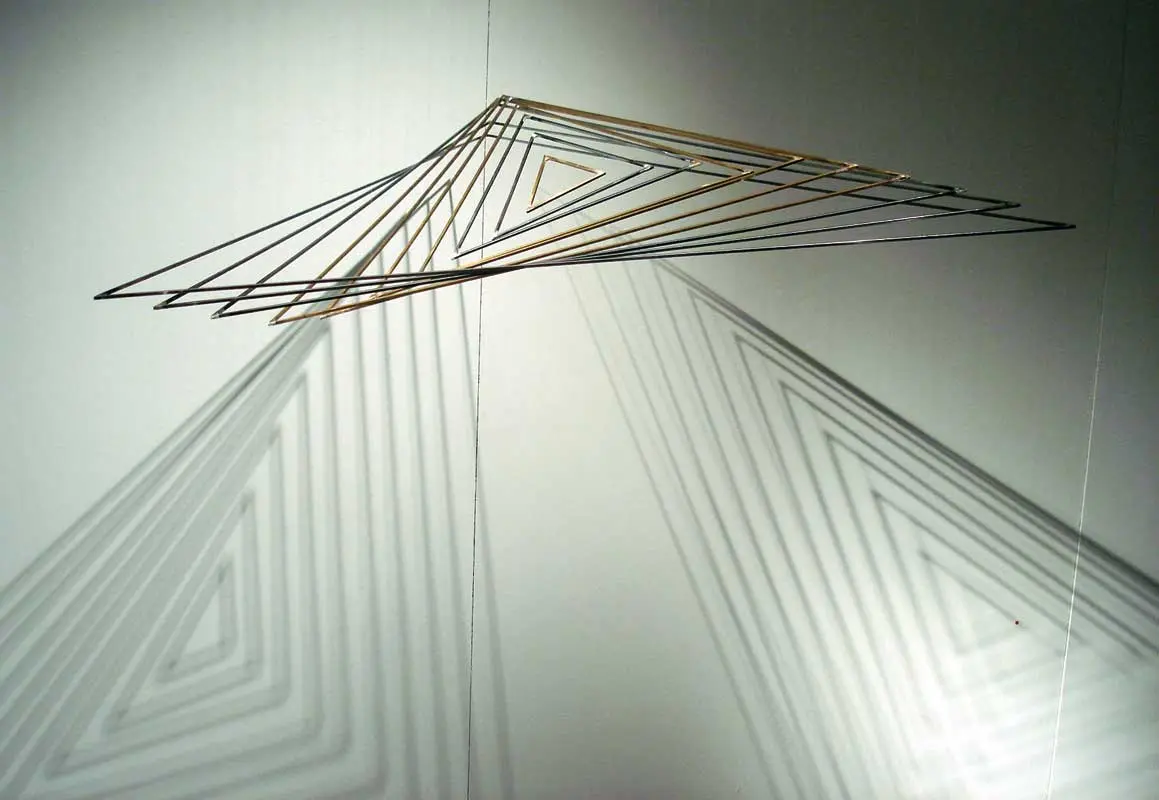
That afternoon, the Cecilia de Torres/Débora Frydman booth at arteBA—Buenos Aires’ Contemporary Art fair—was flooded by innumerable visitors coming to admire and marvel at Crespín’s soft and harmonious cadence of three concentric equilateral triangles, inscribed in an area one meter in diameter, that seemed to react to unseen mathematical formulas and unheard melodies. When the news came out that Eduardo Costantini had also signed on the purchase of Malla Electrocinética II (2008) for his institutional collection (MALBA, Museo de Arte Latinoamericano de Buenos Aires), everybody wanted to learn more about this artist.
The son of mathematicians and grandson of artists, from the day of his birth in 1965 in Caracas, Venezuela, Crespín witnessed the fertile dialog between mathematics and art. In 2008 he resettled in Paris with his molecular-biologist wife and their son—too young to decide between one field or the other, but perhaps free from having to make that decision in the future, since, as Crespín’s own practice proves, it will be possible to work in both disciplines or neither. Aesthetic and scientific curiosity have points in common and often intertwine.
Crespín’s trajectory traverses art and science, which, no surprise, share a joy of exploration and discovery. A graduate in Computer Science from the Universidad Central de Venezuela, he began exploring his artistic veneer and developing his earliest forms and formulas in 2000; in 2002 he started playing with printer motors, and from 2004 on he has exhibited his work regularly.
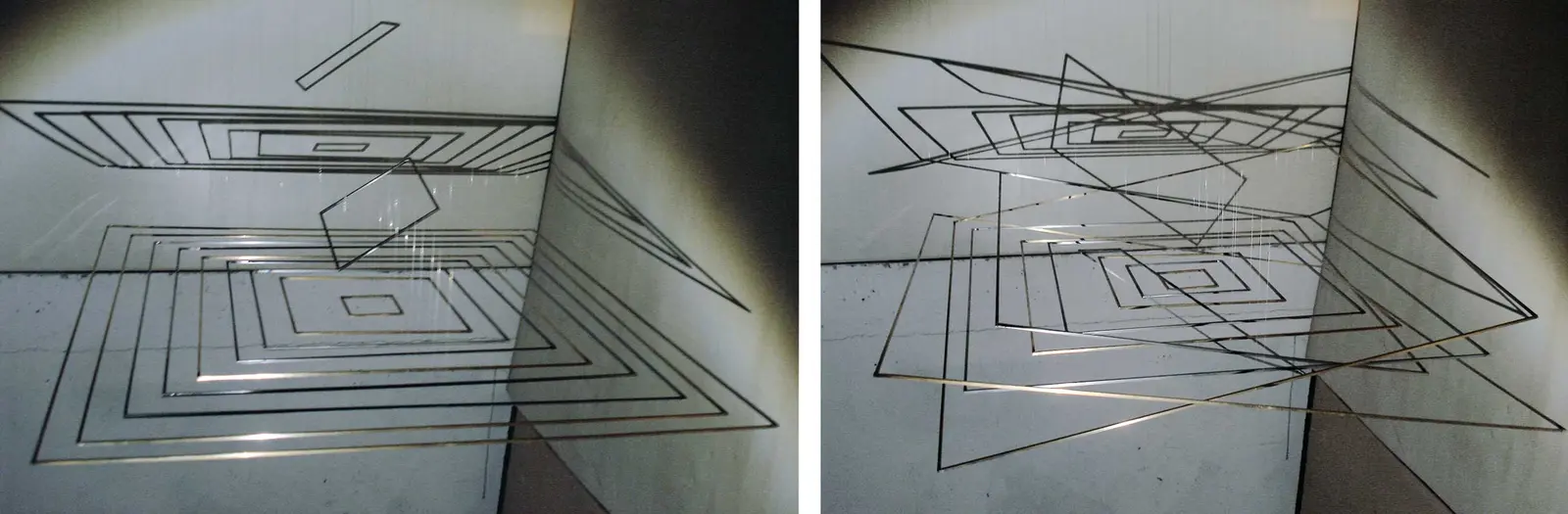
Crespín grew up watching the artistic practices of his grandmother, Gego (Hamburg, Germany, 1912-Caracas, 1994), and her husband, the graphic designer, painter, draftsman, and photographer Gerd Leufert (Memel, Germany—now Klaipeda, Lithuania—1914-Caracas, 1998). An architect, designer, and artist, Gego (Gertrud Goldschmidt) emigrated to Venezuela at the dawn of World War II, fleeing Nazi persecution. A magician of the line, she uses parallels, crossings, and geometric shapes to create the illusion of drawing in space. As Marta Traba put it, Gego knew how to “think like an architect (…), act like an engineer, (…) project like an artist.”
“I learned to bend little pieces of wire with her in her workshop,” the artist told Dubraska Falcón (El Universal, Caracas, September 23rd, 2009). “That left a mark! I had the idea of an undulating movement and I was trying to solve the problem of the structure of the work, which I later called Malla Electrocinética I. I wanted a structure with a certain play at the joints. I realized that Gego’s reticular structure was the perfect solution. I looked at alternatives, but in the end, I told myself, why not?” Unassuming and low-profile, Crespín smiles with satisfaction, with the sparkle of a kid, when he sees the public’s enchantment with his creations. He is the first to be seduced and amazed by his own electrokinetic sculptures; they still surprise him. Pensive and free of complexes, he acknowledged Gego’s influence and took the reticule she used, incorporating the notion of time and latest-generation technology as a constitutive element of his own work. The rhythmic sway of each part of his sculptures follows an inner music. They are governed by sequences Crespín projects using computer programs —held in cards inside a platform that is kept hidden and also contains terminals, cables, and motors— managed remotely via an iPod.
Kinetic art from the 1960s, by artists such as Soto, Carlos Cruz-Diez, and Alejandro Otero, was a dominant and unmistakable presence in Caracas during Crespín’s adolescence. Crespín drinks at the trough of that tradition, born from the romance of modern man and technology and from the desire to put movement on display. Hardware and software, the body and soul of Crespín’s sculptures, cannot by themselves explain his work’s formidable visual potency.
Either You Have It, Or You Don’t
Crespín does have it; might it be genetic? He possesses a highly unusual talent as the inventor of artifacts that generate beauty; the formal dynamism of his potent and lyrical geometric choreographies—as he calls his works—is such that they appear always new to the eye, and their inspired point/counterpoint interplay of light and shadow amounts to the renewal of a utopia.
This is the dream of a liberated viewer who, contemplating Crespín’s dynamic sculptures, can imagine and feel herself back in the territory of childhood, a time when everything is possible and experiences are always new. Freed from all preconceptions, this viewer intuits that these works require careful observation in the expectation that, perhaps, their triangles can be transformed into majestic pre-Columbian pyramids and their latticework into a protecting mantle for holding our dreams; perhaps then it will be true that a crew of invisible is manipulating the cables and the precise shapes, circles, angles, prisms, in an undulating sway and, some times, to the tune of a silent dodecaphonic concert, creating the illusion that, finally, the stars are within reach.
Crespín has no formal training in art, and he didn’t follow the ascending path that takes younger artists along a career. In the five short years since he started exhibiting, his work has been acquired into the collections of at least six museums and public institutions such as El Museo del Barrio (New York City); Kinetica Museum (London); Malba and MNBA, mentioned above (Buenos Aires); The Museum of Fine Arts Houston (Houston); CIFO (Cisneros Fontanals Foundation, Miami). Similarly, his sculptures are now found in over a dozen private collections in London, Madrid, Connecticut, New York, Miami, Houston, Mexico, and Buenos Aires.
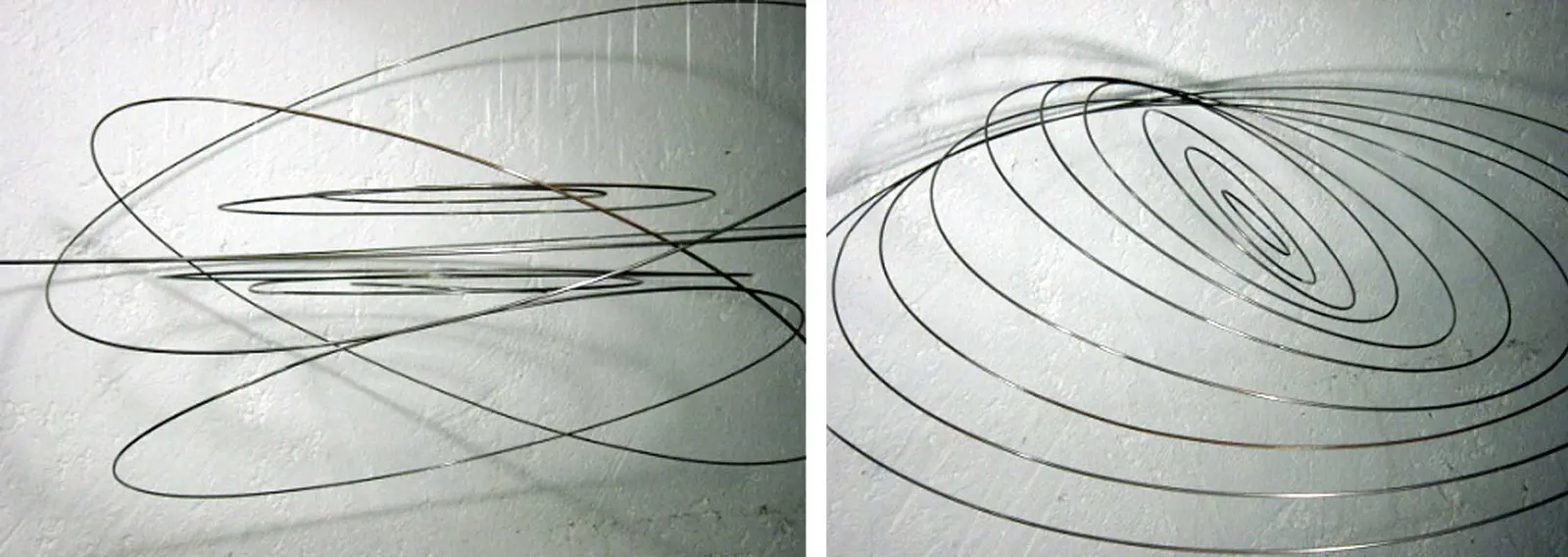
After working for more than fifteen years as a computer programmer, at the crossroads of his twin passions for mathematics and graphic design, Crespín started experimenting with “how to represent mathematical formulas on the screen of an Apple II computer.” His study of Soto’s Cubo virtual in 2000, at Caracas’ Museo de Bellas Artes, drove him to search for a way to “animate physical objects using computer techniques, with the pure and simple purpose of being able to see them.” Thus, he developed a program that allowed him to coordinate the movement of printer motors, independently of each other, and created his Cubo ondulatorio, Homenaje a Jesús Soto (2005). “From my computer’s memory, I transferred a virtual graphic to the third dimension and to real space. The result was a latticework frame suspended in the air, with the ability to make different wave movements. In this way a perspective was revealed to me to create a new, personal kind of art,” Crespín told ArtNexus.
Like Gego’s works, Crespín’s compositions first appear as (altered, scratched, complemented) sketches on paper and, as befits a twenty-first-century artist, on three-dimensional computer simulations.
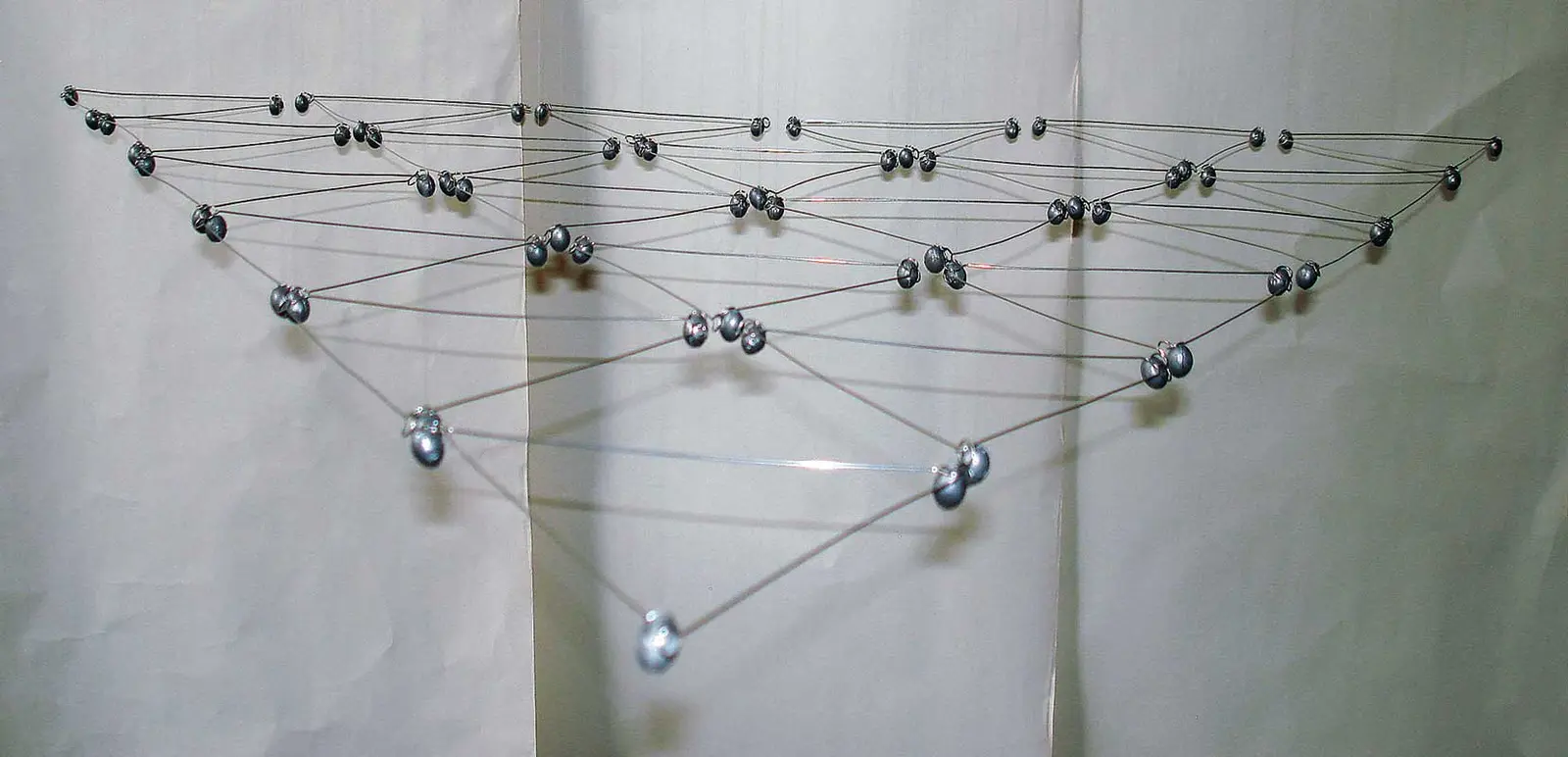
Until January 2010, the artist had presented to the world a total of twenty-five sculptures, starting with his first, Malla Electrocinética I (2004), exhibited in 2004 in several collective shows in Venezuela and at ArtBots 2005 in Dublin, where it won the Artist’s Choice award. It is a square horizontal grid of steel cables, 50cm x 50cm, suspended from 64 nylon wires articulated into 64 lead nodes, connected to 64 recycled printer motors, plus a PC and software. But in 2004, before Ireland, Crespín presented his second work, Malla Electrodinámica Hexa (2004) at the Salón Michelena of the Ateneo de Valencia (Venezuela), and won the Armando Reverón Award.
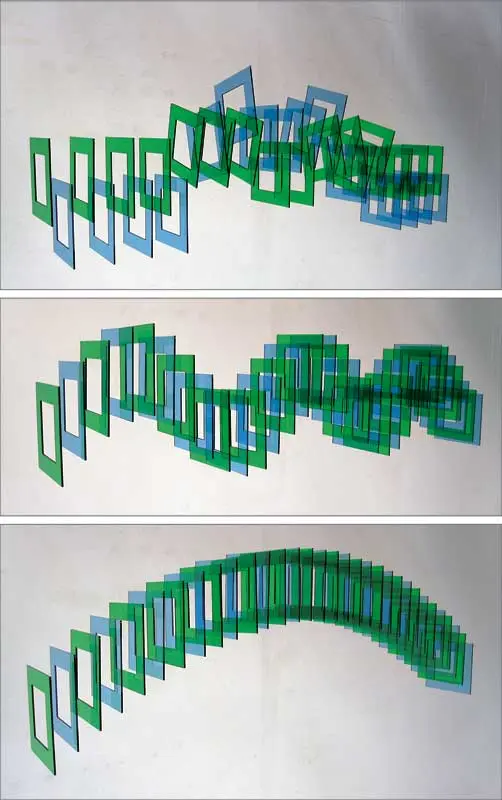
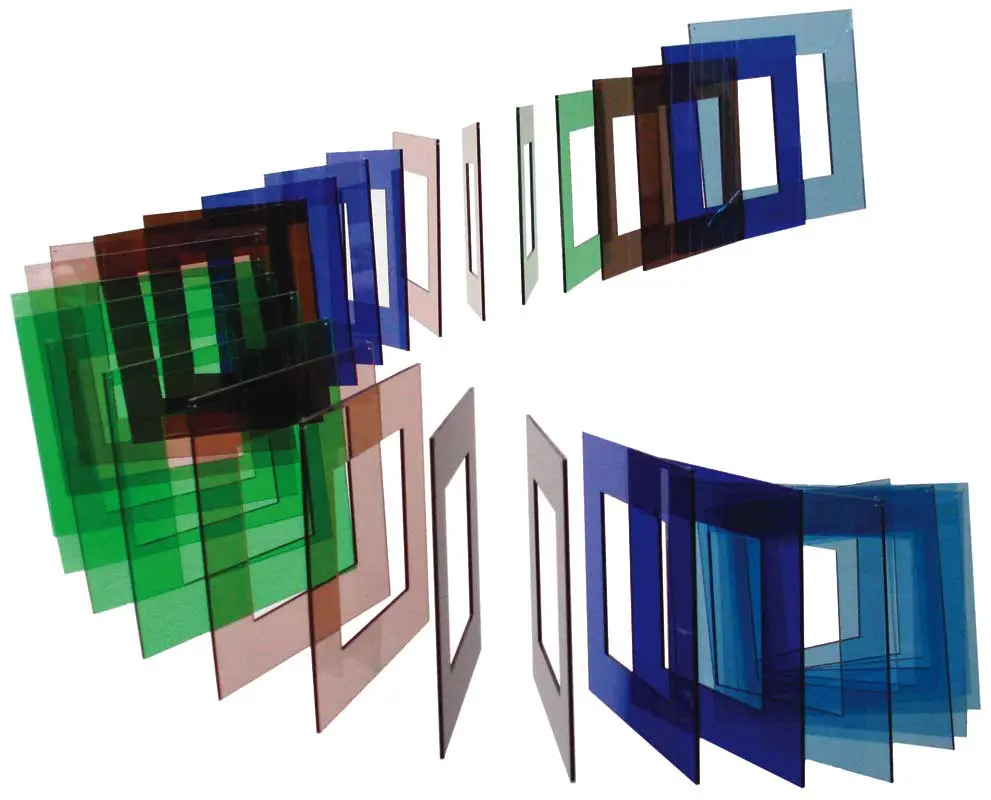
Crespín’s first solo show was held in Caracas, at the CANAL cultural space, invited by its director Yucef Merhi for its inauguration in 2006. In Electrocinéticas Crespín presented three electrokinetic sculptures: Elipsis, Tríada, and Tetralineados. About Elipsis (2005), which he had shown before, Crespín explained that he had worked intensely on a new version with movements that were more fluid, rounded, organic, and natural.” For its part, Triada (2005) is a variation on Malla Electrocinética I with greater “freedom of movement and formulation.” With respect to Tetralineados (2006), he said that from its first conceptualization, “early design, through its construction, trial, and preparation, I was always anxious to see it working. It includes an important change in the visual and functional aspects with regards to all the previous works,” possessing volume and disconnected elements; such “disconnection offers greater freedom of separation and re-merging in the movements,” the artist adds.
It Seems Simple
Different in their formal aspects, all of Crespín’s works even play with the convergence of shadows and, as we have said, start at the same threshold, with a matrix of electric motors connected to a mini-computer that executes a program and parcels out, through nylon wires, its vibrations, and variations. Undoubtedly, the appearance of simplicity in Crespín’s electrokinetic sculptures is a component of their appeal. But nothing is simple behind those oscillations achieved through the use of a technology that, interestingly, instead of generating cold rationalizations offers surprising commotions that result in sensations and feelings.
Clearly, Crespín’s knowledge and use of technological developments are just a means for the unveiling of poetry. Sitting at his monitor, the artist works assiduously to create his sculptures, perhaps imagining an order to confront the untidiness and anarchy of life, to control the respiration of shapes that, literally, hang by a thread and by Crespín’s creativity in order to receive new life. The results of his extensive investigations are not automatic. Who knows how many trials and errors lie behind his gracile, well-constructed works.
Once they are conceptualized, drawn, manufactured, tried, packed, transported, and unpacked, a complex assembly process begins. The artist, along with a team of at least three or four people, follows a long list of tasks, thirty steps minimum, that starts with the hanging from the ceiling of the platform, the control connection, the electrical installation, the trials, the start-up, through the moment when they are in motion and open to public consideration. That, provided everything goes according to plan, the program responds, and everything is in place. Because, as it did at the fourth annual exhibition of robotic art ArtBots 2005, the unforeseen can happen.
Crespín had presented a project for that event in Dublin, which had selected just 21 artists from all over the world. The night before the inauguration, on July 15 at Saints Michael and John church, he left everything in place before going for a rest. On the appointed day, a Saturday, he arrived early at the site to make last-minute tweaks to Malla Electrocinética I and to make himself available to chat about the many things one can do with those “little motors” with a group of schoolchildren who were coming to see the works before the official opening. But his computer was not to be found. At first, he thought it might have been locked away, but soon he realized it had been stolen (this was truly unexpected). A replacement was offered, but he didn’t have with him the updated version of the program controlling the work.
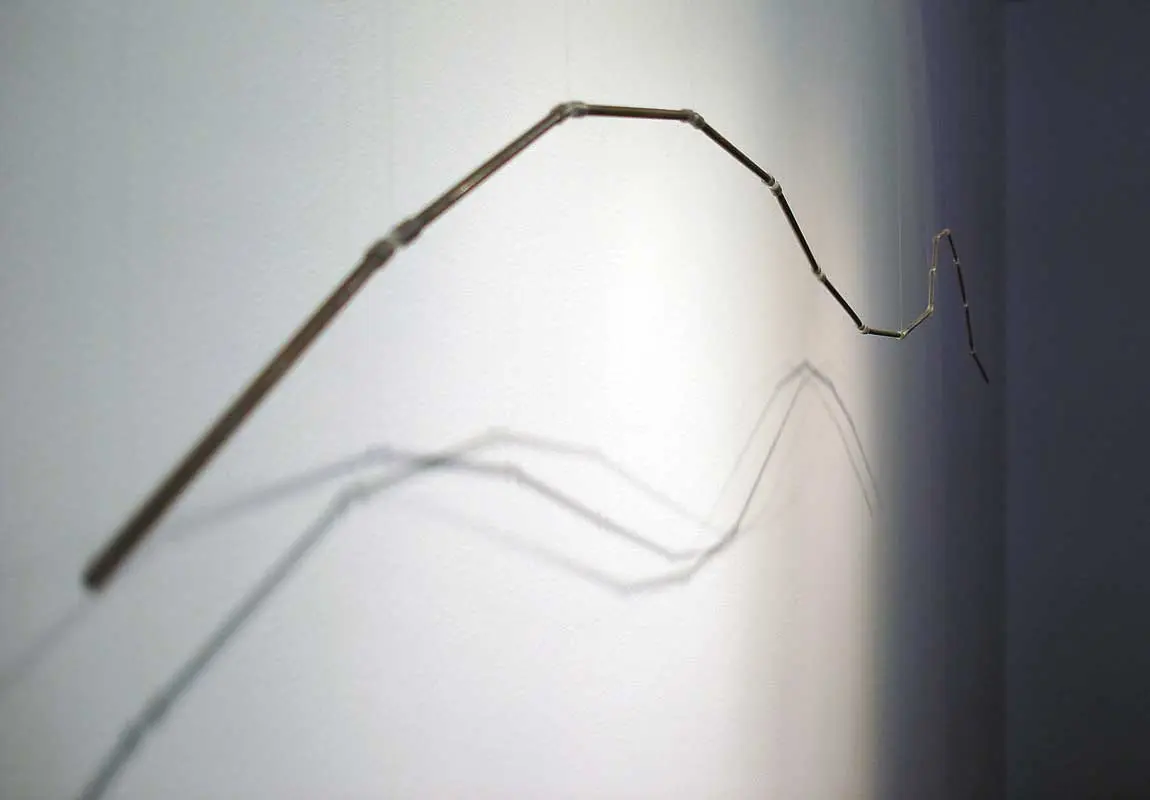
Crespín’s reflections on this incident are touching: “There was the Malla, still, horizontal, silent, dead, a corpse, witness to all our efforts, resources, hopes, and on the crucial moment, nothing. It was a metaphor for death. Luckily, only the death of a metal grid and not of a living or human being. Although it wasn’t really a death, but a coma.” After finding on a CD some old versions of the control program, he attempted to “reanimate” his sculpture. It was impossible. Despite the help of many colleagues, the program returned an error message. After a series of technomisadventures (incomprehensible for this writer that involved downloading the files from the Web, copying them at a cybercafé into his photo camera, a laptop computer with a defective USB port, and many details of the sort, including automated warnings of “path not found,” two phone calls to Caracas to have a friend (he couldn’t find him) email the files, and the help of another artist who changed the port, Malla… began to move, just as people started to come in for the show. Finally, after almost four hours of nerves and disappointment, “the dance began again.”
After this nightmare, once it was activated, Crespín’s work dazzled thousands of attendants, and was seen by Diane Harris, artistic director of Kinetica Museum, who, fascinated, became interested in his work and invited him to London for Life Forms (2006), this pioneering, innovative museum of electronic art’s inaugural show.
Since then, Crespín has continued to create forms and to imagine unsuspected movements and contortions; working with mathematical formulas, motors, computers, electricity, and voltage. Without letting himself get tangled in fishing lines and pulleys, the artist transforms his inventions into artworks that persistently marvel us with the simultaneous appearance of instability and perfection in their lines, the infinitude of pirouettes they create in space, and the outlines of their original profiles duplicated, thanks to the accurate lighting, into enigmatic shadows.
The challenges confronted by Crespín each time he imagines a new work of art, including a multitude of difficult design and programming details, are a means to an end, but at the same time, they are part of the pleasure derived from his incessant creation. Thanks to the evolution of the technology forged by the artist, the levels of stability and dependability of his works are astounding. Starting in 2009, some include color, such as his series of Tetralineados (Circular Azul, Circular Policromática, Rojo, Verde) presented at Art Basel Miami Beach 2009, which dazzles and underscores a shift in the relationships between forms in space, as the vibrant sculptures dance fluidly and touchingly.
Great company for Crespín’s work, who participated with Equiláteros in North Looks South: Building the Latin American Art Collection, curated in 2009 by Mari Carmen Ramírez at the Museum of Fine Arts in Houston. The show celebrates the coming together of more than eighty artworks from the early decades of the Twentieth Century to the present, acquired since 2001 by the Houston museum, with works by Gego, Soto, Cruz-Diez, Oiticica, Lygia Clark, Xul Solar, Antonio Berni, Marta Boto, Juan C. Distéfano, Gyula Kosice, Matta, Alfredo Jaar, Siqueiros, Frida Kahlo, Teresa Margolles, Beatriz González, Oscar Muñoz, José Gurvich, Torres-García, among others.
VICTORIA VERLICHAK