
Gustavo Zalamea is an artist who is nourished by ideas, visual significations, realities, and poetry in order to propose a simultaneity of concepts. In his quest to merge drawing with painting, Zalamea takes the viewer to several geographic sceneries where literature, politics, and writings converge.
Escrituras (Writings) is the name of the most recent exhibition by Gustavo Zalamea held at the Museo de Artes Visuales of the Universidad Jorge Tadeo Lozano (MAV). Curated by María Elvira Escallón, the exhibition presents works associated with the idea of the abyss that the artist tends to develop through a relationship between drawing and writing.
Basing his work on referents that – through his creative process – are converted into metaphors, Zalamea conveys art’s power to alter history in the visual space. The exhibition unfolds around a proposal in which the visual is intertwined with the written word. It is an exercise that this artist uses to incite viewers to exercise their memory; the place where information accumulates, events are registered, and where a way of seeing and understanding the world is revealed.
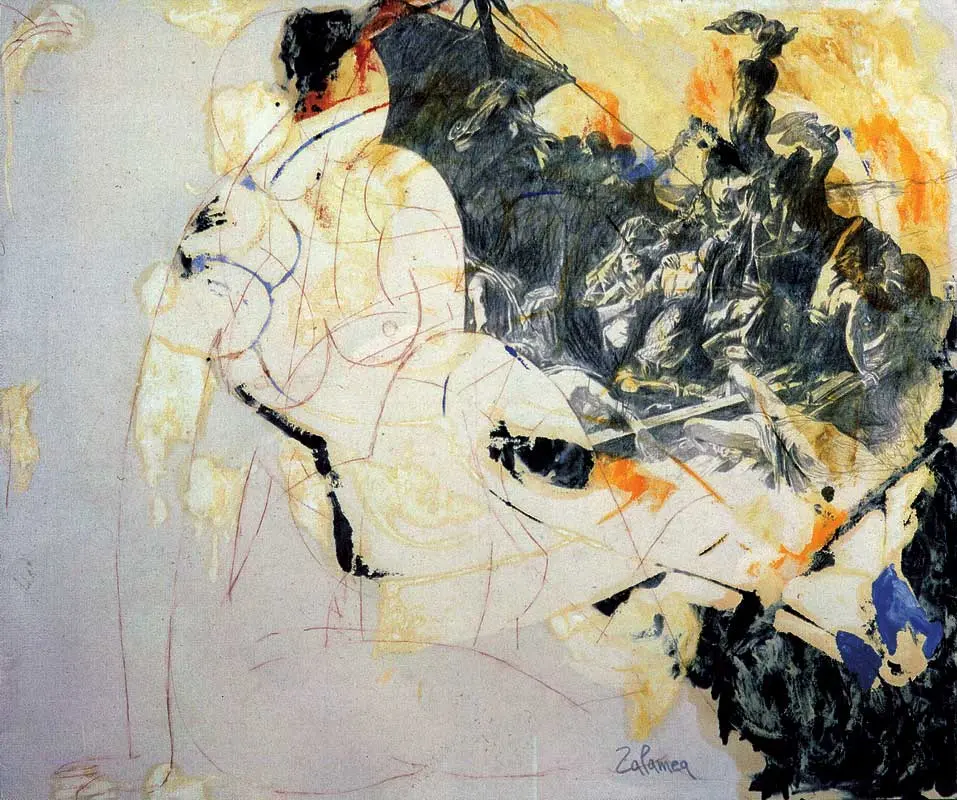
Within the multiplicity of the constructed space, Zalamea is interested in showing the possibility of recuperating fragments extracted from the past and art history in order to assemble these with their current counterparts. Themes such as La Plaza de Bolívar que Naufraga (Bolívar Square Sinking), The Raft of the Medusa (Gericault), and Liberty Guiding the People (Delacroix) are conveyed through several visual manifestations, such as on large-format canvases, sculptures, installations, video, and, of course, writings; elements that make up an exhibition that ranges from Nineteenth-Century Romanticism to modernity’s objectivity and contemporary art writing.
In Zalamea’s work, visual and technical experimentation go hand in hand with a complex and varied appropriation of icons – which works as a point of support for the works exhibited. The artist proposes unsettling images on large canvases – rendered in acrylics, oils, graphite, chalk, and pastels – in which he expresses the precarious, fleeting, and unstable nature of the unreality contained in the themes that he approaches; images that could never successfully achieve the sfumato and fadings solely by the employment of a single technique. His paintings are not assertive but are rather inquisitive, are not concerned with making a stand but are open to many interpretations, are not constrained by outlined limitations but are fluid, with no corrections of form or color. Time is rendered in a fragmented manner as Zalamea proposes the simultaneity of several moments on the plane.
Another element in the exhibition that works in parallel with the visual is writing. In very much the same way that the paintings are on the walls, Zalamea’s writings – the very ones that at some earlier point were utilized for documentation – are now part of the work and are on display. As with the remainder of the works, the writings are observed as a living framework that flows toward the infinite possibilities of the game, in which it is possible to find an infinite number of connections. To Zalamea, the copies, tracings, notes, diagrams, and composition sketches are minimal luminous traces, testimonies of an everyday endeavor that not only takes reliable knowledge into account but also includes new essays and even unsuccessful experiments.
Zalamea proposes combining drawing and writing into an aggressive and non-conformist tool – testimonial and documented – as elements that capture the memory. They represent an artistic language that acquires a new value only after having interrogated the spectator. For this artist, the relationship between drawing and writing is an act that defines moments constructed from several references. It is from such a relationship that cartography or a map of relations is established; a fundamental working base for organizing and communicating.
The exhibition Escrituras by Gustavo Zalamea represents a compilation of his work that reflects the political, critical, and problematic aspects that have always been part of his endeavor, as well as a commitment to the reality that is part of his ethic. The viewer of Escrituras has the opportunity to observe how the artist develops a complex and embellished structure, rich in readings and subtleties. Each work is a collage that defines the establishment by frequently questioning history. An artistic interpretation such as Zalamea’s is woven with emotions that, nevertheless, are propelled by profound reasons, as its creator searches for answers concerning the legitimacy of artistic thinking.
DIANA MARCELA CÁRDENAS