In Barrio de la Torre, a neighborhood in the city of Recife, there is an abandoned house that is looted and demolished every day. With its straight lines, volumes supported by columns, and windows that open onto a garden, the house has traces of the modernist architecture developed in Brazil between 1920 and 1970. What was formerly regarded as a traditional neighborhood of spacious residential real estate, Barrio de la Torre is now overpopulated by tall buildings that stand side by side. Aided by a mockup and a series of eleven photographs, Jonathas de Andrade records in his work titled Projeto de Abertura de uma Casa, como Convém (Project for the Opening of a House, as Befits, 2009) the destruction process of one house that had survived. Suspended by the gallery ceiling at the gallery’s entrance, the wooden mockup conveys the dilapidated condition of the original construction. As if unaware of their time and location, the house and its surroundings announce the misfortunes of a project of modernity now crumbling.
The exhibition Ressaca Tropical (Tropical Hangover) gathers together a group of photographic works that center on the northeastern Brazilian cities of Recife and Maceió, their cartographies, histories, and architectures. In addition to the urban and residential landscapes taken from public archives, there are also images of domestic scenes depicting the way of life of the middle class that used to inhabit these developing cities. Based on these models of urban living, consumer habits, and behaviors, we are able to investigate a recent past that is very familiar to the majority of Latin American cities.
The work that the exhibition is named after, Ressaca Tropical (2009), consists of a group of photographs and pages from a personal diary. The ninety-nine images presented in various formats and sizes appear to come from domestic archives that are combined with aerial photographs and city records. Despite that not all of them belong to past decades –many were recently created by the artist– they portray a period that does not appear to belong to us anymore. Presented on 140 typed pages, the texts reproduce intimate stories of a single man who lived in Recife during the mid-1970s. Here, he records for himself the names of the women he dated, the places he visited, the persons he befriended, and the instability of his professional life. Dispersed over the four walls, texts and images inscribe a narrative that had their origin in very personal experiences that, nevertheless, are part of –and can be confused with– our collective experience. The fictional tone of this proposal flows into the history of this city.
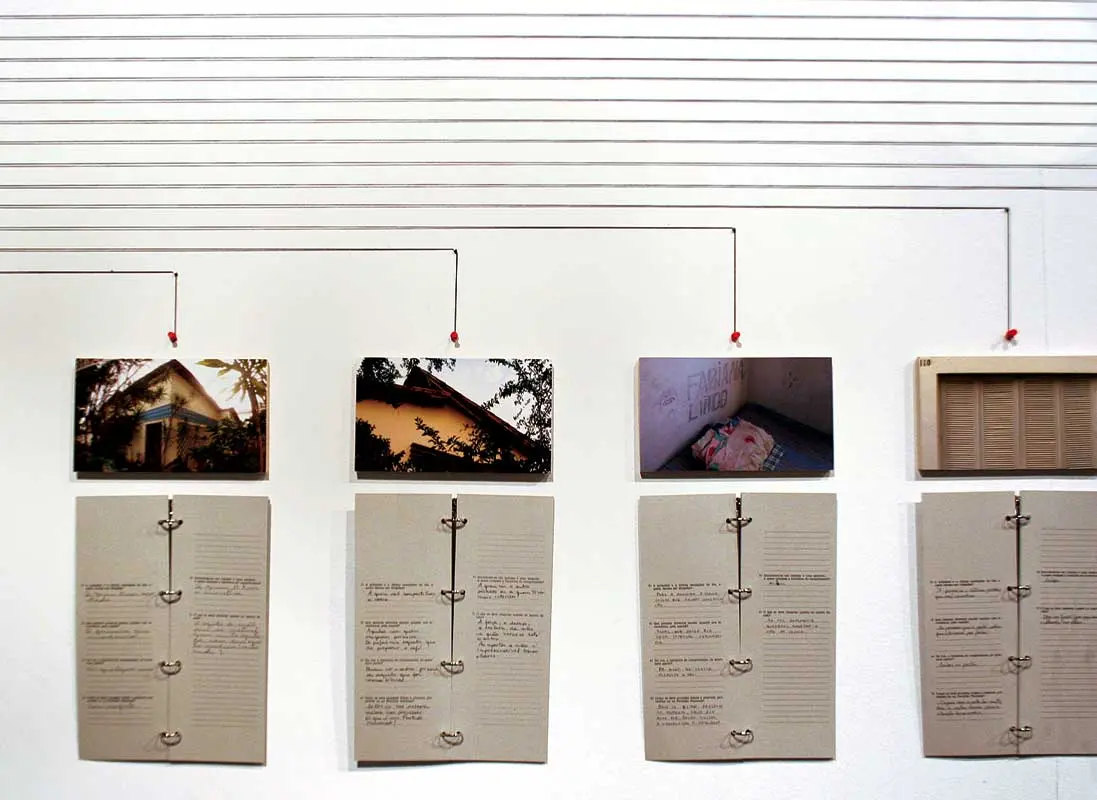
The act of photographing is presented in this exhibition as part of artistic practice, but also as a historic device and an element of individual memory. The images reveal the symbolic vocabulary of a specific period and this terminology operates with traces of social behaviors. In the work titled Recenseamento Moral da Cidade do Recife (Moral Census of Recife City, 2007), twenty inhabitants of several neighborhoods of the urban perimeter respond to a questionnaire taken from a book of good manners published in the 1980s. The questions and answers are placed on the wall and are accompanied by photographs of the interviewees’ homes. A large map of Recife marks the location of each of the houses and generates a sort of cartography of manners and habits. The questions included in the “census” are read today as humorous notes, both because of the ambiguity of the principles presented and the oblique attempt to curb proclivities through the use of conservative norms of behavior. The intensity of these and the remaining works included in this exhibition assumes that the past represented in them permeates the present, making us identify with the remnants of these morals that continue to influence our behavior.
From the landscapes and scenes depicted emerges a way of life organized in opposition to any attempts of moral conditioning; a social organization that attempts to conform, but ends up challenging its own codes. The four photographs in the series titled El Club (2010) depict the headquarters of the Club de Yates de Alagoas (Alagoas Yacht Club), built in 1964 with structural columns that are poised in the Maceió Ocean. Until the 1990s – it was closed in that decade – the town’s high society would gather in the club’s salons while fishermen would go to the lower section of the building to fish. When the tide was low, the structure of the building was left exposed, and the underground level of the club became a place for sexual encounters among men.
Finally, the video 400 Disparos (4000 Gunshots) projects an accelerated sequence – filmed in super8 – of men's faces moving about the city. Despite being close-ups, it is impossible to retain the features of any of the individuals, as all of them merge into a gesture that denotes uneasiness, obsession, and urgency. Jonathas de Andrade appears to be comfortable in a photographic universe that reveals signals of turbulent cities and failed attempts at modernity. Without appealing to the exotic, de Andrade resorts to strong colors, perversions, heat, sensuality, chaos, banality, and nature.
JÚLIA REBOUÇAS