
From the time he was a boy, and also throughout the beginning of the 2000s at the Escuela de Artes Plásticas de Puerto Rico, from which he graduated in 2005, Rito –as Jorge Cordero has been known since childhood– has demonstrated to be one of the most complete, intelligent, profound, and provocative young artists of his generation. He is an artist who, in his own words, wants “to rescue with my work an important past some people want us to forget.”
Rito once crashed the opening of ARCO 2006: He assembled a cross with pieces hidden inside his bag and walked through the place carrying the cross like “a Christ that has returned from the Americas after five centuries.” He risked being detained – and actually was – because he “was not going to pay the thousands of euros for participation in this fair.” His performance was recorded and became one of the artist’s most controversial videos because he criticized the imposition of Christianity that began in 1492 in the Caribbean and later in the remainder of the New World. More recently, this daring artist presented in Puerto Rico and then abroad –at the Scope Art Show and other forums– a very well-thought-out and finely executed work containing powerful historical and poetic elements that reflect the current history and reality of Puerto Rico.
Any artist of importance is capable of seeing more –or foreseeing, or looking at things in a different way– than the rest of us. Any relevant artists have a personal history that gives them strength/immortality. The work by important artists is autobiographical in one way or another, as it also reflects the times they live in. All of these can be observed in the important projects by Rito – a nickname that eventually acquires significance when associated to the concept of the “rite, ritual, historical conscience.”
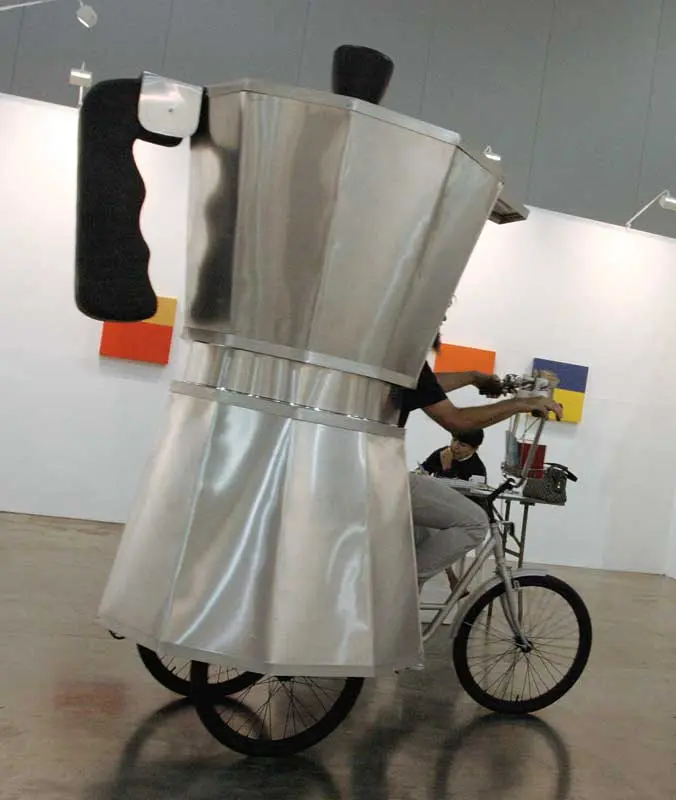
This ever-fascinating artist was born in Hatillo, Puerto Rico, in 1982, but claims to have been “reborn” once he became a “real artist,” after moving to Río Piedras, where he has resided since 2000. Rito became a vanguardist force amid what he calls “the cultural triangle of Puerto Rico: The Universidad de Puerto Rico (UPR); the Santurce sustainable barrio, filled with museums and alternative spaces, and the Escuela de Artes Plásticas de Puerto Rico, located in the Old San Juan.” He evolved into a controversial and appealing chronicler who, through his art, began to shape a very original/different vision of Puerto Rico. He achieved this with the construction of his machines, his performances with these, and through the videos of such performances.
Meticulously conceived and constructed with great honesty and professionalism, the artist’s work –always original and visually challenging– is the result of an extraordinary education that began during his childhood. Rito’s father is a respected bicycle and automobile mechanic, and Rito learned this trade as a child, a skill that was later put to good use when he studied under sculptors/professors Adelino González and Linda Pintor. Rito developed a unique discourse that eventually transformed him into one of the logical recipients of the torch from the previous generation of young Puerto Rican artists of the stature of Allora & Calzadilla, Chemi Rosado-Seijo, or Jesús “Bubu” Negrón.
Important three-dimensional/functional works created between 2006 and 2010, such as El crucisentado, La colecticleta La Habanera, La cafecleta, El carro caravel, and La retornicleta La Habanera– to mention a few– have demonstrated, to the public and critics alike, that he is not afraid to address issues of an existential nature, or to approach national and international themes that help us discuss the historical lies and injustices that, to some extent, define Puerto Rico, the Caribbean, and Latin America.
The first thing that we must know in order to appreciate Rito’s work is that its philosophical-historical elements emerge from a deep respect and honest belief in the postulates of the following Puerto Rican pro-independence patriots: Ramón Emeterio Betances; the deceased poet Juan Antonio Corretjer; the controversial activist Filiberto Ojeda; painter Elizam Escobar, “one of my most important teachers,” who spent 20 years incarcerated in federal prisons and who now teaches painting at la Escuela de Artes Plásticas de Puerto Rico; prominent iconoclastic poet “Che” Meléndez, and the work of the defunct teacher of La Generación del 50, Carlos Raquel-Rivera, among others.
In the dramatic work by Rito titled El carro Caravel, he employed a car frame to create a skull covered in texts by Puerto Rican poet Juan Antonio Corretjer. This work is a fine example of how Rito combines his knowledge as a mechanic with profound conceptual proposals of an existential-political nature. This work has been shown both in traditional exhibition venues as well as in the 2010 strike at the Universidad de Puerto Rico.
In his last exhibition presented in May 2010, Rito showed the work titled La retornicleta La Habanera, which he had already exhibited –causing great interest– at the 2009 Scope Miami. It is a sort of “aquatic/floating bicycle” –inspired by the 1950s and 1960s aesthetics– that parodies/reinterpret the inventions that Cubans contrive to get out of their homeland. The message, however, is that the Cubans who live in Miami “want to return to Cuba in search of what they left behind and yearn for in exile.” Rito is clearly redefining the vision of wanting to escape from Cuba – a theme that has been utilized for a long time by many Cuban artists, such as Kcho. It speaks of the hope – probably unconscious – of going back to what they left behind in Cuba: their lands, their families, and their idiosyncrasy, “what makes them Cuban.” The work La colecticleta La Habanera, accompanied by a video of the in Havana, was also complemented with a series of three-dimensional works, “framed” inside bicycle tires, that reveal dramatic and original gazes based on the initial proposal. To make ends meet, Rito is currently working on murals fashioned with beautiful tiles. But, have no doubt, his best work is yet to come.
MANUEL ÁLVAREZ LEZAMA