A self-taught vanguardist, Peruvian artist José Carlos Martinat (1974) presented the exhibition titled Ejercicios de Abstracción y Substracción para Distracción (Exercises of Abstraction and Subtraction for Distraction. Speaking about the name of the exhibition, Matinat had this to say: “I decided to create a series of somewhat basic addition and subtraction exercises, in order to give new meaning to certain things or actions."1
Concurrently with this exhibition, Martinat also presented an installation at the Museo de Arte in Lima to mark the reopening of the museum. With 10,000 visitors during the first week after the opening, the exhibit broke the museum’s attendance record.
In the exhibition at the Galería Revolver, Martinat included four kinds of works that are markedly different from each other: an installation; a cement sculpture with broken glass; a megaphone suspended from a pendulum, and graffiti images taken from Lima’s street walls. This show is by no means homogeneous, as the essence of Martinat’s work is precisely to surprise and challenge viewers. What is art? Who is the artist? Is the artist the person who envisions the work, or the person who executes it? There is no doubt that the answer is the person who – like Martinat – envisions the work.
The concrete piece titled Ejercicio 2 is a wall-like structure with hollow sections where there were bricks at some point that were removed after the work was finished. There are pieces of broken glass at the top of the structure, very much like those used as a safety measure on the walls of many houses in Lima. This work is not visually pleasing, but it is precisely this – its simplicity, materials, and geometry – that makes it appealing. Each one of Martinat’s works is created with a very specific idea, and according to the artist, “this piece is like an x-ray of Lima, like the skeleton of a city that, after been left without the bricks from its walls, only consists of concrete and a precarious security system often used in the Peruvian Capital.”3
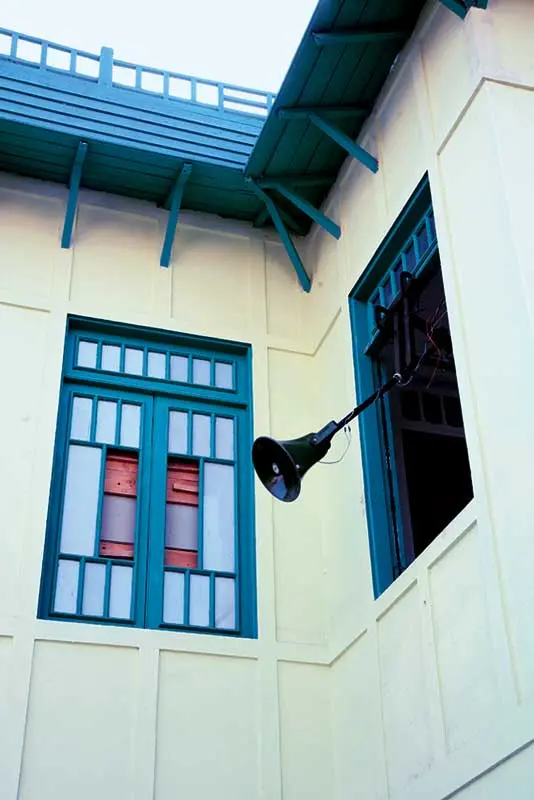
The piece titled Ejercicio 4 consists of a megaphone attached to a pendulum that moves mechanically and repetitively as it hangs from a window frame. It plays audio taken from artistic manifestos found on the Internet, but these are rendered inaudible because the pendulum continually oscillates toward the outside of the window. It is as if the manifestos only serve as decorations. The visual elements in this piece are of little importance. Here, the concept of work is what is important. The pendulum is mechanical, the megaphone electrical, and the two elements are not really aesthetically pleasing. But the importance of the work resides precisely in that it lacks visually appealing attributes. It is a very personal work. Just as Martinat does not rely on any parameters to create his work, the audios of the artistic manifestos serve no apparent purpose, and the artist recounts this here. The piece was executed by two assistants and supervised by Martinat.
Graffiti is a serious problem in Lima. It is everywhere, and Martinat appropriated some of these wall drawings through the use of resin and made them his own. While the quality of the original graffitis resided in their aesthetic beauty and ephemeral nature, Martinat immortalized them by appropriating them for his own work. The images are not framed; there is only the image with resin hanging on the wall. The images range from caricatures, skulls, and women’s faces to those of aliens and clowns. Martinat also borrowed graffiti words from political ads placed on street walls and employed these to form the word mentira; he then placed this on a wall facing the beach and left it there. With these actions, Martinat’s work is aggressive: he has vandalized works by vandals and has appropriated images by unknown artists without any artistic merits and made these his own. It is a very unique artistic proposal that resorts to innovative materials and ideas that, in turn, become the source of such originality.
Martinat works in a very peculiar and vanguardist manner. He approaches his pieces thoughtfully, develops them using a 3D-rendering computer program, and then – guided by measurements and specifications – he delegates the completion of the work to others who work under his supervision. Although these appear inconceivable, this is a reality of our times. The best part of Martinat’s work is the work per se and its materials, not their esthetic appeal. Nevertheless, his works end up being so interesting that even their aesthetic elements can be appreciated, as also occurred with works by Duchamp.
NOTES
1. Interview with the artist, June 2010.
2. Ibid.
3. Ibid.
AUGUSTO CHIMPEN