
The exhibition titled El Ojo Pensante (The Thinking Eye) finally enables, in Chile, a comprehensive look at the work by Juan Downey (1949-1993). Born in Santiago, Downey studied architecture there and eventually migrated, as a young man, to Paris and then to New York. In the Big Apple he was part of – during the 1960s and 1970s – and one of the protagonists of an innovative and effervescent art scene that conducted explorations during a period of social, political, and technological changes. A short time following the appearance of Nam June Paik on the art scene, Downey began to experiment with video art, video installations, electronic sculptures, happenings, and performances, as he also worked with drawing, painting, and engraving. He tested the limits and reformulated the artist’s role. He is, above all, a “cultural communicator” or an “aesthetic anthropologist,” who is never isolated and who chose to work actively in society and deal with social issues, even proceeding beyond boundaries in a search for “the other.”
Under the curatorship of Marilys Downey and Julieta González, this exhibition, which took place from April to June 2010, reveals a Juan Downey who was diverse, unclassifiable, and a visionary; a thinker.
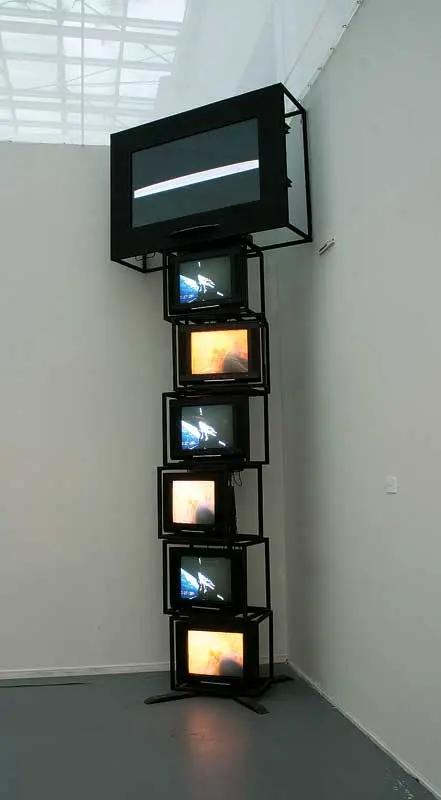
The first work in the exhibition, titled Video Trans Américas (1976), sets the tone for the remainder of the works by establishing the idea of the journey. The installation consists of fourteen monitors, elevated on plinths, exhibiting a polyphony of registries on the journey experienced to date – that is, from 1973 to 1979, from Texas to New York, and to the southernmost part of Latin America – and the drawing of a map of the Americas on the floor. There are street images, urban situations, landscapes, and indigenous people from Chile, Peru, Bolivia, Guatemala, and Mexico, as well as takes from one of the artist’s performances at his studio. Experience guides the works that follow as Downey expands his approach to question the relationship between art, anthropology, and ethnography. The video is a hybrid in which the cuts, the editing, the suggestions, and the staging – that contributes with symbols – as well as notions of multiculturalism ahead of his time, destroy any subjectivity or folkloric undercurrent. Through video, the various cultures gaze at each other with evocations that range from the political to the mythical and poetic. Technology becomes a vehicle, namely, an intermediary and a medium, which leads to other states of perception.
Downey’s journey is political. It is an action and a total commitment to encounter the other. It is a search for his identity, his roots, and his memories that results in a confrontation with the reality of countries marked by grave social conflicts and – in many instances – by dictatorships. After reuniting with his homeland, Chile becomes a persisting theme in his work. It is present in Map of Chile (Anaconda) from 1975, and in About Cages, from 1987: two installations that transgress the experience of torture, repression, and injustice. In a series of videos from the 1980s –Chicago Boys, The Motherland and The Return of the Motherland– Downey takes on documentaries, interviews, the stage, and the experience of the exile.
The journey is also mystical. After Video Trans Américas, Downey travels to the Venezuelan Amazon forest and for a period of one year lives with the Yanomani, where he brings his “thinking eye” into the world of an isolated and primitive tribe. A reciprocal work with this group expands the possibilities of video and the artist’s own experience as an “observer.”
During this time, he produced Meditaciones (Meditations), a series of graphic works with personal visions of meditative states. As in the case with his maps of America, this series manifests ideas of territories transgressed by vibrant energies and dynamic configurations. The sketches and studies on his electronic sculptures, created with aesthetical intent, represent a reality interconnected by invisible flows. In this latter –work– according to photographic records and other documents – technology enables the expansion of what is apparent: bodies are connected with machines that activate sounds, shadows, and images. These are works animated by a cyberspace utopia and by a concern with the theory of systems, lucubrations that address the possibilities of creating communities and networks for a new kind of democratic society.
In the search for his identity, Downey ends up digging even deeper. He arrives at the past, an ecstatic place never before touched upon that is not only about the Yanomami world –the other– but that is also about himself, the artist’s own being. The video is a mirror in which spatial-temporal possibilities, as well as the individual experience and the relationships within the social and collective contexts, are expanded. The “other” is a reflection; it is I. One decisive photograph in this regard is the black-and-white making up a part of the exhibition is that of a Yanomami posed with one eye at the camera lens as he gazes at Downey… or at us, perhaps, a game of reflections in which one knows not who is being observed after all. This was something that obsessed Downey during his visits to the Museo del Prado, where –when he was still in his twenties– he would contemplate Las Meninas by Velázquez during the entire afternoons. He also used this work in the series of videos titled El Ojo Pensante (The Thinking Eye, 1981-1983).
CAROLINA LARA