Some time ago, I read the following brief manifesto by Liliana Durán: “The natural landscape is not only my record and my cry but also my tool. It represents the reality of change or timelessness that depends on chance, just as life does. The landscape is the space that we capture from far or near. It is a real group of elements, but it can also be the most abstract image. If we learn to observe it, it becomes a true teacher. We learn, for instance, that the beauty of a flower does not reside in the adjectives with which we describe it, but in the flower itself – a realization that allows us to become a part of it. This is where the truth lies.”
The 365 drawings that Durán exhibited at the 69 Espacio Flexible Gallery made me understand the meaning of her words. The 18cm x 24cm (7.1” x 9.4”) drawings were created with two different techniques: Oil, and sumi-e (black ink and wash painting). Sumi-e is a technique that originated in China that was later appropriated by the Japanese and by Buddhist monks for writing and drawing. It requires a great deal of skill and precision, as the brushstrokes cannot be erased. The artist must be in an extremely concentrated state, a meditative state that enables him/her to capture the essence of what is being painted rather than its appearance.
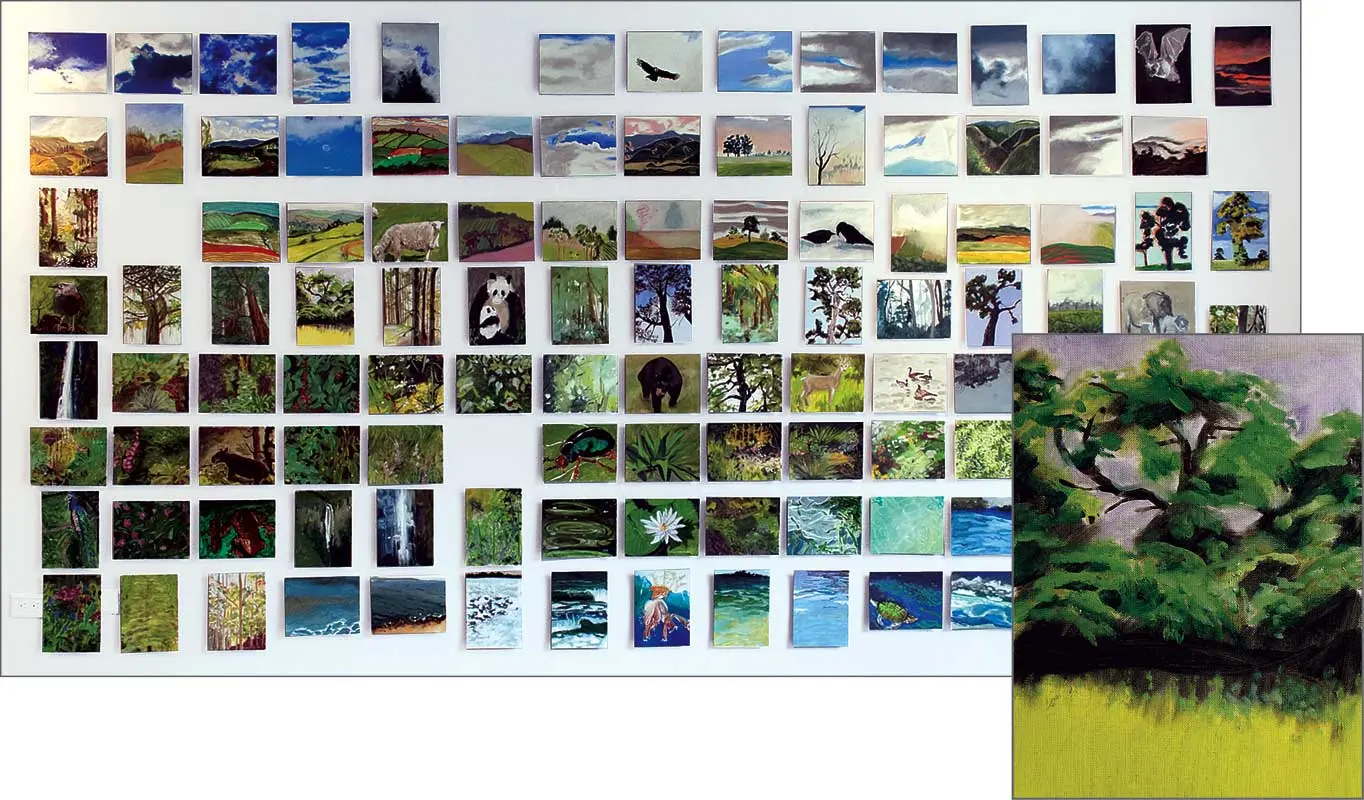
The 365 drawings were exhibited on a single wall and formed a rectangular landscape or mural that is 158cm x 118cm (62.2” x 46.5”) in shape. This vertical layout maintains the characteristics of a naturalist landscape. The upper part is populated by air, sky, and clouds. In the mid-section, we observe mountains, trees, and vegetation that speak of the earth. And at the bottom, there is water shaped like a river, a waterfall, an ocean, or a puddle. Animals are in the areas that correspond to their habitat: birds appear in the sky; mammals and insects roam about in the vegetation, and fish swim in the water. Nevertheless, the structure is profoundly altered, given the diversity of approaches found across the group of images. Indistinctly arranged close-ups and panoramic views interrupt a naturalist perception and widen our perception by rendering a drop of water as visible as an enormous mountain.
The horizontal layout of this mural works in an entirely opposite fashion. It has nothing to do with naturalism and can be read in two different ways: as a visual lesson in the transition between figurativism and abstraction, or as a somehow traumatic experience, as the progressive disappearance of the natural world. To the right, there are the predominantly colorful drawings created with oil paint. The central section contains the works that combine oil paint and sumi-e. And to the left, there are the pieces rendered only with sumi-e. As our gaze moves from right to left, the drawings turn into abstract brushstrokes, lines, patches, and dots. This gaze from right to left across the wall perceives a range of vibrant colors that are gradually more muted until the images become gray. Precise shapes eventually dissolve progressively to become patches and watery lines.
Another important element is the work’s references to art history. On the one hand, there is the convergence of Eastern techniques that capture the essential natural elements through quick brushstrokes. On the other, romanticist emotions and the impressionistic gaze are also evident. The former is present in some drawings depicting expansive visions, while the latter is revealed in the close-ups – executed with agile brushstrokes that capture the vibrating light – of aquatic ripples, of the colors and textures of the vegetation, through agile brushstrokes that capture the vibrancy of light. These small drawings convey the singular life pulsing in each natural element, as well as its formal beauty.
Presented with perceptive possibilities such as these – in which art history, abstraction, and figuration intermingle with the pressing awareness of the planet’s perils – it is important to know the process that led to these 365 drawings. The accelerated change that our planet is experiencing is evident, and we observe this and suffer from its effects every day. Political will, however, is not as strong as one would expect, a fact reflected in the last Copenhagen Climate Change Treaty. In the face of this situation, Liliana Durán decided to compile a record of this dying world. For a two-year period, she set out to create 365 drawings that would pay homage to the infringed-upon natural world. The inauguration of the exhibit coincided with the celebration of Earth Day.
Each image was hurriedly created to correspond with the rapid manner in which our natural surroundings are being eroded. The project concluded with the sumi-e drawings, which were produced at an even faster speed. The level of concentration and meditation required by this technique made Durán even more conscious of the tragedy of nature’s disappearance, as she, on the other hand, was also able to convey nature’s essence. Her understanding of nature became even more profound, and as she “arrived at that more abstract image, the landscape ostensibly became her true teacher.”
MARTA RODRÍGUEZ