The Galería Santa Fe presented during the month of May the exhibition by Lina Sinisterra titled Quiero 115 Mil Veces (I Want 115 Thousand Times). It was a proposal that won an open call, which is one of the mechanisms used to develop the program in this exhibiting venue. Given the peculiar shape of the space – a curved parallelepiped – the Santa Fe Gallery has made very clear to artists and visitors alike that exhibition space is not meant to be neutral or transparent, but opaque. Curiously, theoretical discourses have been circulating for at least two decades that have helped us understand that any exhibition spaces – even the white cube – is equally opaque and interferes with the works.
At the beginning of the 1990s, the Galería Santa Fe – formerly, during the 1970s, the headquarters of the Museum of Modern Art in Bogota – became a venue for contemporary art. Gradually over the years, many artists have regarded the gallery’s physical characteristics as one of the elements at play in their creative process when they exhibit their work there. Emblematic of this space, the Luis Caballero Prize was one of the main triggers for identifying the need to consider the characteristics of the space as advantageous, rather than an obstacle, for the artistic proposals exhibited there.
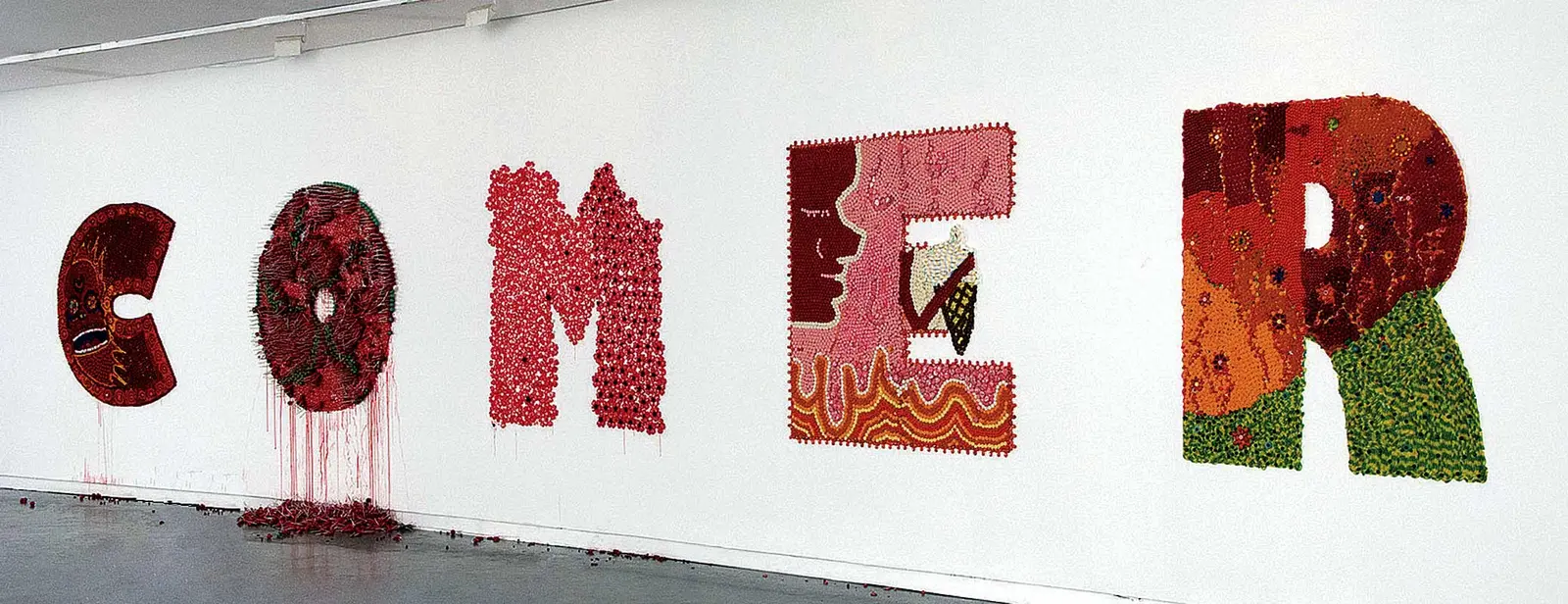
Quiero 115 Mil Veces was conceived as a response to the logic of the space at the Galería Santa Fe. It basically consisted of an installation with a phrase, written by adhering 115 thousand candies on the widest wall (164 feet), located across from the entrance. The installation also includes several candy vending machines that needed ten coins of 200 Colombian pesos each (1 USD approximately). The phrase written was Comer del Arte Quiero (From Art I Want to Eat). Sinisterra wrote that one of the interests of this work is to question the commercialization of art and the artistic work within a consumer society, and that is the reason she was interested in charging $2,000.00 Colombian pesos for the sweets. Likewise, she pointed out that the work functioned as a sort of statement since it could be an inquiry on the current possibility of “making a living from art.” Sinisterra also mentioned the interactive nature of the work, given the options that the viewers had to “consume” it in two different ways: by actually eating it, and by paying for it. Reading these arguments generates certain questions concerning the manner in which is possible to question what she calls “excessive consumption” through approaching art as part of the labor market – a latent element in the installed phrase – or as the logic of capital – because it pertains to the economic exchange that results from selling the candy – or as passive consumption – exemplified in the hypothesis of the spectator postulated by the work.
Upon examining the work more carefully, it appears as if the entirety of its elements were based on the same logic, in that these are composed to achieve a unique dimension of experience that explores similar aesthetic, semiological, cognitive, and ideological aspects. Therefore, they target quite homogeneous sensations, emotions, ideas, and cultural representations. Gerardo Mosquera noted that the best way to understand the necessary and unavoidable coexistence of various kinds of human emotions – within art’s aesthetic dimension – would be to compare it to the sense of taste. Thus, similarly to the way that food can transition from sweet to salty – also involving acidic, bitter, spicy, and tart tastes in the process – the aesthetic experience moves from the beautiful to the ugly, while also incorporating the dramatic, pathetic, sublime, or terrifying. Both processes incorporate unforeseen combinations.
Quiero 115 Mil Veces relies on the senses of smell, touch, and taste to come near the spectator that it presupposes. But this approach is achieved through a very limited group of experiences. Returning to the earlier comparison, it is paradoxical that, while we experience an absolute certainty about the nature of the majority of flavors, we are conversely highly doubtful, confrontational, and argumentative about aesthetic categories. All of these are revealed to us as relative and relational. While the nature of human relationships may be similar among several persons, the facts that motivate these are mainly cultural; therefore, what to some is beautiful, to others is actually repugnant, or what for some causes them to relax, is unnerving to others – exactly as occurs with the palate. That adult tend to prefer salty foods over sweet could perhaps explain their dark – and not always accepted – a fascination for negative emotions.
And it is precisely negative emotions that are lacking in Quiero 115 Mil Veces, or metaphorically, it “lacks salt.” It is strange that to Sinisterra, desire is the basis of a consumer society, given that the term – if understood correctly – contains the most obscure fantasies of human beings, as marginally occurred in this project, with the posters that warned spectators of the danger of eating the candy attached to the wall with glue.
I cannot avoid comparing this exhibition with another: a perverse and unsettling exhibition during the Eighties, when the Galería Santa Fe was in limbo – after the MAM and before the gallery became what is today. It was an exhibition of traditional Colombian candies full of color that, nevertheless, were accompanied by a small poster headlined with the danger symbol warning of their poisonous nature.
I introduce this latter example to underscore that works of art need to contain the experience of their opposite so that viewers are permitted to choose their own fantasies and to interact with the work according to their own desires. This is something that destabilizes the logic of capital – in which everything is exchanged for one thing – that is, the basis for a consumer society.
JAIME CERÓN