
Luis González Palma has become one of the most sought after Latin American contemporary photographers. With an unmistakable and well-defined style, he has been consistently producing work for the past twenty years. His last solo exhibition, Guarded, functions as a small retrospective, bringing together works from the last ten years and offering the perfect frame for his new series of works, after which the exhibition is titled. Throughout the show we can perceive certain formal and conceptual evolutions that Gonzalez Palma’s oeuvre has endured during these years, allowing us to appreciate the unity and solidity of it. Simultaneously we can also see the diverse phases that he has gone through. His earlier portraits, which first gave him recognition, are very distinctive. He found a way to ‘isolate’ the person in what seemed almost like a studio portrait, citing a long tradition in the New World. Then he did the Family Album series, in which people were captured in the environment of their everyday lives. Later on, he would concentrate on objects, turning to narrate the stories through ‘absences’ instead. His latest series, the Bodyguards, can be perceived as a bold move because he is focusing exclusively on masculine portraits.
One of the elements that unify all his work, regardless of the period, is the unusual treatment of his characters. We can safely say that the vast majority of Gonzalez Palma’s pieces are portraits, except for a short period when he leaned towards interiors and objects. Even though this period many of his images included human figures, mostly women. In a simplistic analysis, we can nod at these works and think that portraits are commonplace in photography, and have been since the very beginning. While this may be true, González Palma turns it into a new kind of work by the effect he achieves. When we look at one of his works, we instantly recognize that he is the author. Perhaps the answer lies in what he is able to get from the people he photographs; the intensity of their look, or their sad, aware gaze containing so much sorrow. The anonymity of his characters is part of their identity, and this is Gonzalez Palma’s view of his people; his way of telling us that they are there even if we don’t know their names, and their apparent lack of expression is in a way an identity that carries them as people. There is a story behind each of these images, a very personal one of complicity between the person portrayed and the artist. These people touched him in a way or another, be it through a personal relationship or by a casual encounter, and they are now immortalized in these frozen images.
There is also a nostalgic sense in these works, a stir of past and lost time; or as Marcel Proust would say, he seems to be ‘in search of lost time.’ In his own way, Gonzalez Palma is searching for the past as an element of identity, a thread that can carry his country to the present. This sense of loss is conveyed in the longing of his characters, reinforced by the golden tone that dominates his work, applied to the background as sfumato.
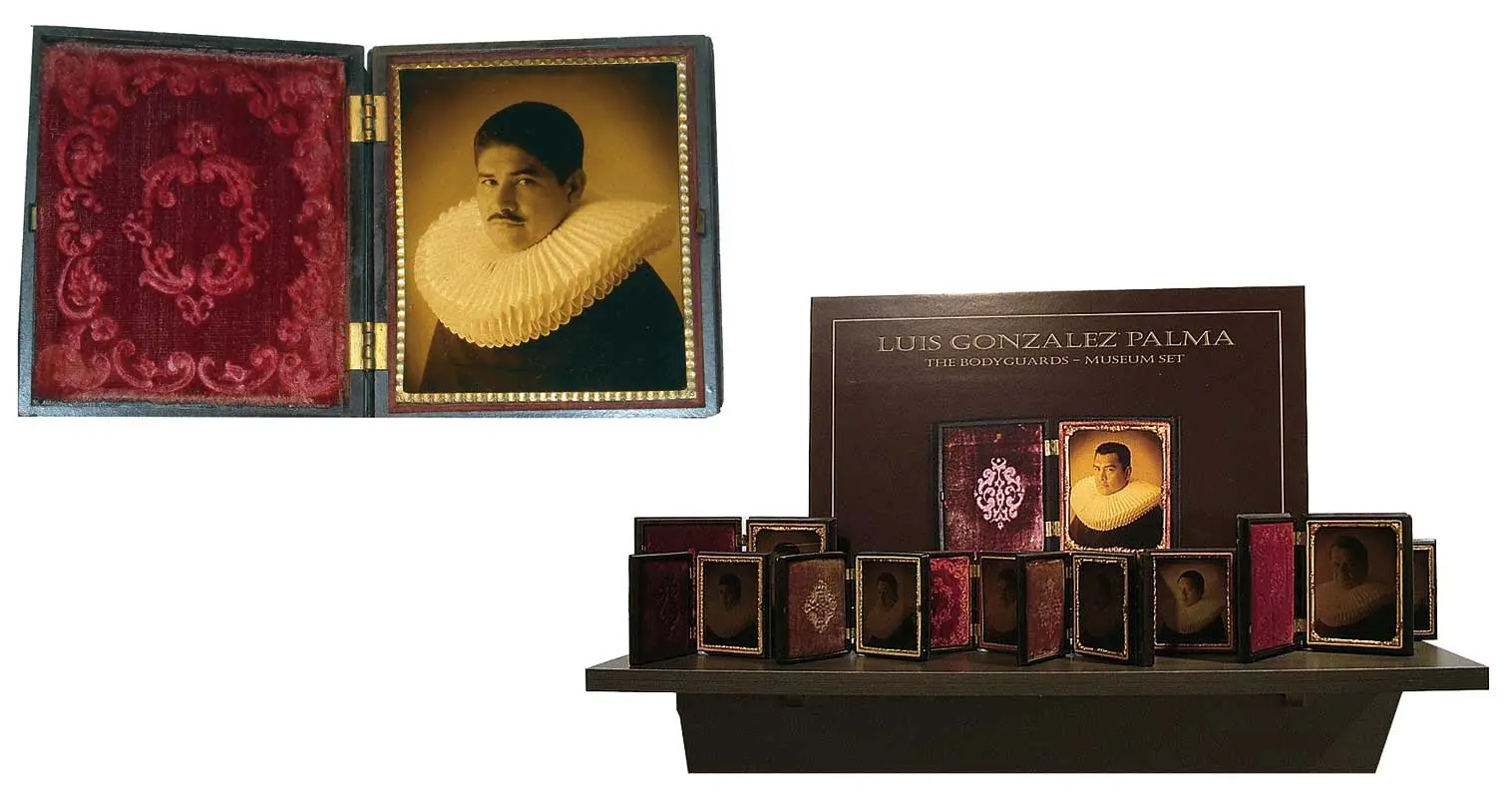
The newest work in the exhibition, from 2009, is the series of Bodyguards. This is a series of masculine portraits for which he photographed actual bodyguards from the most prominent families in his country. Bodyguards are people who are usually anonymous and ‘invisible.’ Their place in the current society in Central America is a tricky one since they are protectors, but at the same time, their presence signals the violence and uncertainty that prevails in the area. Gonzalez Palma ‘dressed them up’ with collar ruffs, an element that was in use customarily in the XVI and XVII centuries. There is a histrionic component to the images: they seem like actors from a play but at the same time they are uncomfortable, looking straight to the camera in an almost defiant attitude. When we look at the images we don’t get a direct connection to what they are, nor even suspect what it is that they do for a living. González Palma made the images as daguerreotypes, encased in the typical ornate box, which instantly creates an intimate relationship. It gives the image a distinctive flair, making them powerful in spite of the fact that they are very small.
In this exhibition we can easily identify the many characters that have populated Gonzalez Palma’s iconography; from the traditional men, women, and children, the mysterious ladies, and more recently the bodyguards. These haunting images are about humanity in the broader sense.
Without question, González Palma’s work carries with it an implicit social critique. At first, we only see the face of the person he portrays, then we get the whole idea behind it: social hierarchies in Central American society. By representing the indigenous population of his country he is commenting on their existence, the marginalization, the discrimination, and their place in society. Now, with the Bodyguards series, he is talking about another side of the contemporary reality of a country where violence is a daily occurrence. The Bodyguards series is an ironic representation of a solid and established social structure based on a hierarchy, where in order to be protected you need to be able to afford it.
IRINA LEYVA