
The reality of Latin America, with its unfinished identity, remains far from what José de San Martín and Simón Bolívar dreamed for the region, “the greatest nation in the world, less for its size and riches than for its liberty and glory.” Puny glory in a region filled with social disparities, its liberty truncated by inefficient and/or totalitarian regimes, shackled by endemic poverty and corruption. Little to celebrate, even of the calendar marks the arrival of the independence “Bicentennials” for many countries in the region (Argentina, Chile, Colombia, Mexico, Venezuela) examined with a critical lens in the traveling exhibition Menos tiempo que lugar. El arte de la independencia.
Conceived by the Goethe Institute and curated by Alfons Hug (Germany), the project El arte de la independencia: ecos contemporáneos brings together 22 artists and five writers to dialog among themselves and travel through countries in the region to produce works in video-art, installation photography, and painting, as well as several essays included in an illustrated, bilingual 300-page catalog. The authors are Uruguayan writer and activist Raúl Zibechi, who traveled in Bolivia and Ecuador; Peruvian writer Alonso Cueto Caballero, who explored Argentina and Mexico; German journalist, writer, and translator Timo Berger, who crossed Paraguay and Peru; Frank Stemper, a journalist and advertising man from Germany, who visited Colombia and Venezuela; and Spanish-born philosopher Alexander García Düttmann, who investigated Chile and Uruguay. Theirs are politicized visions and expressions of desire, filled with references, traditions, and living histories that question the status quo.
The title for the exhibition, Menos tiempo que lugar comes from a poem by Uruguayan writer Mario Benedetti: “There is less time than place / yet / there are places that last a minute / and a certain time is out of place.” Curator Alfons Hug, who lives and works in Brazil, wonders whether “This perhaps means that we have less time than space, that time flees from us while we search for a place to settle, that in the end we have somewhere to stay but time has left us, ‘concluding that maybe’ only art is capable of situating the time of the moment and giving it a refuge.”
Hugs take as his starting point the “Letter from Jamaica” written by Bolívar on September 6th, 1815 in Kingston in response to a message from Henry Cullen, with the intention of calling Great Britain to collaborate with the cause of American independence. In this extended, meditative text, Bolívar analyzes at length the situation and the time and, although acknowledging the difficulties and the internal struggles, expresses his desire to see Latin America become a single nation, with a single government from the Panama Isthmus to Patagonia. Far from such aspirations, the region is plagued by calamities, divisions, and conflict. In his Letter, Bolívar mentions Baron Von Humboldt, whom he encountered on two occasions and who, as Hugs notes, “is seen by some as the intellectual father of the Latin American independence movement and an inspiration to the Libertador”; it is from this historical standpoint that the Goethe Institut, a cultural center that specializes in teaching the German language, developed the present exhibition.
Consequently, the show is filled mainly with videos, photographs paintings installations, and texts that clearly state that 200 years of independent life are too many for the region still to be saddled with backwardness, and for the excluded still to be legion. Attractive visual narratives from artists who, with keenness, intelligence, and humor—on occasion, peppered with a degree of binary thinking and a romanticized vision—both engage contemporary problems and follow the traces of ancient cultures, recreate history, and establish a relationship with nature.
In many of the works displayed, the accumulation of negative aspects of reality appears as if to summarize a catalog of frustrations, but alongside the recognition of the dire state of things the best works here also present the public with the possibility of discovering utopias, teaching to cure our ills, to find the “total meaning [of the America] and those cryptic hills of their syllables that we cruise back and forth unendingly will become transparent, clearly defined (…) [Although] for now this is no more than an aspiration, and frequently a despair,” as critic Marta Traba put it.
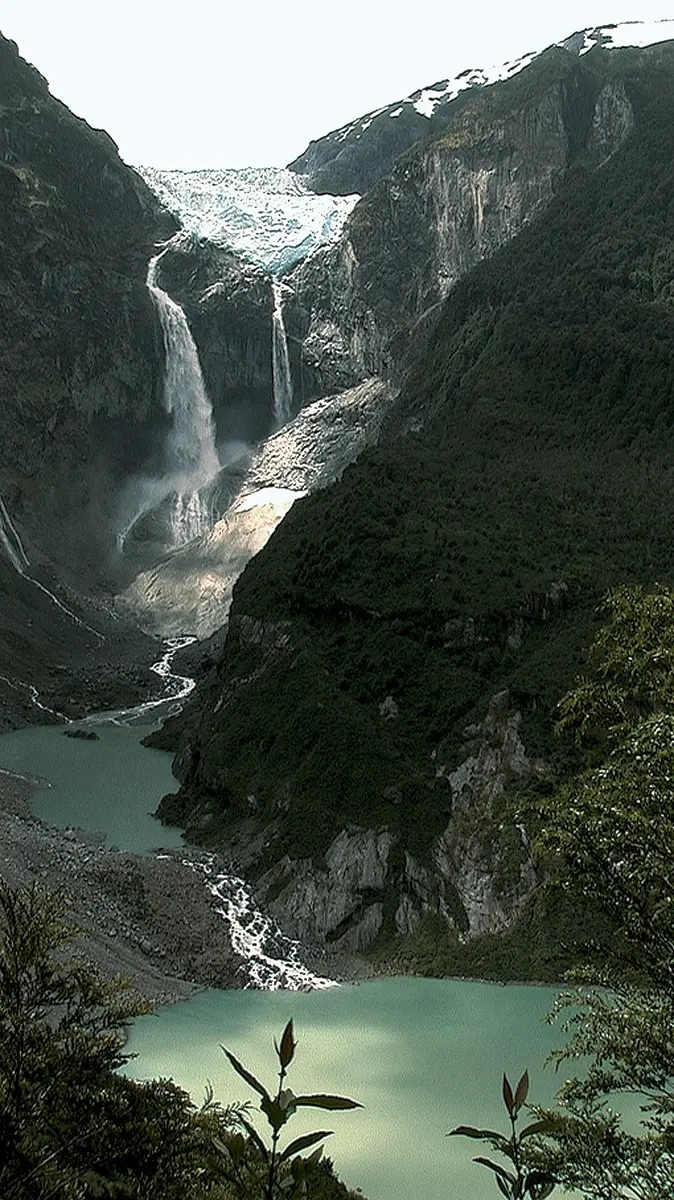
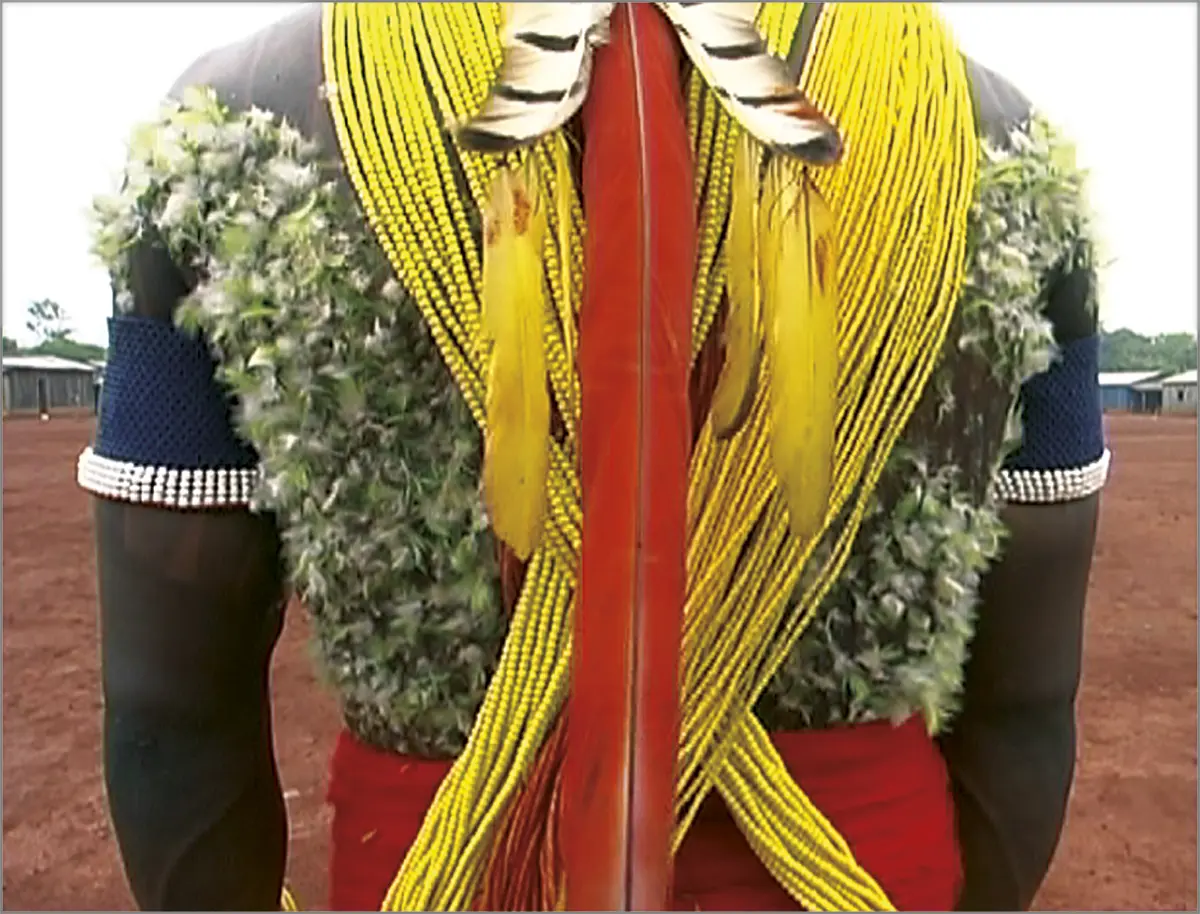
While Julián d’Angiolillo (Argentina) denounces in his video the contamination of Riachuelo—a situation that was already apparent in 1811—showing its decomposition, Gianfranco Foschino (Chile) calls attention to the dramatic loss of mountain snowcaps with a video recording the stunning landscape of the Ventisquero Colgante. The figure of the traveler/artist Frederic Edwin Church, who painted Mount Chimborazo in 1864 as well as other landscapes of the Americas, adding details from his own imagination, recovered and critiqued by Frank Thiel (Germany), who presents his own photographs of Ecuador’s highest volcano and of the Cotopaxi looming over Quito, alongside images of Church’s works now in the collections of various museums. Journeying through the Inca Trail, Agata Madejska (Poland/Germany) photographs the majestic Andes mountains, archeological excavations, and the vastness of the desert. The video presented by Neville D’Almeida (Brazil) brings forth the labors and the days of a community in the Amazon basin, while Laura Glusman’s (Argentina) documents the extraordinary journey of the hummingbird, those little American birds that shine dazzlingly in their incessant flight.
Claudia Aravena Abughosh (Chile) uses images of the vastness of the Pacific Ocean—in a video recorded from Valaparaíso as if it were the great Atlantic sailed by the Spanish Conquistadors—to remind us of the phrase “Greater is the hate She [Spain] has inspired, then the ocean that separates us from her,” from Bolívar’s Jamaica letter, material that is also deployed in videos by Leticia El Halli Obeid (Argentina) ad Alexander Apóstol (Venezuela), where, the irony of ironies, the inhabitants of a poor Caracas neighborhood make an incongruous reading, aloud and into the camera, of the letter originally written in English, without knowledge of that language.
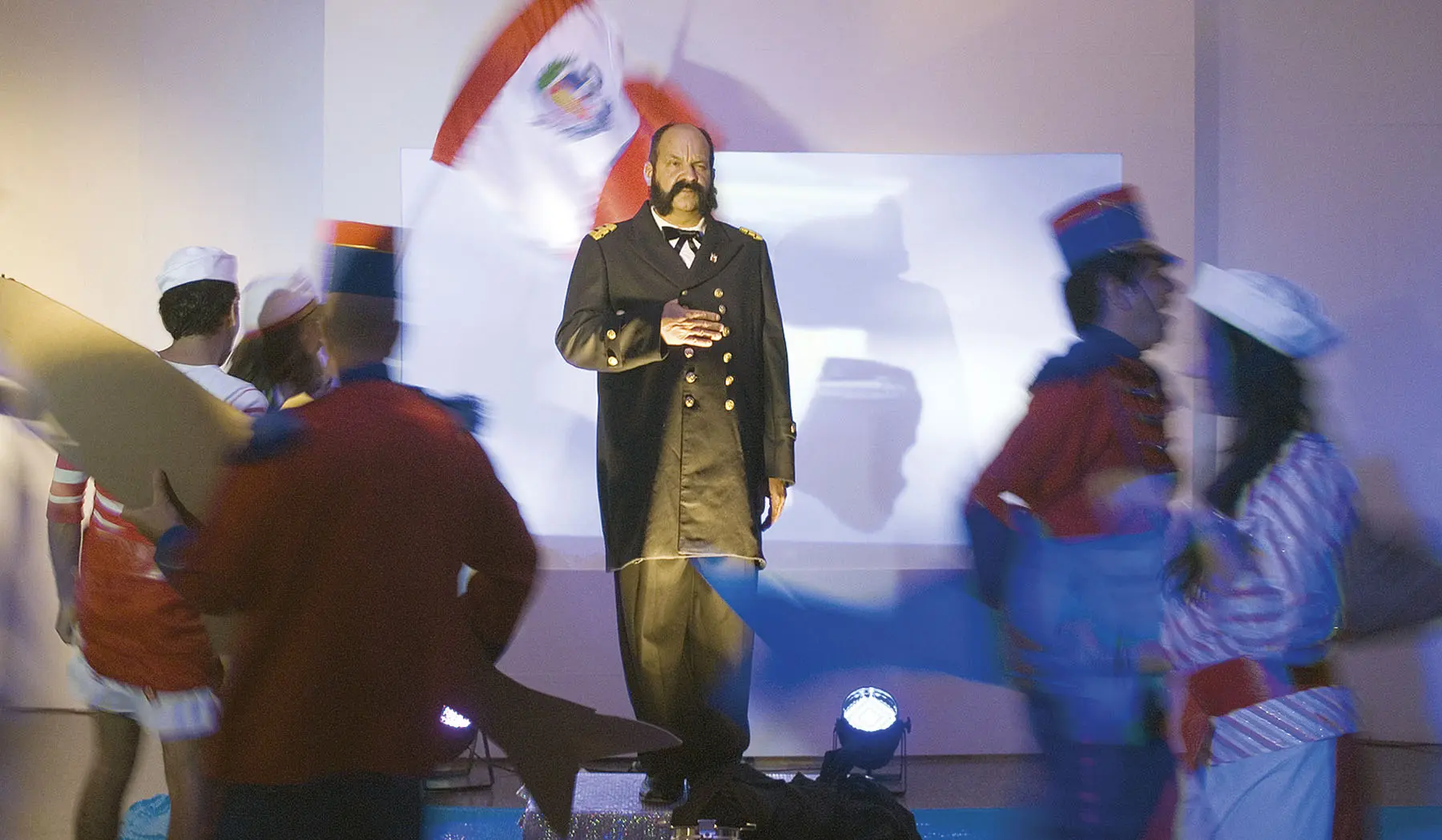
The work of Fernando Gutiérrez (Peru), performance and photography, ironizes about defeat and the cult of personality by recreating Peruvian admiral Miguel Grau’s journey from Lima to southern Chile through the presentations and representations in towns along the coastline of his descendant Germán Grau, dressed as the illustrious forebear, killed in 1879, whom he resembles greatly.
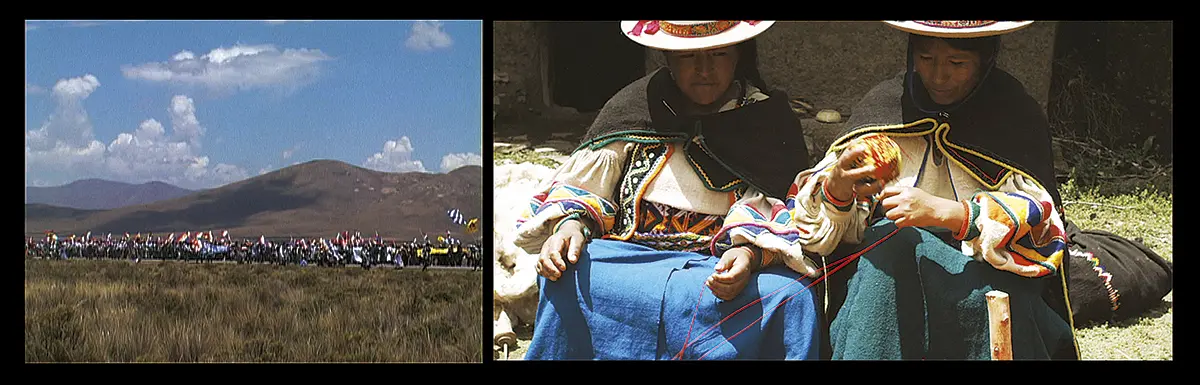
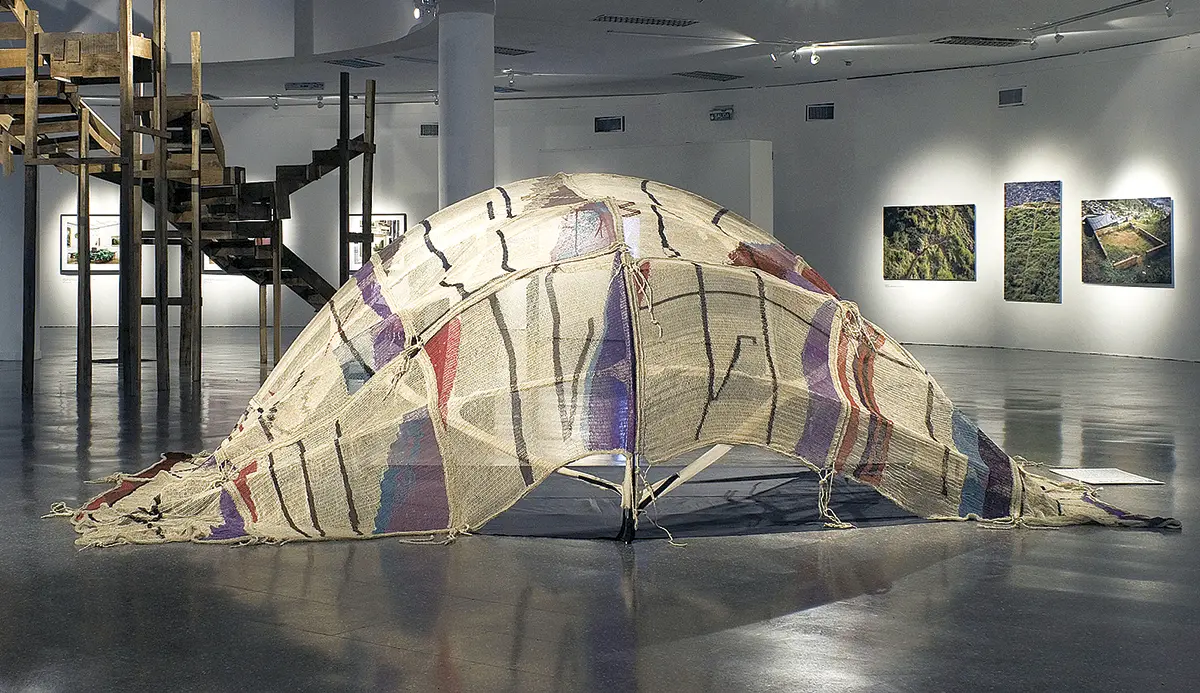
Claudia Casarino (Paraguay) presents Pinandi (Ni Puta ni Diosa ni Reina) three dresses in very thin cloth with applications of ñandutí lace that refer to the situation of women before the arrival of the conquistadors and after the decimation of the country’s male population in the Triple Alliance War (1865-1870). On a dual-screen, the weavers in the video presented by Joaquín Sánchez (Bolivia) undo a Bolivian flag and create a new spool, while we see documentary images of popular marches demanding better social policies. Using chaguar weavings (a vegetable fiber) from the region of the Chaco, Olaf Holzapfel (Germany) builds provisional architectures intended to point out the scarcity of appropriate housing and the failure of cities, while Juan Fernando Herrán (Colombia) alludes to the region’s precarious lodgings through a staircase, metaphor for the possibility of flight in the poor areas encircling Latin America’s cities, where millions survive.
The videos presented by Miguel Venture (Mexico) and Bjørn Melhus (Norway/Germany) coincide, via different paths—from the absurd to a fictional documentary—in pointing out the growing militarization and surveillance of Mexican society but also its vulnerability to the armies of drug traffickers and militias, and the threat posed by the proliferation of weapons, given the saying that advises us that “weapons are carried by the devil and discharged by idiots.”
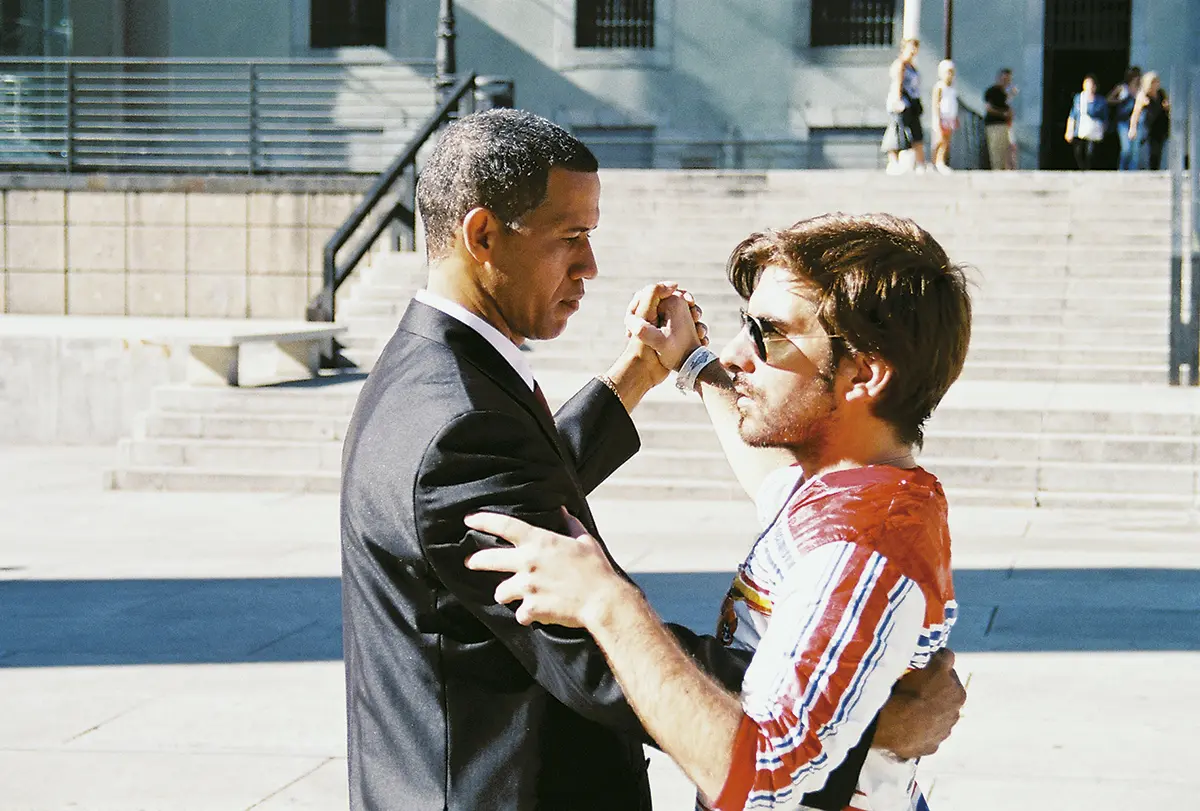
The edition inaugurated in Buenos Aires also included works by Narda Alvarado Martín Sastre (Uruguay). In Sastre’s video, between love and possession, the US and Latin America perform a tango, with a Barack Obama look-alike and the artist as protagonists.
This dialog between artists and writers, between Latin Americans and Europeans—mostly from Germany—at times floats between both the magical and the trite. Yet, and despite a certain reductionism, this conversation invites the pubic to reflection and allows us to know our neighbors—distant despite their geographic closeness—beyond the stereotypes and the problems emphasized by the mass media. Not a slight accomplishment; between fantasy and reality these works create worlds and promote debate. Much more than was achieved by the celebration of the Bicentennial in Buenos Aires, a large-scale spectacle that was pure entertainment for the here and now, without the smallest critical intent and without any future-oriented text, program, or collective design.
The exhibition Menos tiempo que lugar, and publication also supported by Germany’s Federal Foreign Relations Ministry, first presented an abridged version at Quito’s Centro de Arte Contemporáneo. The complete edition opened at the Palais de Glace in Buenos Aires and traveled to the Solar Barão Cultural Center in Curitiba, Brazil. It will remain through August at Subte – Centro Municipal de Exposiciones in Montevideo, Uruguay. Later, as the show continues its itinerary, more artists will join. In September it will be at the Instituto Cultural Peruano-Norteamericano (ICPNA) in Lima, and in October at the Museo de Antioquia, in Medellín. The show will be seen in Germany in 2011.
VICTORIA VERLICHAK