
This exhibition offers spectators a walk through several perception-altering altered experiences. The light operates as a sort of catalyzer of relationships with space – whether as a builder of physical dimensions or as the object of representation – throughout three exhibition areas.
The exhibit begins with a group of sketches that Nicolás Cárdenas presents as a sort of project diary. In these, he conveys to the public the questions that he himself had about the space, the way it is structured, and the possibilities that it may offer for experimentation. This first exhibition room also includes the work Sombra de Umbral (Threshold Shadow), the most defining piece of the project. By making a reference to a solar eclipse, this work unfolds through a projection framed by a large drawing in the form of a solar corona. Only the presence of the projector gives away clues about the visual phenomenon being constructed, a threshold that is also a visual trick, a show, and a ludic vehicle for viewers. Accompanying this piece are sketches that illustrate this corona’s various stages of development. As a group, the sketches represent a meaningful body of exercises. Their autonomy is determined by the simple cataloging of events, a structure for reflection as vast as the natural system it represents, and as effective as a map that enables the forecasting –based on the initial model –of future variations in this system.
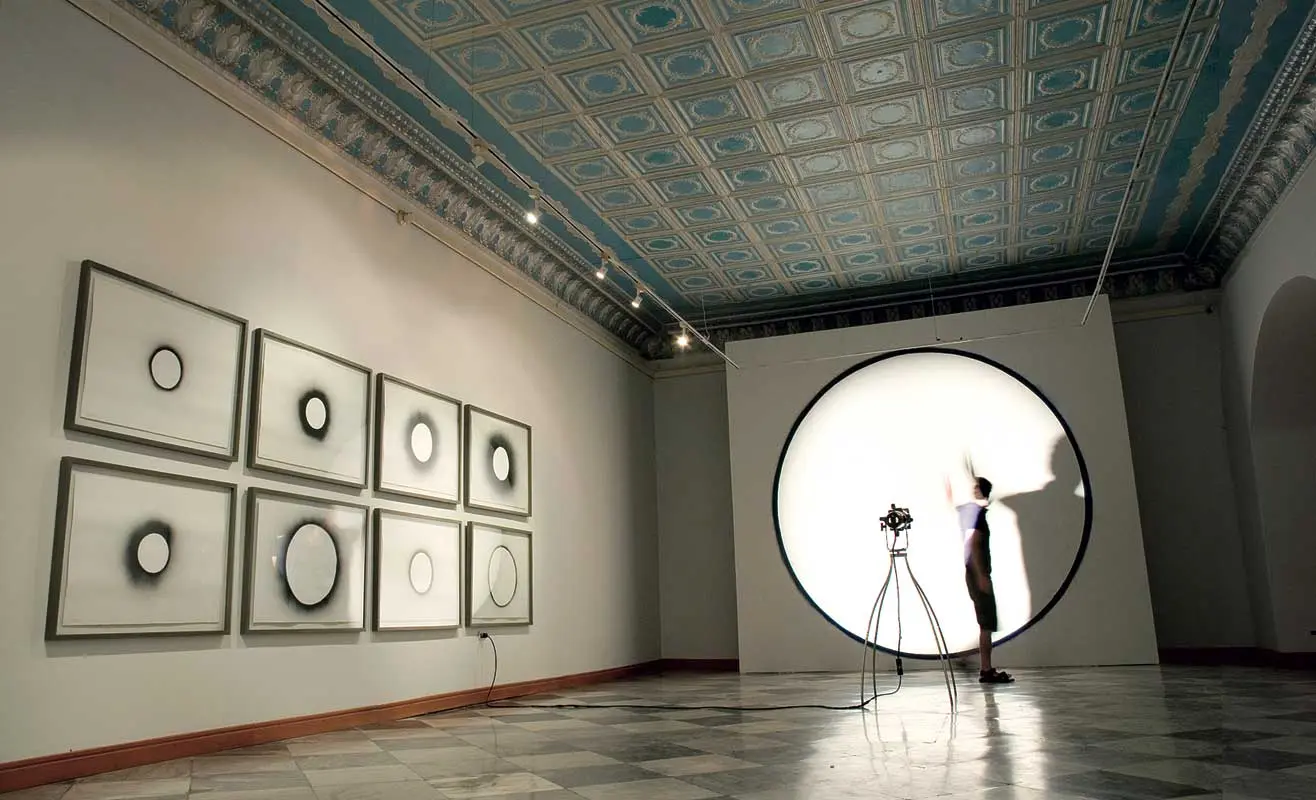
The second part of the project continues with an installation that Cárdenas had been working on for a while. Titled 3 a.m., its development axle centered on the elaboration, during the event, of notions of time and place. What is the image that results from observing a dark space or the celestial vault? The black as a background or as an infinite notion is an absolute limit to modern humans and it is the opposite of transparency. The depth, or existence, of a real space under the black is always doubted by perceptions that cannot see. In this regard, the work disputes this sensorial stereotype and proposes the possibility that space – tangible or intangible – does indeed exist behind a plane covered by several layers of graphite. The installation consists of two elements countering each other in the exhibition room: on the one hand, a graphite drawing as the material expression of a concept, and on the other, a video that registers the elaboration process of this same drawing in which the white background on the surface of the paper is gradually overtaken by black. This light to dark change is also reflected in the exhibition space, as the reflection of the projection is the only thing illuminating it; thus, when the projection turns dark, so does space.
The other group of works that complete the exhibition illustrates, in a different way, the central notion of the show’s proposal: the relationship between a concept and its materiality perceived as a phenomenon. The work Piedra de 4000 m3 de Carbón is the physical representation of an absent mass; m2 de Tierra and m2 de Césped are horizontal paintings that illustrate the represented impossibility of a self-contained territory; Esquina (Corner) constructs the illusion of a dual space based on the limit as a problem, and Horizontal/Vertical questions the relationship between the horizon and gravity as a link between physical forces and the perceived reality.
To Nicolás Cárdenas –and to the Museo de Arte Contemporáneo in Santa Marta– this exhibition represents an ambitious project that demonstrated the interactive possibilities between artists and institutions in venues inside Colombia that are not part of the centers of artistic activity found in Bogotá, Medellín, and Cali. It is a wide-ranging exchange of artistic circulation and promotion of contemporary art. It enriches artists as well as the contexts and public visiting the institutions that open their doors to such an event.
CARLOS BETANCOURT