
Rivane Neuenschwander, a Brazilian artist working with interactive and conceptual ideas, is the focus of New York’s New Museum’s summer schedule. Her exhibition, A Day Like Any Other occupies the lobby, third and fourth-floor galleries, and is curated by Richard Flood, Chief Curator at the New Museum. It contains works from the last decade and is dubbed a “mid-career survey,” although, at the age of 42, this intriguing artist’s career midpoint may well lay ten or twenty years ahead.
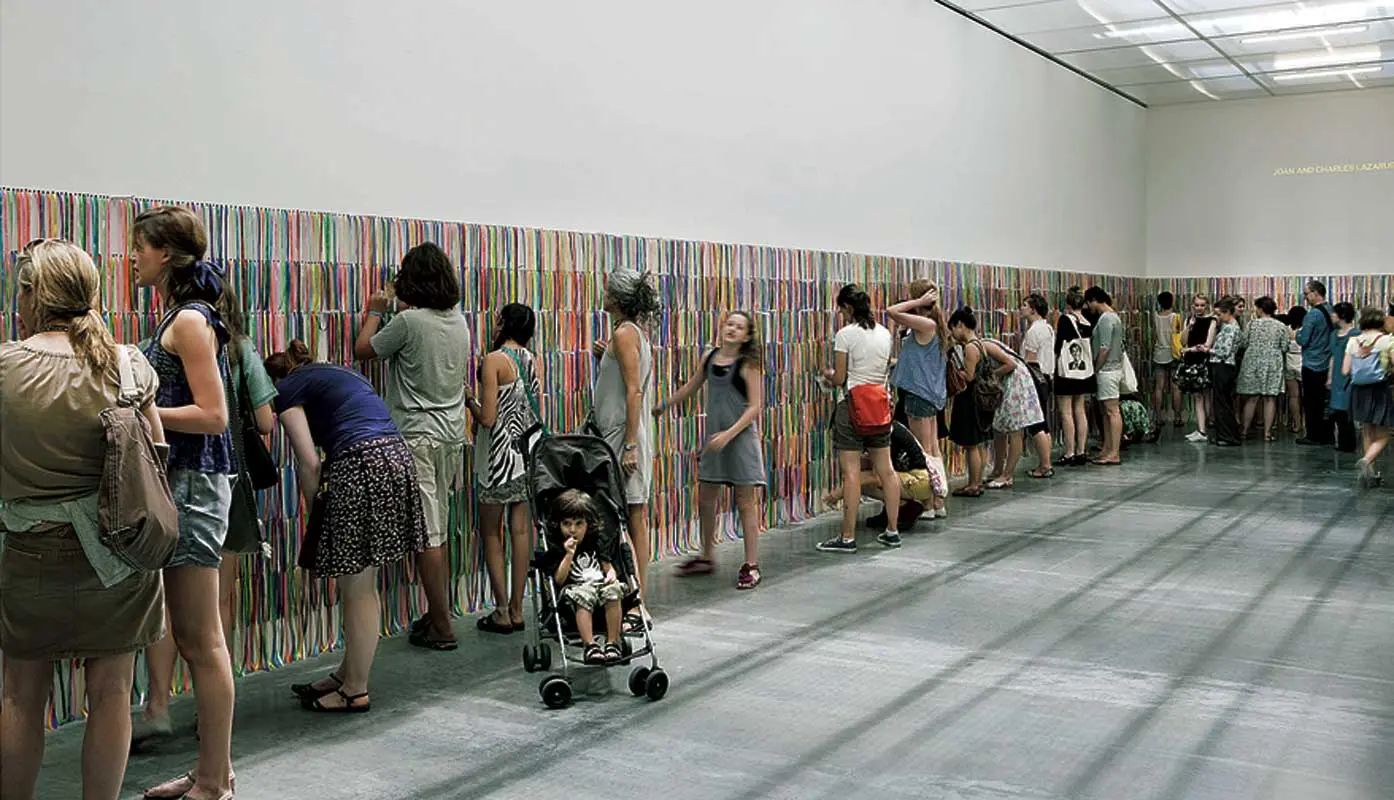
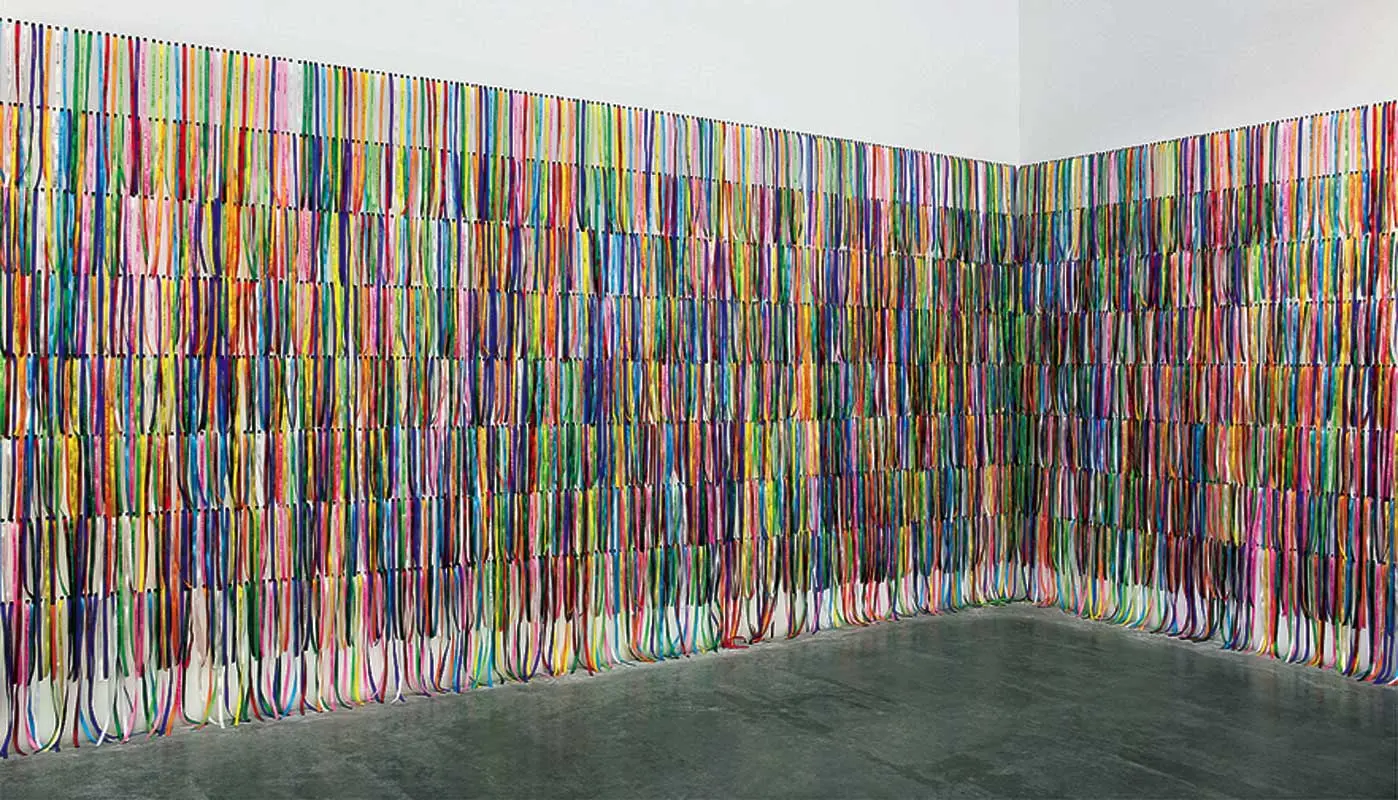
Perhaps the best-known work in the exhibition, I Wish Your Wish, is an ongoing interactive installation in the New Museum’s lobby gallery. Neuenschwander found inspiration in the popular tradition from the church of Nosso Senhor does Bonfim, in Salvador, Bahia, of tying colorful ribbons to the wrists of parishioners for good luck, inspired by the Afro-Brazilian syncretic cult of Candomblé. In the artist’s version, she invites visitors to take a ribbon from one of 10,296 tiny holes in the wall, tie it to their wrist, and then, along with a wish they have written on a piece of paper, place the ribbon back in the wall. Future visitors will find these wishes printed on the ribbons. Neuenschwander’s installation as well as her website exhibit some of the printed wishes, ranging from the intimately personal (“I Wish He’d Love Me,” “I Wish It Was Benign”) to the more idealistic (“I Wish For Peace In The Middle East,” “I Wish For The Oil Spill To Stop”).
In First Love (2005), inspired by the short story by Samuel Beckett of the same title, the artist asks visitors to describe their first love’s features to a forensic sketch artist. The resulting image, supposedly familiar to the visitor’s idealized memory, is quite distinct from Beckett’s story of a decidedly unromantic relationship with a prostitute, a crude depiction of poverty, abandonment, and bad sex. The work draws on the irony between prevailing ideologies and unpredictable, uncontrolled chaos. Her Involuntary Sculptures (Speech Acts) (2001-10), whose title references a term by language philosopher John L. Austin and a book by John Searle, consists of folded straws and napkins, bent bottle caps and other trinkets left in bars and restaurants, collected and preserved by Neuenschwander during the past decade. These tiny installations that combine relational theory and chance are inspired by Brassaï’s pictures of folded tickets and other minutia from one year of combing the streets of Paris.
Neuenschwander uses the term “ethereal materialism” to characterize how even the most subtle, near-invisible things are all part of a network of uninterrupted relationships and airy exchanges. And she, as observer and conductor, acts as a mediator of these relationships, as the ‘floating eye’ of the disembodied camera. This is clearly the case in her video, The Tenant (2010), which takes its name from the 1976 Roman Polanski film. In Neuenschwander’s version, with sound by the Brazilian duo O Grivo, a soap bubble floats around the artist’s studio for 10 minutes and 34 seconds. Here, the long-lasting bubble, orchestrated to traverse a predetermined space, touching surfaces without exploding, almost strikes one as absurdly ‘realistic’; it prompted me to look for editing flaws, fruitlessly. In another video, The Fall (2009), an egg balances precariously on a spoon for 14 ½ minutes. The viewer’s perspective is that of the person holding the spoon while walking; Neuenschwander borrows from animation here to create ‘spatial’ effects.
Rain Rains (2002) consists of a series of 62 metal buckets suspended from the ceiling by varying lengths. Through holes in their bottoms, water drips continuously and is collected by identical buckets on the floor. Every four hours, museum employees must empty the lower buckets into the top ones to keep the process going. This act of maintaining the work is, in effect, the cause of its very existence. Integrated around the buckets is another installation, Walking in Circles (2000), consisting of circles drawn with invisible glue on the floor. As visitors walk over them, they collect dirt, assuming the imprint of a multitude of shoes. Initially, viewers seem mostly unaware of the piece, even less so of their participation in it. Neuenschwander creates situations of unavoidable complicity, all the while keeping this complicity largely anonymous. The series After the Storm (2010) hangs nearby: the artist exposed vintage maps of New York counties to rain outside her home in Belo Horizonte, then painted the remaining dried fragments in bright, flat colors. The series takes its name from a short story by Ernest Hemingway, although in Neuenschwander’s piece, the issue of global changes in weather patterns suggests a shift in geographical topographies.
At A Certain Distance (Ex-Votos) (2010) is a series of paintings on wood panels based on traditional Latin American ex-votos. These paintings, with their receding tiled floors, reference Renaissance paintings of interior spaces, addressing the inaccuracy of perspective in its scenographic, architectural appearance. In The Conversation (2010), the interior gallery space is linked to the interior space of the apartment in Frances Ford Coppola’s 1974 movie of the same title, with Gene Hackman playing a paranoid surveillance expert. Pre-installation, Neuenschwander hired a security firm to bug the gallery. She then began cutting up carpet and drilling holes in the wall to find the listening devices. A soundtrack plays back the noise created during Neuenschwander’s destructive search.
Undoubtedly, Neuenschwander owes much to her Brazilian heritage, to movements such as Neo-Concretism and Tropicália. Her conceptualism and interactive practices encapsulating viewers/participants are direct influences from fellow Brazilian artists Hélio Oiticica and Lygia Clark. While works that demand viewers’ participation are well-represented in this retrospective, the artist has, in the past, coaxed a diverse number of critters to complete her works. She has exhibited snails eating through rice paper, ants crawling on raw meat, and filmed an ant colony, in carnivalesque fashion, carrying sugar-coated, brightly colored confetti through the jungle. These works from the early 2000s are curiously absent from A Day Like Any Other, an otherwise memorable exhibition of the artist’s oeuvre.
DENISE CARVALHO